
5 Bhagavad Gita Shlokas for Letting Go Without Pain
Riya Kumari | Apr 14, 2026, 11:04 IST

Krishna
Image credit : AI
Letting go without pain may be impossible. But letting go without becoming bitter, numb, or smaller, that is possible. The Gita offers that quieter path. Not the path of forgetting, but of loosening. Not the path of indifference, but of freedom. And perhaps that is enough for today: not to have fully moved on, but to loosen your grip by one breath, one thought, one truth. Sometimes that is how the heart begins again.
There are seasons in life when nothing looks broken from the outside, yet inside, something keeps aching. You smile, you answer messages, you do what needs to be done, but a part of you remains caught somewhere else, in a person, a plan, a version of life that did not stay. Letting go sounds simple when spoken aloud. In real life, it feels like trying to open your hand when your heart is still gripping what it loves. The Bhagavad Gita does not ask you to become cold. It asks something far more difficult and far more healing: to stay fully alive without becoming imprisoned by what you cannot hold forever.
When You Keep Holding What Is Already Leaving
![Let go]()
“Karmanye vadhikaraste ma phaleshu kadachana”
Bhagavad Gita 2.47
You have a right to action, not to its results.
Much of pain comes not from love, but from the demand that love must end the way you wanted. You gave your time, your sincerity, your effort, and somewhere quietly, you made a home inside the outcome. But life is not a contract. It is more like water in your palms. You can carry it gently, but the moment you close your fist, it begins to slip away.
This shloka does not dismiss your effort. It honors it. It simply reminds you that peace begins when you stop asking life to guarantee what it never promised.
When Loss Feels Like It Has Changed Who You Are
“Dehino ’smin yatha dehe kaumaram yauvanam jara”
Bhagavad Gita 2.13
Just as the body passes through childhood, youth, and old age, the self passes through change.
Sometimes you do not miss the person or thing alone. You miss who you were when it was yours. The old routine. The old laughter. The old certainty. Loss can feel like being locked out of your own home.
But the Gita gently reminds you: change is not theft. It is the law of being alive. The self is not destroyed every time life changes its clothes. What you are is deeper than the roles you played, the names you carried, the attachments that once gave you shape. You are not disappearing. You are shedding.
When the Mind Keeps Returning to the Same Wound
![Meditate]()
“Dhyayato vishayan pumsah sangas teshu upajayate”
Bhagavad Gita 2.62
Where the mind lingers, attachment grows.
The mind can turn one sorrow into a shrine. It returns to the same memory, polishes the same regret, reopens the same door. Not because it wants pain, but because pain can feel familiar, and the familiar often feels safer than the unknown.
This is how attachment survives long after life has moved on. Not in reality, but in repetition. You do not always need closure from the world. Sometimes you need distance from the story your mind keeps rehearsing. A thought is not a home. You are allowed to step out of it.
When You Want Peace but Life Feels Loud
“Yogasthah kuru karmani”
Bhagavad Gita 2.48
Established in inner balance, act.
There is a mistaken belief that peace comes after everything settles. After the conflict ends. After the answer arrives. After the heart stops hurting. But the Gita points elsewhere. Stillness is not the reward at the end of chaos. It is the center you learn to return to while chaos continues.
Like the unmoving axle of a spinning wheel, there is a part of you untouched by the noise. Letting go becomes possible when you stop waiting for life to become quiet and begin listening for the quiet already within you.
When You Are Tired of Carrying Everything Alone
“Sarva-dharman parityajya mam ekam sharanam vraja”
Bhagavad Gita 18.66
Abandon all false burdens and surrender to the highest truth.
There comes a point when strength no longer looks like holding on. It looks like release. Not defeat. Not collapse. Release. You were never meant to carry every answer, every fear, every ending by yourself. Some burdens are made heavier by the ego’s insistence that it must control, fix, and preserve everything.
But surrender is not weakness. It is the moment you stop dragging your soul behind your fear. Sometimes healing begins when you finally say: I cannot carry this the old way anymore.
When You Keep Holding What Is Already Leaving
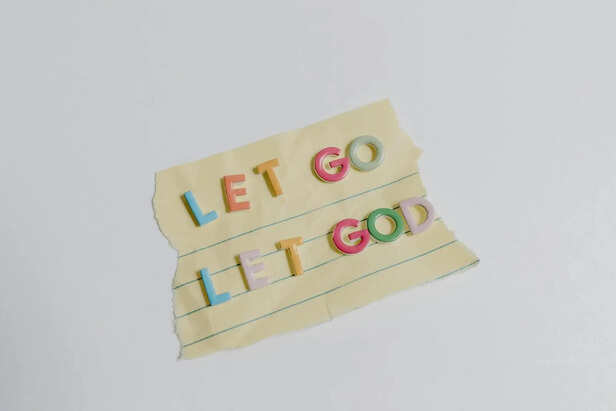
Let go
Image credit : Pexels
“Karmanye vadhikaraste ma phaleshu kadachana”
Bhagavad Gita 2.47
You have a right to action, not to its results.
Much of pain comes not from love, but from the demand that love must end the way you wanted. You gave your time, your sincerity, your effort, and somewhere quietly, you made a home inside the outcome. But life is not a contract. It is more like water in your palms. You can carry it gently, but the moment you close your fist, it begins to slip away.
This shloka does not dismiss your effort. It honors it. It simply reminds you that peace begins when you stop asking life to guarantee what it never promised.
When Loss Feels Like It Has Changed Who You Are
“Dehino ’smin yatha dehe kaumaram yauvanam jara”
Bhagavad Gita 2.13
Just as the body passes through childhood, youth, and old age, the self passes through change.
Sometimes you do not miss the person or thing alone. You miss who you were when it was yours. The old routine. The old laughter. The old certainty. Loss can feel like being locked out of your own home.
But the Gita gently reminds you: change is not theft. It is the law of being alive. The self is not destroyed every time life changes its clothes. What you are is deeper than the roles you played, the names you carried, the attachments that once gave you shape. You are not disappearing. You are shedding.
When the Mind Keeps Returning to the Same Wound

Meditate
Image credit : Pexels
“Dhyayato vishayan pumsah sangas teshu upajayate”
Bhagavad Gita 2.62
Where the mind lingers, attachment grows.
The mind can turn one sorrow into a shrine. It returns to the same memory, polishes the same regret, reopens the same door. Not because it wants pain, but because pain can feel familiar, and the familiar often feels safer than the unknown.
This is how attachment survives long after life has moved on. Not in reality, but in repetition. You do not always need closure from the world. Sometimes you need distance from the story your mind keeps rehearsing. A thought is not a home. You are allowed to step out of it.
When You Want Peace but Life Feels Loud
“Yogasthah kuru karmani”
Bhagavad Gita 2.48
Established in inner balance, act.
There is a mistaken belief that peace comes after everything settles. After the conflict ends. After the answer arrives. After the heart stops hurting. But the Gita points elsewhere. Stillness is not the reward at the end of chaos. It is the center you learn to return to while chaos continues.
Like the unmoving axle of a spinning wheel, there is a part of you untouched by the noise. Letting go becomes possible when you stop waiting for life to become quiet and begin listening for the quiet already within you.
When You Are Tired of Carrying Everything Alone
“Sarva-dharman parityajya mam ekam sharanam vraja”
Bhagavad Gita 18.66
Abandon all false burdens and surrender to the highest truth.
There comes a point when strength no longer looks like holding on. It looks like release. Not defeat. Not collapse. Release. You were never meant to carry every answer, every fear, every ending by yourself. Some burdens are made heavier by the ego’s insistence that it must control, fix, and preserve everything.
But surrender is not weakness. It is the moment you stop dragging your soul behind your fear. Sometimes healing begins when you finally say: I cannot carry this the old way anymore.