
6 Sacred Forest Regions Mentioned in Ramayana
Nidhi | Feb 26, 2026, 14:11 IST

Sita Ram
Image credit : Ai
From Dandakaranya to Panchavati, the forests of the Ramayana were not just wilderness but sacred spaces that shaped Lord Rama’s exile journey. Explore six spiritually significant forest regions mentioned in the epic and their deeper meaning.
“वनानि रामस्य सखा, वनानि धर्मस्य मार्गः।
राज्यं त्यक्त्वा यः प्रविष्टः, स वनं प्राप्य स्वयम् ज्ञातः॥”
The Ramayana is not only the story of a prince in exile. It is the story of a man who walked into the forest and discovered who he truly was.
When Lord Rama left Ayodhya, he did not just leave behind a throne. He left behind certainty. The palace had rules. The forest had questions. The palace offered protection. The forest offered trials.
But it was in the forests that Rama’s character was shaped. Among sages, rivers, wild paths, and unseen dangers, he learned patience, compassion, strength, and restraint. The forests were not silent backdrops. They were living witnesses to his transformation.
Each forest region in the Ramayana holds a moment of turning. A lesson. A loss. A promise. Together, they form a spiritual geography that still lives in India’s memory.
The journey of Rama is, in many ways, the journey of every human being. We all leave comfort at some point. We all walk through uncertainty. And like Rama, it is often in our own inner forests that we discover our true dharma.
![Kakawin Ramayana]()
Dandakaranya was one of the largest and most significant forest regions in the epic. It covered a vast area across present day central India. This is where Rama, Sita, and Lakshmana spent much of their exile.
The forest was home to sages who performed intense penance, but it was also troubled by rakshasas who disturbed their rituals. Rama’s role as a protector of dharma became clear here when he defended the sages and eliminated destructive forces.
Dandakaranya represents the moral battlefield of the Ramayana. It was in this wilderness that Rama’s strength, discipline, and sense of duty were repeatedly tested.
Chitrakoot, located near the border of Uttar Pradesh and Madhya Pradesh, was one of the earliest forest refuges of Rama during exile. It is described as serene, beautiful, and spiritually uplifting.
This is the place where Bharata met Rama and requested him to return to Ayodhya. The emotional exchange between the brothers unfolded in this peaceful forest setting.
Chitrakoot symbolizes reflection and devotion. Unlike the harsher forests, it represents calm acceptance of fate and the purity of familial bonds.
Panchavati, near present day Nashik in Maharashtra, marks a turning point in the Ramayana. Rama built a hut here and lived a simple forest life with Sita and Lakshmana.
Major events occurred in this region. The encounter with Shurpanakha, the golden deer episode, and ultimately the abduction of Sita by Ravana all took place here.
Panchavati reflects the fragile balance between peace and disruption. What began as a quiet phase of exile soon transformed into the beginning of separation and conflict.
![The Ramayana]()
Kishkindha, associated with the region around Hampi in Karnataka, was the kingdom of the vanaras. Surrounded by hills and forested terrain, it became central to the later part of the epic.
It was here that Rama formed an alliance with Sugriva and defeated Vali. From Kishkindha, the organized search for Sita began under the leadership of Hanuman.
This region represents friendship, loyalty, and collective action. The forested landscape became the foundation for a united effort to restore righteousness.
Ashoka Vatika was the grove in Lanka where Sita was kept after her abduction. Though it was a royal garden rather than a wild forest, it holds deep spiritual significance.
Within this enclosed grove, Sita demonstrated immense strength and unwavering faith. It was here that Hanuman first met her and delivered Rama’s message.
Ashoka Vatika stands as a symbol of inner resilience. Even in captivity, the forested space became sacred through Sita’s steadfast devotion.
Naimisharanya, located in present day Uttar Pradesh, is traditionally associated with sages and sacred narration. While not central to the exile journey itself, it plays an important role in preserving the Ramayana tradition.
It is believed that sages gathered here to hear and recount sacred stories, including the Ramayana. The forest was known as a center of spiritual learning and discourse.
Naimisharanya represents the forest as a place of knowledge and memory. It reminds us that the Ramayana was not only lived in forests but also preserved in them.
राज्यं त्यक्त्वा यः प्रविष्टः, स वनं प्राप्य स्वयम् ज्ञातः॥”
The Ramayana is not only the story of a prince in exile. It is the story of a man who walked into the forest and discovered who he truly was.
When Lord Rama left Ayodhya, he did not just leave behind a throne. He left behind certainty. The palace had rules. The forest had questions. The palace offered protection. The forest offered trials.
But it was in the forests that Rama’s character was shaped. Among sages, rivers, wild paths, and unseen dangers, he learned patience, compassion, strength, and restraint. The forests were not silent backdrops. They were living witnesses to his transformation.
Each forest region in the Ramayana holds a moment of turning. A lesson. A loss. A promise. Together, they form a spiritual geography that still lives in India’s memory.
The journey of Rama is, in many ways, the journey of every human being. We all leave comfort at some point. We all walk through uncertainty. And like Rama, it is often in our own inner forests that we discover our true dharma.
1. Dandakaranya

Kakawin Ramayana
Image credit : Freepik
Dandakaranya was one of the largest and most significant forest regions in the epic. It covered a vast area across present day central India. This is where Rama, Sita, and Lakshmana spent much of their exile.
The forest was home to sages who performed intense penance, but it was also troubled by rakshasas who disturbed their rituals. Rama’s role as a protector of dharma became clear here when he defended the sages and eliminated destructive forces.
Dandakaranya represents the moral battlefield of the Ramayana. It was in this wilderness that Rama’s strength, discipline, and sense of duty were repeatedly tested.
2. Chitrakoot
This is the place where Bharata met Rama and requested him to return to Ayodhya. The emotional exchange between the brothers unfolded in this peaceful forest setting.
Chitrakoot symbolizes reflection and devotion. Unlike the harsher forests, it represents calm acceptance of fate and the purity of familial bonds.
3. Panchavati
Major events occurred in this region. The encounter with Shurpanakha, the golden deer episode, and ultimately the abduction of Sita by Ravana all took place here.
Panchavati reflects the fragile balance between peace and disruption. What began as a quiet phase of exile soon transformed into the beginning of separation and conflict.
4. Kishkindha
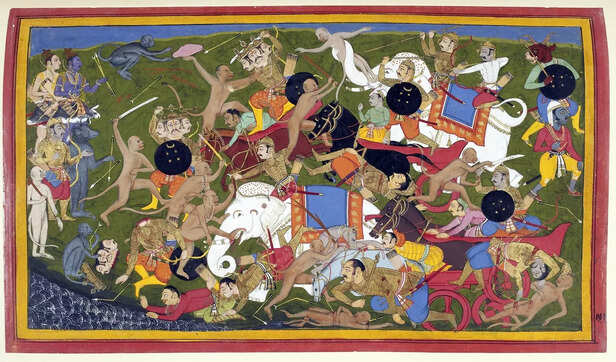
The Ramayana
Image credit : Pixabay
Kishkindha, associated with the region around Hampi in Karnataka, was the kingdom of the vanaras. Surrounded by hills and forested terrain, it became central to the later part of the epic.
It was here that Rama formed an alliance with Sugriva and defeated Vali. From Kishkindha, the organized search for Sita began under the leadership of Hanuman.
This region represents friendship, loyalty, and collective action. The forested landscape became the foundation for a united effort to restore righteousness.
5. Ashoka Vatika
Within this enclosed grove, Sita demonstrated immense strength and unwavering faith. It was here that Hanuman first met her and delivered Rama’s message.
Ashoka Vatika stands as a symbol of inner resilience. Even in captivity, the forested space became sacred through Sita’s steadfast devotion.
6. Naimisharanya
It is believed that sages gathered here to hear and recount sacred stories, including the Ramayana. The forest was known as a center of spiritual learning and discourse.
Naimisharanya represents the forest as a place of knowledge and memory. It reminds us that the Ramayana was not only lived in forests but also preserved in them.