The lamp is already leaving before your fingers lift from it. That is the whole point. Deepdaan, the gift of light, is one of the few ritual acts in Hindu devotion where completion depends entirely on loss. You make the flame, you set it on water, and then it belongs to the river.
What the Word Carries
The Sanskrit root is straightforward: deep, a lamp or flame, and daan, a gift freely given with no expectation of return. Daan in the Rigveda and later in the Mahabharata is distinguished from other forms of giving precisely because it severs the giver's claim. You cannot give daan and then take it back. The moment the lamp touches the water, the transaction is complete and irreversible. This is not a metaphor layered onto the ritual after the fact. It is the ritual's architecture. The water is chosen because water moves. A lamp placed on stone can be retrieved. A lamp placed on the Ganga, the Yamuna, the Godavari, or any moving body of water during a festival cannot. The current is the mechanism of release.
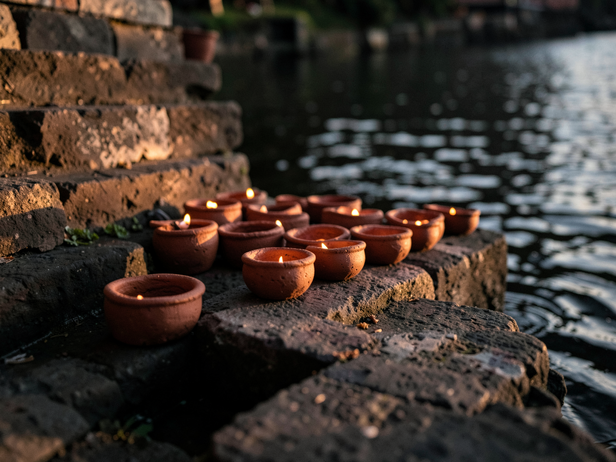
![Dawn Diya Ritual on Water]()
Dawn Diya Ritual on Water
Image credit : AI
Witnessing the spiritual significance of a diya on water, a lamp offering in Hindu tradition.
The River as Witness and Carrier
In the Skanda Purana, rivers are described as tirtha, crossing places, not merely as geography but as thresholds between states of being. To offer something at a tirtha is to send it across. The flame you float is not a decoration on the water. It is a message dispatched to a recipient you cannot see, through a carrier that will not wait. The Ganga in particular is addressed in devotional tradition as both mother and judge, the one who purifies and the one who receives what the living can no longer hold. Deepdaan performed on her banks during Kartik Purnima, Dev Deepawali, or Pitru Paksha carries this understanding explicitly: the lamp is sent toward the ancestors, toward the divine, toward the part of experience that has already passed beyond reach. The river does not symbolise this transit. The river performs it.
What the Giver Is Actually Releasing
Grief is the most common answer given at the riverbank, but it is not the only one. Deepdaan is performed for the dead, yes, a lamp floated for a parent or a child is one of the most direct acts of mourning in the Hindu ritual vocabulary. But it is also performed at moments of transition: after illness, after a vow fulfilled, at the threshold of a new undertaking. In each case, the logic is the same. Something has run its course. Something is finished, or needs to be finished, and the person standing at the water's edge cannot finish it by holding it. The lamp is not a symbol of what is being released. It is the release itself, made visible and then made irretrievable. The Bhagavad Gita, in Chapter 3, verse 19, speaks of action performed without attachment to its fruit, nityam kuru karma tvam karma jyayo hyakarmanah, and Deepdaan is perhaps the most literal enactment of this instruction available in everyday devotion. You perform the action completely. You bring the flame, you set it on the water with both hands, you watch it go. The fruit of the action, where the lamp travels, whether the message arrives, is not yours to know.
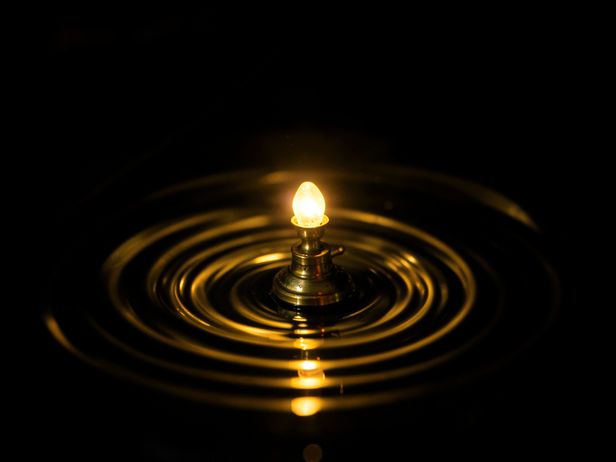
![Golden Light on Water]()
Golden Light on Water
Image credit : AI
I offer my light, a diya on water, spreading golden rings. This floating lamp ritual is a sacred tradition.
The Flame That Must Not Go Out
There is a practical condition that carries metaphysical weight: the lamp must stay lit as it moves away. An extinguished lamp is not considered an offering; it is simply debris. This means the act of Deepdaan requires care in its making, the clay lamp, the wick, the ghee or oil, the shelter of the cupped hands against the wind, and then total release once it is given. The two phases are not in tension. They are the same instruction. Tend the flame completely. Then let it go completely. The attention that goes into keeping the flame alive until it touches the water is the same quality of attention the Gita describes in action performed without ego. You are not careless. You are simply not the owner.
After the Lamp Is Gone
The moment after a lamp disappears around a bend or is swallowed by the darkness of the river is the moment the ritual is actually doing its work. There is nothing left to manage. The offering is made, the claim is surrendered, and what remains is the person standing at the edge of the water with empty hands. Every tradition that includes Deepdaan, whether performed during the great riverine festivals of the north or the quieter lamp-floatings of coastal temple culture, preserves this moment of empty hands as part of the rite. You are not meant to walk away quickly. You are meant to stay long enough to feel what it is to have given something away that the water will not give back. The lamp carries the grief, the gratitude, the vow, the name of the dead. The river takes it. What crosses back is not the thing you sent. It is the fact that you were able to send it.