There is a difference between a temple that houses a deity and one where the deity appears to remain. Architecture explains the first. Nothing quite explains the second. These five Shiva temples, spread across different landscapes, different traditions, different centuries of stone, share one quality that pilgrims and priests describe in almost identical words: the sense that something is already present when you arrive.
Kedarnath, Uttarakhand, The Himalayan Witness
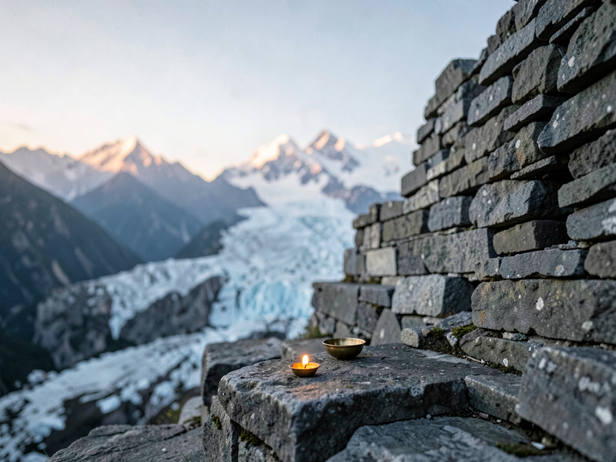
The Kedarnath jyotirlinga sits at 3,583 metres, surrounded by glacier and silence. The temple itself is built from interlocked grey stone, no mortar, assembled in a way that has held through avalanches that levelled everything around it. In the winter months, the priests seal the sanctum and leave. The belief, held without apology, is that Shiva continues his vigil through the locked months, that the lamps inside burn without being lit. What a pilgrim encounters in the brief summer window is not a scheduled darshan but an interruption of something ongoing. The Kedarnath jyotirlinga is one of twelve in the country, but it is the only one that feels genuinely remote in the way a hermit's cave is remote: not picturesque, not scenic, but withdrawn. The cold is not incidental. It is part of the atmosphere of renunciation that the Shaiva texts associate with Shiva's own nature, tapas, the heat generated by stillness held long enough.
![Himalayan Temple Dawn]()
Himalayan Temple Dawn
Image credit : AI
I stand before a powerful Shiva temple in the Himalayas, a single diya illuminating the dawn.
Chidambaram, Tamil Nadu, The Temple of Empty Space
The Nataraja temple at Chidambaram contains a sanctum called the Chidambara Rahasyam, the secret of Chidambaram, where the primary object of worship is a curtain. Behind it, according to the Shaiva Agamas and the Thillai Nataraja priests who have served here for generations, is nothing. Or rather: Akasha, the element of space, which the tradition understands as the subtlest and most pervasive of the five elements, the one in which all the others arise. Shiva here is not depicted. He is the space in which depiction becomes unnecessary. The Dikshitar priests open the curtain during specific rituals, revealing the golden vilva leaves that mark the spot and the Akasha lingam that has no physical form. Chidambaram 10.7 is the verse in the Tirumantiram, Tirumular's ninth-century Tamil Shaiva text, that circles this idea: that the Lord who dances in the hall of consciousness is not separate from the awareness watching the dance. The theology is not metaphor. It is the architecture.
Mahakaleshwar, Ujjain, The Temple That Faces South
Most Shiva lingas are swayambhu, self-manifested, but the Mahakaleshwar linga at Ujjain is also dakshinamukhi: facing south, the direction of death, of Yama, of what cannot be avoided. In the Shaiva tradition, only Mahakal, Shiva as the lord of time, can face what time does to everything else without flinching. The Mahakaleshwar Jyotirlinga Mahatmya in the Skanda Purana describes this form of Shiva as the one who does not govern time from outside it but inhabits it completely, which is the only position from which time loses its terror. The bhasma aarti here, performed before dawn with ash, in a ritual that the temple priests have conducted in an unbroken sequence for centuries, is not decorative. Ash in the Shaiva tradition is what remains after everything combustible has gone. To anoint the deity with it is to acknowledge that what remains after burning is the only thing that was real. Pilgrims who attend the 4 a.m. aarti describe the experience less as witnessing a ritual and more as being present for something that was already in progress.
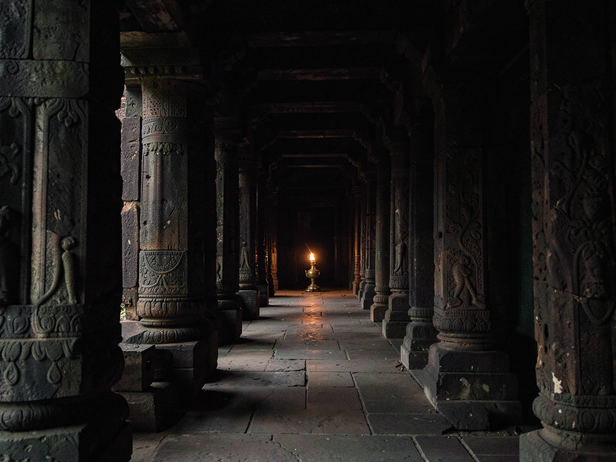
![Ancient Temple Corridor's Glow]()
Ancient Temple Corridor's Glow
Image credit : AI
I explore a powerful Shiva temple corridor, its ancient stone bathed in the warm glow of a single lamp.
Kashi Vishwanath, Varanasi, The City That Is the Deity
The Kashi Vishwanath temple is not the oldest structure in Varanasi, having been rebuilt by Ahilyabai Holkar in 1780 after repeated destruction. But the tradition it holds is among the oldest in continuous practice on the subcontinent. Varanasi, Kashi, is understood in the Shaiva Puranas not as a city where Shiva resides but as a city that Shiva is: the Kashi Khanda of the Skanda Purana describes the entire settlement as resting on Shiva's trishula, lifted above the cycle of creation and dissolution that governs everything else. To die in Kashi, in this tradition, is to receive Shiva's taraka mantra, whispered, it is said, into the ear of the dying, which dissolves the karma that would otherwise require another birth. This is not a minor theological footnote. It is why the city's relationship to death is not one of avoidance. The ghats, the pyres, the ash carried into the Ganga, these are not morbid. They are the logical consequence of a theology in which the lord of time lives here, and dying in his presence is the most auspicious thing that can happen to a consciousness still caught in time.
Srikalahasti, Andhra Pradesh, The Temple of Wind
The Srikalahasti temple on the banks of the Swarnamukhi river holds one of the five elemental Shiva lingas, the Vayu lingam, the form of Shiva as air. The flame inside the sanctum moves without a discernible source of wind. Priests and pilgrims have noted this for centuries; it is documented in the Sthalapurana of the temple and repeated in accounts from the Vijayanagara period. The temple's name carries the story of three devotees, a spider (Sri), a snake (Kala), and an elephant (Hasti), each of whom worshipped the lingam in the only way available to them, and each of whom received liberation. The Shaiva understanding embedded in this story is precise: the form of worship is irrelevant. The orientation of the worshipper is everything. Srikalahasti is less visited than Kedarnath or Kashi, which gives it a quality the larger pilgrimage sites sometimes lose, the sense that the ritual here is not performed for an audience, including a divine one, but simply continues, the way breathing continues, because stopping is not an option that has ever been considered.