Your grandmother never explained it. The stone sat in the puja room the way certain things do, present before memory, requiring no introduction. Black, smooth, cool to the touch, with a spiral groove cut into it that her fingers knew by feel. If you asked what it was, she said Vishnu. If you asked why it looked like a river stone, she said it came from the Gandaki. Both answers were complete.
A River That Cuts Through Stone and Time
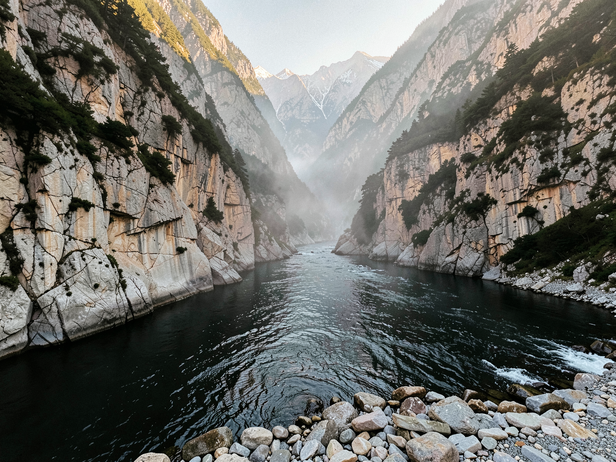
The Shaligram comes from one place: the Kali Gandaki River in Nepal, which runs through the Mustang district and carves through the Himalayas at one of the deepest gorges on earth. The river cuts through limestone laid down when this entire region was the floor of the Tethys Sea, roughly 66 to 140 million years ago. Inside that limestone are ammonites, coiled cephalopods, relatives of the nautilus, that went extinct at the end of the Cretaceous. The river does not merely carry these fossils down from the mountains. It polishes the limestone nodules around them until the outer shell is a perfect black disc, and the ammonite's spiral is revealed as a groove, a wheel, a chakra pressed into the stone from the inside.
The spiral is called a chakra-ankita, the mark of the wheel. In Vaishnava theology, the chakra is Vishnu's Sudarshana, the discus he holds. A stone that carries this mark naturally, formed by a river over geological time, is not a symbol of Vishnu. It is Vishnu, a swayambhu form, self-manifest, requiring no consecration by a priest because it was consecrated by the earth itself.
![Himalayan Gorge at Dawn]()
Himalayan Gorge at Dawn
Image credit : AI
I observe the powerful flow of the Kali Gandaki ammonite fossil river, its waters carving through ancient limestone, bathed in soft morning light.
What the Texts Say and What the River Confirms
The Skanda Purana names the Gandaki as the body of Devi Gandaki herself, and describes the worms, Vajrakita, whose diamond-hard teeth cut the chakra marks into the stones as they feed. This is mythology performing a kind of accurate observation. The Vajrakita of the Puranas corresponds to a real organism: a bivalve mollusc, Cephaloolithus shaligrama, that bores into the limestone nodules and whose feeding creates the distinctive holes and channels found on many Shaligrams alongside the ammonite spiral. The ancient text noticed the biological fact and named it in the language available to it.
The Garuda Purana and the Padma Purana both describe the Shaligram's worship as conferring the merit of a pilgrimage to every major tirtha simultaneously. For households that could not travel, and across centuries, most could not, the stone brought the sacred river into the home. The puja room became a riverbank. The daily offering of tulsi leaves and water became the Gandaki flowing over the stone as it does in Mustang.
How a Shaligram Is Read
Not every black stone from the Gandaki is the same. Traditional texts identify dozens of forms by the number of chakra marks, their position, their depth, and the colour of the stone's interior where the fossil shows. A stone with one chakra mark is Sudarsana. Two marks indicate Lakshmi-Narayana. A stone with a golden interior, where the iron pyrite in the fossil catches the light, is considered especially auspicious and associated with Lakshmi. A stone with a broken or incomplete spiral is traditionally not kept for worship, not because it is inauspicious in itself, but because it signals the stone was damaged in transit and may have been separated from a matched pair.
The reading of a Shaligram is a form of close attention. You are looking at the geometry of a creature that died before the Himalayas existed, inside a river that is still rising as the Indian tectonic plate pushes north. The stone is not static. The Gandaki is still cutting. New Shaligrams are still forming. The ones in puja rooms across India, Nepal, and wherever the diaspora has carried them, were pulled from the river at some point in the last several centuries and have been in daily worship since. Some are old enough that the family has no record of when they arrived.
![Ancient Manuscript and River Stone]()
Ancient Manuscript and River Stone
Image credit : AI
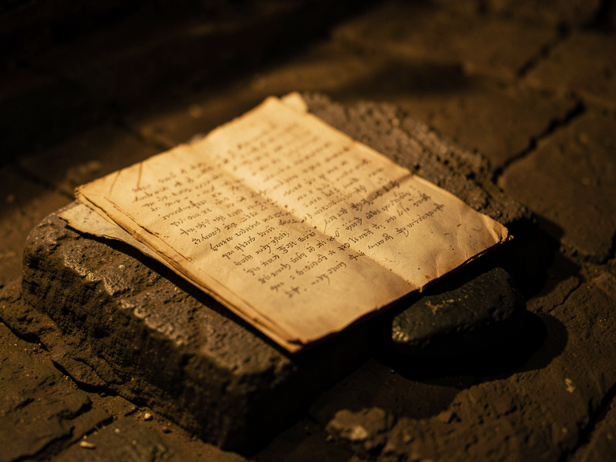
I rest beside a dark river stone, a relic of ancient knowledge, hinting at Shaligram Vishnu puja.
The Ecology of Devotion
The Kali Gandaki's Shaligram beds are not unlimited. The stones form over millions of years and are carried downstream by the river's force. Export of Shaligrams from Nepal has been restricted since the 1990s, and their collection is regulated. The stones that are already in households are, in a real sense, irreplaceable, not in the market sense, but in the geological one. No new ammonites are forming. The Tethys Sea is gone. The Himalayas are still rising, still exposing new limestone, and the river is still polishing what it finds, but the pace is geological, not generational.
This is part of what the stone holds when it sits in a puja room. It is not a manufactured object. It is not a sculptor's interpretation. It arrived in the world through processes that had nothing to do with human intention, and it has been in continuous relationship with human devotion for as long as anyone in the family can remember. The grandmother who kept it did not choose it the way you choose a murti from a shop. More often, it chose the family, passed down, received, sometimes found.
Vishnu in the Fossil Record
The Bhagavata Purana describes Vishnu as Anantashayana, resting on the infinite serpent Shesha, floating on the cosmic ocean between one creation and the next. The ammonite's coil inside the Shaligram is that same image compressed into stone: a spiral that suggests infinite recursion, a creature that lived in a sea that no longer exists, preserved in a mountain that was not yet a mountain when the creature was alive. The Purana and the fossil are not in competition. They are describing the same quality of time from different angles, one through story, one through limestone.
The stone in your grandmother's puja room is not a metaphor for Vishnu. In the Vaishnava understanding, it is a direct, unmediated presence, the closest a household can come to the deity without a temple, without a priest, without an image made by human hands. What it asks in return is daily water, a tulsi leaf, and the attention of someone who knows how to look at a river stone and see what it took the earth sixty-six million years to say.