The Sundarbans does not give you time to decide what you believe. The tide comes in fast, the paths disappear, and the tiger is already watching before you see it. In that particular kind of fear, the question of which religion owns the forest goddess does not arise. Bonbibi is asked because she is the one who answers.
A Story That Carries Two Traditions at Once
Bonbibi's origin narrative, called the Bonbibi Johuranama, circulates in oral and printed versions across the delta. It is written in Bengali verse and draws from Islamic cosmology, Bonbibi and her brother Shah Jongoli are born to Ibrahim, a man from Medina, and a second wife left in the forest. The two children are raised by a doe, then called by God to travel to the Sundarbans and subdue Dokkhin Rai, the demon king who rules the forest and demands human flesh as tribute.
What makes this story unusual is what it does not resolve. Bonbibi arrives from a lineage the text frames as Meccan, yet she is worshipped with the rituals of Hindu devotional practice, flowers, incense, the ringing of bells. Dokkhin Rai, her adversary, is himself a figure some communities also propitiate, because the forest's danger is real whether or not it is demonic. The Johuranama does not ask its listeners to choose. It asks them to recognise that the forest is larger than any single claim on the sacred.
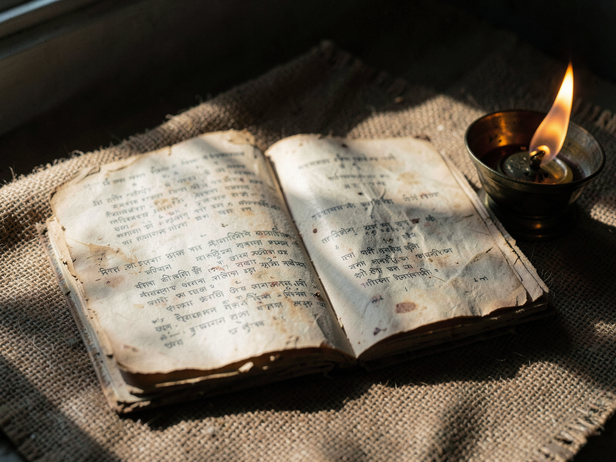
![Ancient Palm-Leaf Manuscript Glows]()
Ancient Palm-Leaf Manuscript Glows
Image credit : AI
A weathered Bengali manuscript, its pages soft and illegible, rests beside a brass oil lamp. The early morning light highlights the texture of the Bonbibi Sundarbans story.
The Boy Dukhe and What the Story Actually Teaches
The narrative's moral centre is a boy named Dukhe, sent into the forest by a greedy merchant named Dhona who has promised him to Dokkhin Rai in exchange for safe passage and a good haul of timber and honey. Dukhe, alone and terrified, calls on Bonbibi. She comes.
The detail that has stayed in the delta's memory for generations is not the rescue itself but its condition. Bonbibi does not protect the greedy. Dhona, who bargained a child's life for profit, does not receive her grace. Dukhe does because he entered the forest with nothing, no surplus, no ambition beyond survival, no plan to take more than he needed. The Johuranama is, among other things, an ecological text. It encodes a rule that forest communities have enforced through the story itself: the Sundarbans tolerates the person who takes what they need. It does not tolerate extraction.
How She Is Worshipped at the Forest's Edge
Bonbibi's shrines sit at the entry points of the Sundarbans, on riverbanks, at the mouths of creeks, at the edges of villages where the mangrove begins. They are modest structures: a painted image of Bonbibi, often flanked by Shah Jongoli and sometimes by Dukhe, set in a small roofed enclosure. The image style is popular devotional, bright colours, direct gaze, the goddess holding a staff or a raised hand.
Before a fishing boat pushes off, before a honey collector called a moule steps into the forest with his smoker and his prayers, the ritual is the same. An offering is made at the shrine. The Johuranama or a portion of it may be recited. The fisherman or the moule asks permission. This is not metaphor. In a forest where a Royal Bengal Tiger can take a person silently and completely, the asking is as practical as checking the tide table. The two things are not in tension.
Hindu and Muslim families both maintain these shrines. The same image receives both communities' offerings. No theological negotiation preceded this arrangement; it emerged from the forest's terms, not from any institution's.
![Sundarbans Dawn Mist]()
Sundarbans Dawn Mist
Image credit : AI
I observe the tranquil Sundarbans at dawn, a quiet riverbank with a boat, hinting at the presence of Bonbibi.
What Survives When Institutions Cannot Reach
The Sundarbans is one of the most climate-vulnerable landscapes on earth. Cyclones, rising salinity, and shifting channels have already swallowed villages and pushed communities further into the forest's margins. The tiger population, roughly a hundred individuals on the Indian side, makes every entry a calculated risk. The forest department regulates access; it cannot regulate fear.
Bonbibi survives in this environment because she addresses what neither the state nor any single religious institution fully reaches: the specific terror of a person alone in a tidal forest with a tiger in it. She is not a symbol of syncretism in the way that term is usually deployed, as evidence of tolerance between communities who have chosen to get along. She is something older and more functional, a shared address for a shared danger, kept alive because the danger is still there.
The Johuranama continues to be performed at forest-edge gatherings. Scholars including Annu Jalais, who conducted fieldwork among Sundarbans communities, have documented how deeply the Bonbibi narrative structures daily life and environmental ethics in the delta. The story is not folklore in the archival sense. It is operational knowledge, passed down because it still tells people how to enter the forest without dying, and what kind of person the forest will and will not protect.