Guru Nanak spent years walking. He walked to Mecca, to the Himalayan monasteries, to the courts of emperors and the huts of weavers. At every stop, the ascetics and the sadhus told him the same thing: leave the world behind. He kept walking, and he kept saying no.
That refusal is the theological centre of Sikhi, and it is more radical than it first appears. Most traditions treat the householder's life as a compromise, the path taken by those who cannot manage the real path. Nanak called the household the real path.
What Gurbani Actually Says About Renunciation
In the Guru Granth Sahib, the Shabad that addresses this most directly is in Raag Suhi, where Guru Nanak writes of the ascetic who smears his body with ash and wanders without purpose, and contrasts him with the one who finds the Lord while remaining in the world. The Guru is not romanticising domestic life. He is making a precise claim: the ego that the forest is supposed to dissolve does not dissolve in the forest. It relocates. It becomes pride in one's own renunciation.
Guru Nanak's word for this trap is haumai, the I-ness that persists through every costume change. A man who leaves his family to meditate in a cave has not killed his haumai. He has given it a new project. The Guru Granth Sahib, Ang 466, makes the point plainly: one who calls himself a renunciant but still harbours inner desire is not free.
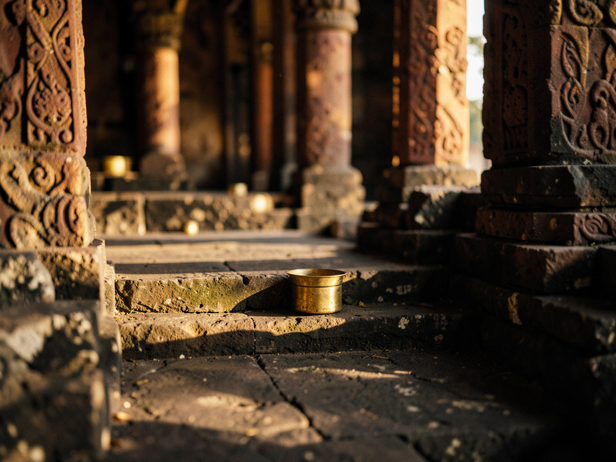
![Temple Diya Glow]()
Temple Diya Glow
Image credit : AI
I arrange lit brass diyas on worn temple steps, embracing the warmth of golden hour light. This moment reflects the essence of Kirat Karo in my daily life.
Kirat Karo: Labour as a Spiritual Practice
The three pillars Nanak gave his Sikhs are Naam Japna, Kirat Karo, and Vand Chakko, remembering the divine name, earning through honest labour, and sharing what you earn. The second pillar is the one that separates this tradition from most of what surrounds it. Kirat is not a concession to necessity. It is not what you do while waiting for the real spiritual work to begin. It is the spiritual work.
When your hands are in the work and your mind is in the Naam, you are not distracted from the divine, you are practising the most demanding form of its remembrance. The forest offers silence. The household offers resistance. Nanak chose resistance as the better teacher, because silence can be mistaken for stillness, and stillness can be mistaken for freedom.
The Langar, the free community kitchen that runs in every Gurdwara, is kirat made visible. Volunteers cook, wash, serve, and clean. No task is elevated above another. A surgeon and a student sit on the same floor and eat the same food. This is not symbolism. It is a daily demonstration that the sacred is not somewhere else.
The Grihastha and the Guru: A Different Kind of Ideal
Every one of the ten Sikh Gurus lived as a householder. They married, raised children, ran communities, engaged with political power, and faced its violence. Guru Har Gobind carried two swords, one for spiritual sovereignty, one for temporal responsibility. He did not present these as opposites in tension. He wore them together.
This stands in deliberate contrast to the models of spiritual authority that surrounded Sikhi in the Punjab of the sixteenth and seventeenth centuries. The sant who had left everything, the yogi who had transcended need, the monk whose holiness was measured by his distance from ordinary life, Nanak looked at all of them and asked what they were actually running from.
The Guru Granth Sahib does not answer this question gently. In the Asa Di Var, Guru Nanak describes the man who abandons his household and then begs at other people's doors, he has traded one dependency for another and called it liberation.
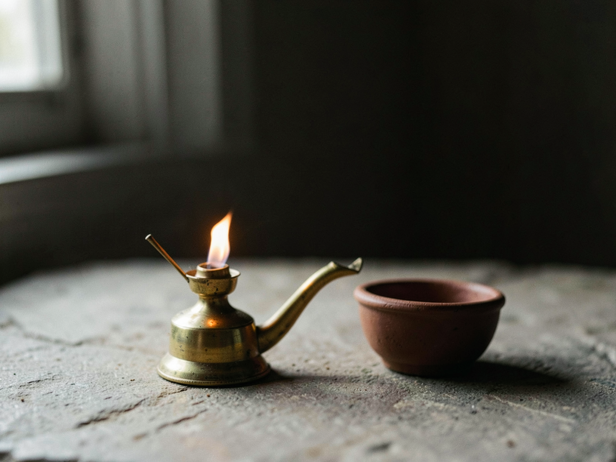
![Brass lamp, morning light]()
Brass lamp, morning light
Image credit : AI
Illuminating the path of Kirat Karo, this lamp signifies devotion and simple living.
Simran in the Middle of Everything
Simran, the continuous remembrance of the divine name, is not a practice confined to the early morning hours before the household wakes. That is where it begins. But the Gurbani does not end the instruction there. The aspiration is to carry the Naam into the argument with your brother, the tedium of the account books, the exhaustion at the end of a working day.
This is harder than sitting in stillness. It requires a quality of attention that stillness alone cannot build. The household tests simran in the way that a weight tests muscle, not by making it comfortable, but by making it necessary.
Guru Arjan Dev Ji, the fifth Guru and the compiler of the Guru Granth Sahib, writes in Raag Gauri that the one who meditates on the Lord while performing worldly duties, that one alone finds peace. The peace is not the absence of the duties. It arrives inside them.
What This Means for the Person Reading This Now
The person who feels pulled toward something deeper but cannot leave, cannot leave the children, the ageing parent, the work that pays the rent, is not failing a spiritual standard. According to Nanak, that person is already standing in the right place. The question is only whether they are present to it.
The Sikh teaching is not that the household is easy or that its obligations are automatically sacred. It is that the search for the divine that requires you to first escape your life is a search that has already gone wrong. Haumai is patient. It will wait for you in the forest. It will not follow you into honest work done with an open hand and a mind turned toward the Naam.
Nanak refused the forest because the forest was the easier answer. The harder answer, the one he spent his life demonstrating, was that the divine was already here, inside the noise and the obligation and the ordinary Tuesday morning, waiting to be noticed.