
Golden Ratio Isn’t Western: 12 Jyotirlingas Prove Hindu Dharma Was Ahead
Riya Kumari | Jan 05, 2026, 16:03 IST

Golden ratio
Image credit : AI
Long before the West discovered the Golden Ratio, Hindu Dharma had already encoded cosmic harmony in sacred geography. The twelve Jyotirlingas, Shiva’s most luminous abodes are more than pilgrimage sites; they are manifestations of life’s inherent proportion, cycles, and balance. When mapped together, their arrangement reflects patterns of creation, consciousness, and existence itself.
In the heart of Sanatan Dharma lies a vision of reality that is mathematical, sacred, cosmic, and human all at once. Long before modern science and Western geometry coded divine proportions into art and nature, Hindu thought was already weaving sacred numbers into the structure of existence — from the metre of the Vedas to the architecture of temples. The universe is not randomm it is patterned. Just as life expresses harmony in the spiral of a conch and the unfurling of a lotus, the sacred geography of Shiva’s manifestations may also reflect a deeper proportion, one that Western scholars later named the Golden Ratio. The principle is unmistakable: creation itself is beautifully ordered, resonating with life and sacred intelligence.
The Jyotirlinga and Infinite Proportion
![Shiva]()
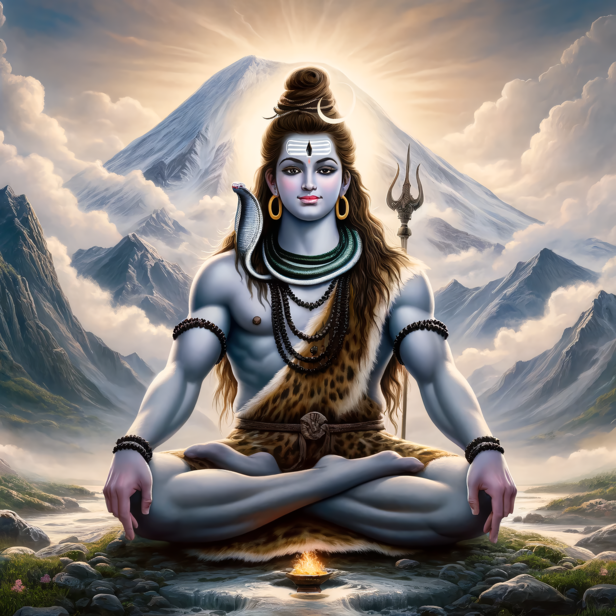
“Jyotirlinga” comes from jyoti (light) and linga (sign), representing Shiva’s radiant, infinite presence. According to the Shiva Purana, Shiva manifested as a pillar of luminous consciousness (without beginning or end) to resolve a cosmic dispute between Brahma and Vishnu. It encodes a philosophy of essence over form, light over limitation, a principle that reappears in sacred geometry and proportion.
Each of the twelve Jyotirlinga sites, from Somnath in the West to Rameshwaram in the South, Kashi in the North, and Mallikarjuna in the East, marks a unique expression of Shiva’s consciousness on Earth. They are anchors of spiritual potential, each reflecting a different aspect of life, liberation, time, healing, protection, and surrender. Numbers are sacred: 108 for completeness, 12 for cosmic cycles, 64 for the arts, 360 for the wheel of time. The number twelve itself resonates with cycles - months of the year, zodiac signs, rhythms of life. When we contemplate the 12 Jyotirlingas together, there emerges a pattern that echoes life’s own geometry: expansion, contraction, rhythm, proportion, balance.
Mapping the Divine Spiral
![Golden ratio universe]()
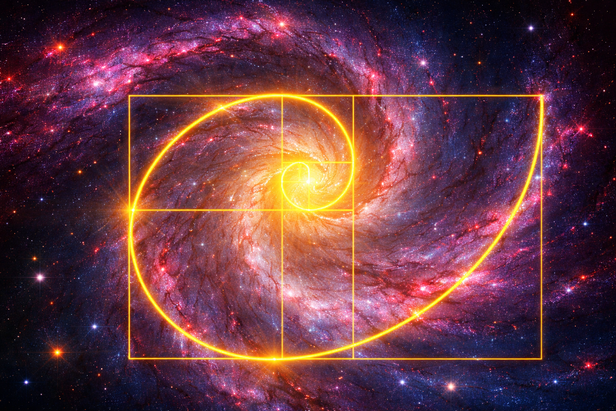
Modern observers who plot the locations of the 12 Jyotirlingas on a map sometimes notice they form a spiral pattern reminiscent of the Fibonacci sequence and the Golden Ratio, a mathematical sequence where each number arises from the sum of the previous two, and the ratio of successive numbers converges to ~1.618. While this is a contemporary interpretation, it is remarkable how such patterns resonate with ancient Indic insights into life’s unfolding order.
In the Vedic worldview, cosmos and consciousness reflect one another. The same proportion that organizes petals in a sacred lotus, the orbit of celestial bodies, and the symmetry of human physiology also manifests in sacred architecture - from temple dimensions to yantras. The Sri Yantra itself, a central symbol of cosmic proportion embodies ascending and descending triangles interlocked in sacred balance. Rather than mere coincidence, this apparent harmony suggests sanatana vision predated named mathematical constructs in its ability to see unity in diversity.
Life, Liberation, and Human Experience
![Kedarnath]()
Each Jyotirlinga embodies a teaching applicable to the human journey:
They are stations of inner evolution, a pilgrimage of the soul through layers of existence - ego, time, desire, surrender, and ultimately, unity. In life, too, we encounter cycles of tension and ease, growth and dissolution, hope and surrender. The 12 Jyotirlingas mirror these rhythms of human experience, affirming that religion isn’t separate from life, it is life understood deeply.
Sanatan Dharma’s Universal Geometry
When Western mathematics later defined the Golden Ratio and Fibonacci spirals, it was rediscovering something already intuitively known in Indic thought: existence is not chaos; it has rhythms, proportions, harmonies that echo throughout nature and spirit. In the ancient Pingala Chandas Shastra, sequences akin to what the West would later call Fibonacci numbers emerge in the study of poetic metre, long before formal European notation.
Thus, the 12 Jyotirlingas mapped in a spiral or proportion aren’t anachronistic curiosities, they are testaments to a worldview where sacredness and science are two names for the same truth:
Sacredness is geometry lived in the heart.
Mathematics is geometry observed in the world.
Sanatan Dharma never separated the inner and the outer, the abstract and the embodied, the pilgrim and the cosmos.
The Jyotirlinga and Infinite Proportion
Shiva
Image credit : Pixabay
“Jyotirlinga” comes from jyoti (light) and linga (sign), representing Shiva’s radiant, infinite presence. According to the Shiva Purana, Shiva manifested as a pillar of luminous consciousness (without beginning or end) to resolve a cosmic dispute between Brahma and Vishnu. It encodes a philosophy of essence over form, light over limitation, a principle that reappears in sacred geometry and proportion.
Each of the twelve Jyotirlinga sites, from Somnath in the West to Rameshwaram in the South, Kashi in the North, and Mallikarjuna in the East, marks a unique expression of Shiva’s consciousness on Earth. They are anchors of spiritual potential, each reflecting a different aspect of life, liberation, time, healing, protection, and surrender. Numbers are sacred: 108 for completeness, 12 for cosmic cycles, 64 for the arts, 360 for the wheel of time. The number twelve itself resonates with cycles - months of the year, zodiac signs, rhythms of life. When we contemplate the 12 Jyotirlingas together, there emerges a pattern that echoes life’s own geometry: expansion, contraction, rhythm, proportion, balance.
Mapping the Divine Spiral
Golden ratio universe
Image credit : AI
Modern observers who plot the locations of the 12 Jyotirlingas on a map sometimes notice they form a spiral pattern reminiscent of the Fibonacci sequence and the Golden Ratio, a mathematical sequence where each number arises from the sum of the previous two, and the ratio of successive numbers converges to ~1.618. While this is a contemporary interpretation, it is remarkable how such patterns resonate with ancient Indic insights into life’s unfolding order.
In the Vedic worldview, cosmos and consciousness reflect one another. The same proportion that organizes petals in a sacred lotus, the orbit of celestial bodies, and the symmetry of human physiology also manifests in sacred architecture - from temple dimensions to yantras. The Sri Yantra itself, a central symbol of cosmic proportion embodies ascending and descending triangles interlocked in sacred balance. Rather than mere coincidence, this apparent harmony suggests sanatana vision predated named mathematical constructs in its ability to see unity in diversity.
Life, Liberation, and Human Experience
Kedarnath
Image credit : AI
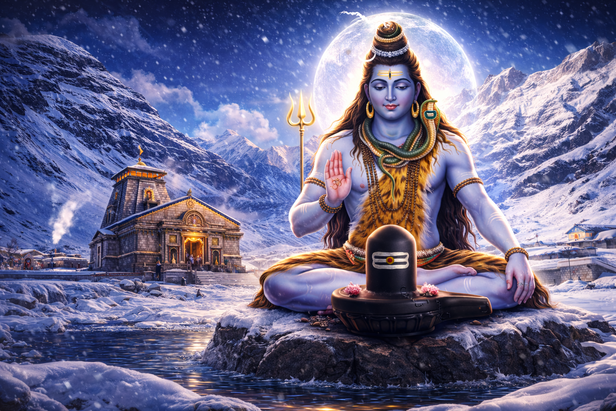
Each Jyotirlinga embodies a teaching applicable to the human journey:
- Somnath: the indestructible light of faith amid adversity.
- Mahakaleshwar: the reality of time and death as teachers of liberation.
- Omkareshwar: the resonance of Om as the pulse of universal consciousness.
- Kashi Vishwanath: the meeting of life and death in sacred remembrance.
They are stations of inner evolution, a pilgrimage of the soul through layers of existence - ego, time, desire, surrender, and ultimately, unity. In life, too, we encounter cycles of tension and ease, growth and dissolution, hope and surrender. The 12 Jyotirlingas mirror these rhythms of human experience, affirming that religion isn’t separate from life, it is life understood deeply.
Sanatan Dharma’s Universal Geometry
When Western mathematics later defined the Golden Ratio and Fibonacci spirals, it was rediscovering something already intuitively known in Indic thought: existence is not chaos; it has rhythms, proportions, harmonies that echo throughout nature and spirit. In the ancient Pingala Chandas Shastra, sequences akin to what the West would later call Fibonacci numbers emerge in the study of poetic metre, long before formal European notation.
Thus, the 12 Jyotirlingas mapped in a spiral or proportion aren’t anachronistic curiosities, they are testaments to a worldview where sacredness and science are two names for the same truth:
Sacredness is geometry lived in the heart.
Mathematics is geometry observed in the world.
Sanatan Dharma never separated the inner and the outer, the abstract and the embodied, the pilgrim and the cosmos.