The full moon of Ashwin is the brightest of the year, and the tradition attached to it is stranger than most festival customs admit. On Kojagari Purnima, the instruction is simply to stay awake. But the reason the texts give is not discipline or austerity, it is that Lakshmi is walking.
What the Name Actually Says
The word Kojagari collapses a question into a festival. Ko jagarti: who is awake? The Skanda Purana and several Vaishnava texts record a version of the same story, on this one night each year, Lakshmi descends from Vaikuntha and moves through the human world asking that question at every threshold. Whoever is awake receives her blessing. Whoever is asleep does not. The ritual vigil, the lamps kept lit, the games of dice played through the night, all of it is an answer to that question. I am here. I am watching. Come in.
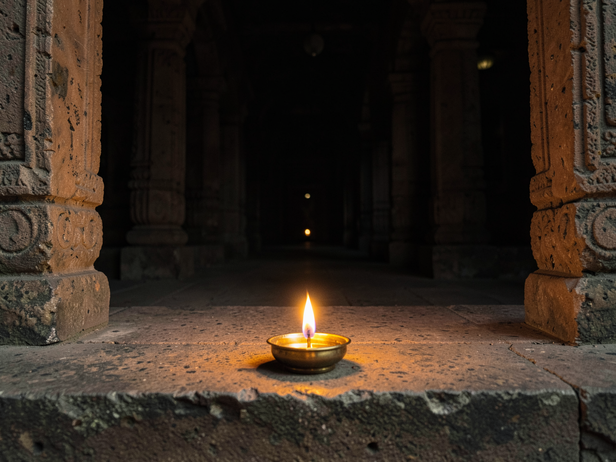
![Temple Diya's Golden Glow]()
Temple Diya's Golden Glow
Image credit : AI
The single glowing diya marks the entrance, a focal point of light on this Kojagari Purnima night.
Why Lakshmi and Not Durga or Saraswati
Lakshmi is the goddess of abundance, but the Sanskrit root of her name, laksha, meaning aim or mark, points to something more precise than wealth. She is the goddess of auspicious attention, of the quality of presence that draws good things toward it. The Vishnu Purana describes her as chanchala, restless, never staying where she is taken for granted. She moves. She leaves. She returns only where she is genuinely received. Kojagari is built entirely on this attribute. The vigil is not performed to earn her; it is performed to be the kind of person she would find worth visiting.
The Lamp, the Moon, and the Milk
The ritual elements of Kojagari are specific in a way that repays attention. Lamps are kept burning through the night, not for warmth or visibility, but because an unattended flame is a sign no one is home. The full moon of Ashwin is traditionally said to carry amrita, the nectar of life, in its light; offerings of puffed rice and milk left outdoors under the open sky are understood to absorb that light before being consumed. This is not metaphor dressed as belief. The Atharva Veda treats moonlight as genuinely curative, and the Charaka Samhita, the foundational Ayurvedic text, records cooling and digestive properties attributed to moonlight-exposed foods. Whether one holds the cosmological claim or not, the practice orients the body outward and upward on a clear autumn night, which is itself a kind of attentiveness.
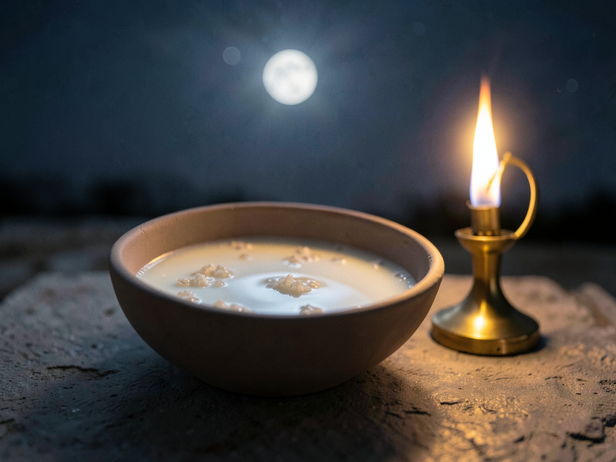
![Moonlit Milk Offering]()
Moonlit Milk Offering
Image credit : AI
I observe the Kojagari Purnima tradition, a bowl of milk reflecting the moon and lamplight.
The Dice Game and What It Means
Gambling on Kojagari Purnima is not a folk corruption of a serious rite. It is part of the original practice. The Skanda Purana mentions it directly. One reading is pragmatic: dice keeps people awake. Another is theological. The dice game places the player in a condition of genuine uncertainty, alert to each throw, unable to drift into habit or comfort. Lakshmi, the texts remind us, does not visit the complacent. She visits the attentive. The dice game is a machine for producing attentiveness on demand. That the stakes are small, cowrie shells, coins, sweets, is the point. The wager is not the thing. The wakefulness is.
Kojagari Across Regions
The festival carries different names and different emphases across the subcontinent. In Bengal it is Kojagori Lakshmi Puja, celebrated with elaborate clay images of Lakshmi installed in homes and courtyards, the alpana drawn at the threshold in rice paste, a literal welcome mat for a goddess known to read such signs. In Odisha it is Kuanr Purnima, with its own set of stories. In Maharashtra the night is observed as Sharad Purnima with particular attention to the moonlit offering of kheer. In each form the structure is the same: a lit home, a wakeful household, something offered to the open sky. The question being answered is always the same question.
Lakshmi does not knock. She asks. The festival is a theology of receptivity, not passive waiting, but the active, lit, open-eyed condition that makes receiving possible. The question ko jagarti has survived long enough to become a festival name because it turns out to be the right question to ask of any threshold, on any night when something worth having might be passing through.