Malunkyaputta was a monk who had grown tired of waiting. The Buddha had not answered his questions, whether the universe is eternal, whether the soul survives the body, whether the enlightened continue after death, and Malunkyaputta was ready to leave the order over it. The Buddha's response was not a rebuke. It was a parable about a man with an arrow in his chest.
The Man Who Needed Answers First
The wounded man refuses treatment. He will not let the physician near him until he knows the name of the man who shot him, his caste, his height, whether the bow was made of wood or horn, whether the bowstring was sinew or hemp. He will have his answers. He dies with the arrow still inside him.
The Buddha's point was precise: none of those answers would have pulled the arrow out. And the arrow is in. That is the only fact that changes anything.
This parable appears in the Majjhima Nikaya, the Middle Length Discourses, in a teaching known as the Culamalunkya Sutta (MN 63). It is not a story about ignorance being bliss. It is not a story about faith over reason. It is a story about what questions are for.
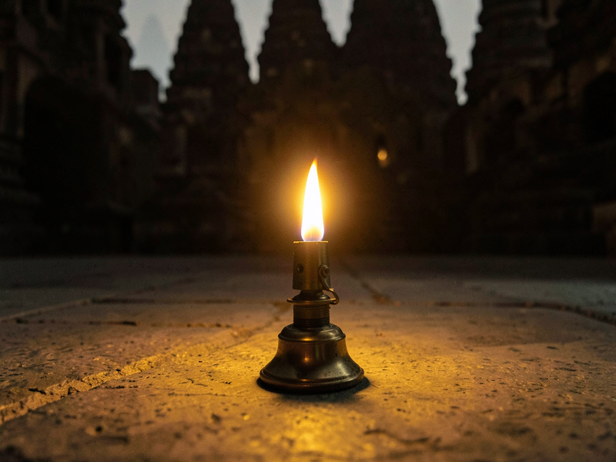
![Temple Lamp's Golden Glow]()
Temple Lamp's Golden Glow
Image credit : AI
A steady flame offers a focal point, a quiet reminder of life lessons, much like the poisoned arrow parable.
The Questions We Use to Stay Still
There is a particular kind of question that feels like progress because it is earnest and because it is hard. Why did this happen to me? What is the meaning of all this suffering? Is the universe just? Will I ever be at peace? These are not small questions. But notice what they share: none of them can be answered in a way that changes what needs to change today.
The monk Malunkyaputta was not a fool. He was a sincere practitioner with a genuine philosophical hunger. The Buddha did not dismiss the questions as stupid. He pointed out that the holy life does not depend on resolving them. Birth, aging, sorrow, grief, despair, these are present whether the universe is eternal or not. The arrow does not wait for the answer.
The trap is not in asking questions. The trap is in using questions as the condition for living. I will begin when I understand why. I will heal when I know whose fault it was. I will be present when I have resolved what presence even means. The questions become the wound's reason to stay open.
What the Parable Does Not Say
It would be easy to read this as a command to stop thinking, to accept without examination, to trust without inquiry. That reading misses the teaching entirely.
The Buddha answered thousands of questions. The Pali Canon is vast precisely because he engaged with the texture of human confusion in extraordinary detail. What he refused to answer were questions he called avyakata, undeclared, set aside, not because they were wrong to ask, but because speculating on them produces neither clarity nor relief. They are the kind of questions that feel like they are about the arrow but are actually about the archer.
The distinction is between a question that opens the next step and a question that replaces it. One kind of asking moves you toward the physician. The other kind keeps you on the ground, articulate and bleeding.
![Dawn Lotus Stillness]()
Dawn Lotus Stillness
Image credit : AI
I find stillness in the dawn lotus, a moment of peace like the Buddha's teaching on suffering.
The Arrow in the Present Moment
The Culamalunkya Sutta is sometimes taught alongside the Sallatha Sutta, the Dart, in which the Buddha describes two darts of pain. The first dart is the pain that arrives: loss, illness, failure, the end of something you loved. The second dart is the story you tell about the first one. The second dart is optional. It is the one we shoot ourselves.
The questions, why me, what does it mean, is the universe fair, are often the second dart in philosophical clothing. They feel like wisdom-seeking. They function as suffering extended.
This is not a call to spiritual bypassing, to skipping grief or pretending pain is not real. The first dart is real. The parable never denies the wound. It only asks: what are you doing while the arrow is still in?
Pulling the Arrow Out
The physician in the parable does not need the archer's name to do the work. The work is the same regardless. This is the teaching's quiet radicalism: it relocates the sacred from the metaphysical to the immediate. The holy life is not the one lived after the great questions are settled. It is the one lived now, with the questions still open and the arrow still acknowledged.
Malunkyaputta stayed. The Buddha gave him a set of practices, the five lower fetters, the path of their abandonment, things that could actually be done. Not answers. Instructions.
The parable does not end with the man understanding archery. It ends with the arrow out. That is the only ending that matters. The questions you are holding right now may be real and may be worth your life's attention. The question worth asking first is simpler: are they the kind that help you stand up, or the kind that make lying down feel like philosophy?