Somewhere in the long history of Indian philosophical debate, a rule emerged that most modern arguers would find quietly humiliating. Before you stated your own position, you had to state your opponent's, fully, charitably, in its strongest form, without caricature. Only then were you permitted to respond. The tradition called this Purva Paksha, meaning the prior side or the eastern wing, and it shaped how the great acharyas of the Vedantic, Buddhist, and Nyaya schools engaged with one another across centuries of intellectual contest.
What Purva Paksha Actually Meant
The word Purva means prior or eastern; Paksha means side or wing. Together they name the first movement of classical Indian philosophical debate: the presentation of the opposing view. This was not a formality. In the major commentarial traditions, from Adi Shankaracharya's Brahmasutra Bhashya to the Nyaya school's systematic treatises, the Purva Paksha section could run for pages, sometimes entire chapters, before the author introduced their own position, called the Uttara Paksha or Siddhanta.
The discipline had a specific test. Your rendering of the opposing view had to be good enough that a genuine adherent of that school would recognise it as their own position, not a softened or distorted version of it. If you had flattened the argument, you had failed the first step before the debate had properly begun.
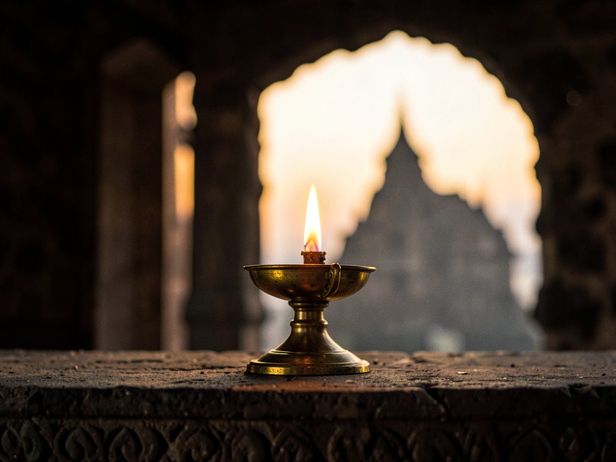
![Temple Lamp's Golden Glow]()
Temple Lamp's Golden Glow
Image credit : AI
The steady flame of a lamp, a symbol of knowledge, illuminates the dawn. This scene evokes the spirit of ancient Indian philosophical debate.
Why the Rule Existed at All
The Indian philosophical tradition, particularly the Nyaya school, which formalised the rules of inference and debate, recognised something that modern rhetoric tends to obscure: refutation that does not begin with genuine comprehension is not refutation. It is performance. You can appear to defeat an argument you have misrepresented. The audience may applaud. But the argument itself remains standing, untouched, in the mind of anyone who actually holds it.
Shankaracharya's commentaries demonstrate this with unusual rigour. When he engages the Sankhya school's account of causation, or the Buddhist school's denial of a permanent self, he does not reach for the weakest version of those positions. He reaches for the strongest. The Advaita response that follows is built to answer the actual challenge, not a convenient substitute. This is why those commentaries survived as serious philosophical texts and not merely as sectarian polemics.
The Bhagavad Gita's second chapter offers a compressed version of the same logic. Arjuna's opening argument in Chapter 2, verses 4 through 8, his case against fighting, is presented with genuine emotional and philosophical weight before Krishna begins his response. The Gita does not dismiss Arjuna's grief as weakness. It takes the grief seriously enough to answer it over eighteen chapters.
The Schools That Took It Furthest
Among the six orthodox darshanas, the Nyaya and Mimamsa schools developed the most formal apparatus around debate. Nyaya texts such as the Nyaya Sutras of Gautama distinguish between honest debate, called Vada, and two corrupted forms: Jalpa, which is arguing to win rather than to find truth, and Vitanda, which is arguing purely to refute without offering any position of one's own. Purva Paksha belongs to Vada. It is the mark of a debater who is genuinely interested in the question.
The Mimamsa school, concerned with the correct interpretation of Vedic injunctions, developed Purva Paksha into an almost procedural discipline. A Mimamsaka commentator would present the prima facie objection to an interpretive claim with the same care a lawyer gives to the opposing brief, not because they agreed with it, but because the strength of the final position depended entirely on how much the objection had been allowed to press.
Across traditions, the same logic held. Ramanuja's Vishishtadvaita and Madhva's Dvaita both engage Shankara's Advaita through Purva Paksha, and Shankara's own texts anticipate objections from both directions, even from schools that had not yet fully formed in his lifetime. The tradition was generative precisely because it demanded that each school understand the others well enough to argue for them.
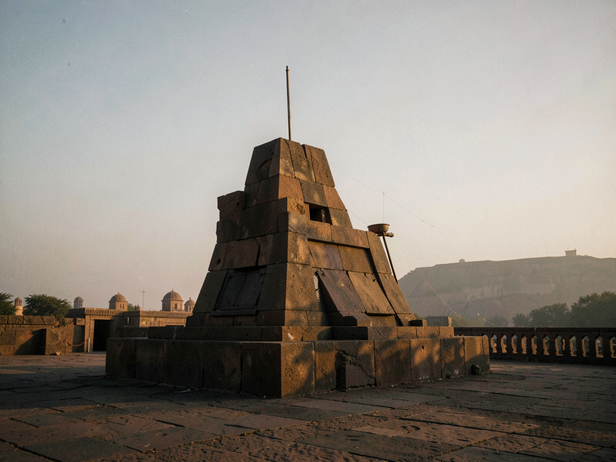
![Jantar Mantar Dawn Geometry]()
Jantar Mantar Dawn Geometry
Image credit : AI
I witness the Jantar Mantar's ancient geometry bathed in dawn's light, a testament to classical Indian astronomical pursuits.
What It Asks of the Person Practising It
Purva Paksha requires a specific kind of intellectual honesty that is harder than it sounds. The temptation in any argument is to represent the opposing view in the form that is easiest to answer. This is sometimes called a straw man, but the classical tradition had a more precise diagnosis: it is a failure of attention. You have not listened carefully enough to know what the other side actually believes.
To argue your opponent's case well, you have to temporarily suspend the reflex to disagree. You have to follow the logic of a position you find wrong all the way to where it is most coherent, most internally consistent, most genuinely persuasive. This is not the same as agreeing with it. It is the opposite of dismissing it. The tradition held that this suspension of reflex was itself a form of practice, that the discipline of understanding before responding was inseparable from the discipline of thought itself.
There is a reason the acharyas who practised this most rigorously are also the ones whose arguments remained in serious philosophical circulation for centuries. Positions built on caricature collapse when the actual opponent responds. Positions built on the strongest version of the opposing view become harder to move with each generation that tries.
Why It Disappeared from Most Arguments
The conditions that made Purva Paksha possible were specific. Classical shastraic debate happened in settings where both parties were trained in the same formal tradition, where the goal was explicitly the pursuit of truth rather than the defeat of a person, and where the audience was capable of evaluating the quality of the engagement rather than just its emotional register. Remove those conditions and the incentive structure inverts. Speed rewards the confident assertion. Platforms reward the sharp takedown. Charity toward the opposing view reads, in most modern contexts, as weakness or ambiguity.
What survives of the discipline tends to survive in corners: in legal reasoning, in certain academic traditions, in the practice of serious translators who have to understand a text before they can render it. The form has dispersed. The name has mostly gone with it.
The loss is not sentimental. An argument that has not passed through Purva Paksha is an argument that has not been tested. It may be right. But it does not yet know why.