The argument between Advaita and Vishishtadvaita is not a quarrel about God's existence. Both Shankara and Ramanuja accepted Brahman as the ultimate reality. The disagreement is narrower and more consequential: what happens to you when you get there?
What Shankara Actually Said
Shankara's Advaita Vedanta rests on a single claim: Brahman alone is real, and the appearance of multiplicity, of individual selves, of a world of distinct objects, is maya, a superimposition on the one undivided consciousness. The jiva, the individual self, is not a separate entity that approaches Brahman. It is Brahman, already, mistaking itself for something bounded. Liberation is the falling away of that mistake. The wave does not travel to the ocean. It recognises that it was always water.
This is philosophically rigorous and spiritually demanding. It leaves no room for a devotee who loves a personal God, because the devotee and the God would both have to dissolve into the same undifferentiated awareness. Bhakti, on Shankara's terms, is at best a preparatory practice, useful for the mind not yet ready for jnana, the direct knowledge that erases the lover and the beloved alike.
![Temple Lamp's Golden Glow]()
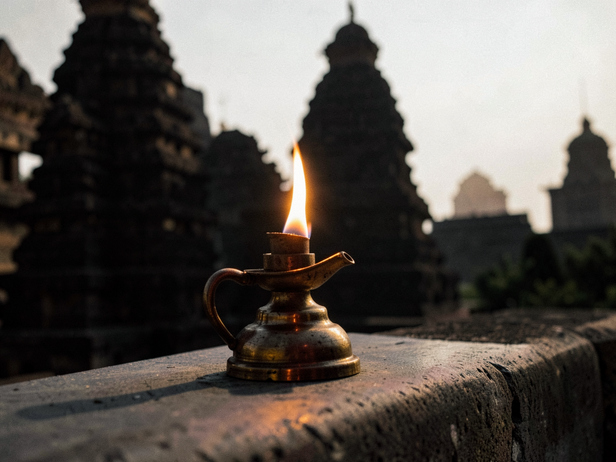
Temple Lamp's Golden Glow
Image credit : AI
My warm flame reflects, a beacon of light against the temple's silhouette. Exploring Ramanuja bhakti and self in Hinduism.
The Objection Ramanuja Pressed
Ramanuja, writing in the eleventh and twelfth centuries from within the Sri Vaishnava tradition, found Shankara's position philosophically incoherent at a specific joint. If Brahman is pure, undivided, attributeless consciousness, then maya, the power that produces the illusion of multiplicity, must itself be either real or unreal. If real, it is a second principle alongside Brahman, and Advaita is not non-dual. If unreal, it cannot produce anything, including the very illusion it is supposed to explain. Ramanuja pressed this as the anirvacaniya problem: maya is described as neither real nor unreal, which he argued was not a solution but an evasion.
He also pressed a different objection, more personal in register. The Upanishads that Shankara read as teaching the identity of atman and Brahman, tat tvam asi, thou art that, Ramanuja read as teaching a relation of inseparability, not identity. The self is real. It is not an illusion to be dissolved. It is a mode, a prakara, of Brahman in the way that a body is a mode of the person whose body it is.
The Architecture of Vishishtadvaita
Vishishtadvaita means, literally, non-duality of the qualified. Brahman is one, but that one is not featureless. It has, as its body, the entirety of conscious selves and the material world. Ishvara, the personal God, for Ramanuja specifically Narayana, is the inner controller, the antaryamin described in the Brihadaranyaka Upanishad, who dwells within all selves as their ground without being identical to them in the flat sense Shankara meant.
The individual self, the jiva, is real, eternal, and distinct. It does not become Brahman at liberation. It reaches a state of intimate union, sayujya, in which it knows Brahman directly and participates in divine consciousness, but retains its own centre of experience. The Bhagavad Gita, Chapter 18, verse 65, man-mana bhava mad-bhakto mad-yaji mam namaskuru, is read by Ramanuja not as a provisional concession to the devotionally-minded but as a metaphysically precise instruction: fix your mind on me, be devoted to me, because the me and the you are both real, and the relationship between them is what liberation consists of.
![Dawn Lotus Serenity]()
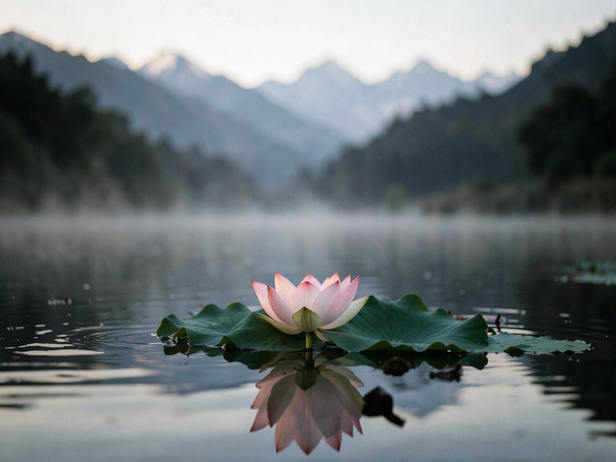
Dawn Lotus Serenity
Image credit : AI
A serene dawn unfolds with a fully open lotus, embodying the essence of Ramanuja bhakti.
Why the Difference Matters for Bhakti
Ramanuja's system gave the bhakti movements of South India a philosophical foundation they had not previously possessed in systematic form. The Alvars, the Tamil Vaishnava poet-saints whose Divya Prabandham Ramanuja treated as a fifth Veda, sang of longing, of separation, of the ache of a self reaching toward a God who is genuinely other. That ache is only coherent if the self reaching and the God being reached are both real. On Shankara's terms, the longing is part of the illusion. On Ramanuja's terms, it is the correct perception of an actual relationship.
This is not a minor liturgical point. It determines whether devotion is a ladder to be kicked away or the thing itself. Ramanuja argued it was the thing itself: prapatti, surrender to Ishvara, is not a preliminary stage before the real work of self-dissolution. It is the culminating act of a self that has understood what it is.
What You Are Left With
The philosophical disagreement between Shankara and Ramanuja has never been resolved, and it does not need to be. What Ramanuja's Vishishtadvaita offers is a coherent account of why the self you bring to practice, the one that grieves, that longs, that chooses, is not an obstacle to realisation but its very instrument. The self is not the problem. Mistaking the self for something isolated and self-sufficient is the problem. Brahman is the whole of which you are a real, irreducible part, not a fragment to be reabsorbed, but a mode through which the whole knows itself in a particular way that only you can provide.