Gandhari made her choice before the wedding. Dhritarashtra was blind, and she would be blind too, not by accident, not by force, but by her own hand, her own cloth, her own knot. The Mahabharata records it without judgment. What it does not spare is the consequence.
The Devotion That Looked Like Virtue
![Blindfold of Devotion]()
Blindfold of Devotion
Image credit : AI
A symbol of loyal blindness, this scene evokes Gandhari's devotion and the spiritual lessons of the Mahabharata.
Every tradition that tells Gandhari's story calls the blindfold an act of love. And in the narrowest sense, it was. She refused an advantage her husband did not have. She levelled the ground between them. There is something genuinely moving in that, a woman choosing, in an era that offered women almost no choices, to make one so absolute.
But the Bhagavad Gita does not speak of devotion as the abandonment of discernment. In Chapter 3, Verse 8, Krishna tells Arjuna that prescribed action is better than inaction, that the body itself cannot be sustained without work, without engagement. Gandhari's blindfold was a form of chosen inaction dressed as sacrifice. She removed herself from the work of seeing.
What a Mother's Sight Was Worth
Duryodhana grew up watched by servants, tutors, and a court full of people with reasons not to speak plainly to a crown prince. The one person whose gaze carried both love and authority, whose seeing him whole, flawed, capable of worse, might have changed something, had given that up before he was born.
This is where Gandhari's story stops being about a wife and becomes about a mother. The blindfold, once tied, did not stay between husband and wife. It spread. It covered her children. It covered Kurukshetra.
She was not absent. She was present in every scene the epic gives her, counselling, warning, even cursing Krishna at the war's end in a grief so vast it reshapes the text around it. But presence without sight is a different thing. You can be in the room and still not see the person in front of you. Gandhari was in every room. She saw nothing.
The Curse at the End and What It Tells Us
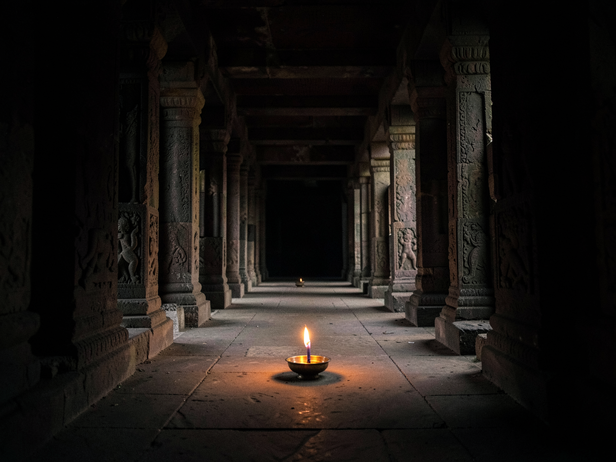
![Temple Corridor's Solitary Light]()
Temple Corridor's Solitary Light
Image credit : AI
A lone diya's flame pierces the temple's gloom, a symbol of unwavering devotion, echoing Gandhari blindfold meaning.
After Kurukshetra, after a hundred sons are dead and the earth is quiet with the wrong kind of quiet, Gandhari lifts her blindfold for one recorded moment. She looks at Yudhishthira's toe, and the nail blackens. The power was always there. The sight was always possible. She had simply chosen not to use it.
Then she turns to Krishna and curses him, his clan will destroy itself, his city will fall, he will die alone in the forest. And Krishna accepts the curse. He does not argue. He says she is right.
What does it mean that the most devastating act of Gandhari's life was the one where she finally looked? The epic is not subtle here. The sight she withheld for a lifetime came back as destruction. Devotion deferred does not dissolve. It accumulates interest.
Loyal Blindness as a Living Pattern
Gandhari is not a figure from a sealed past. The blindfold she tied is tied in every household where a parent refuses to see what a child is becoming, in every friendship where honesty is sacrificed to comfort, in every institution where loyalty to a leader is purchased with the surrender of judgment.
The people who needed Gandhari to look were not her enemies. They were her sons. The blindfold protected no one it was meant to protect. It protected only the feeling of being a devoted wife, a feeling, not a fact.
Dhritarashtra himself, the man the blindfold was for, is the Mahabharata's portrait of what happens when a person in power refuses to see clearly. He knew Duryodhana was wrong. He said so, repeatedly, in private, to Vidura, to Sanjaya, to anyone who would listen in the dark. And then he did nothing. Gandhari mirrored him so completely that the epic gives us two blind rulers of the same house and asks us to watch what grows in that darkness.
What the Mahabharata Asks of Us Instead
The epic's answer to Gandhari is not her opposite, not the cold judge who sees everything and loves nothing. It is Kunti, who saw her sons clearly enough to send them into exile and clearly enough to grieve them returning. It is Vidura, who spoke plainly to power until power stopped listening. It is Krishna himself, who in Chapter 2 of the Gita tells Arjuna that grief which clouds vision is not tenderness, it is a failure of the self.
Seeing the people you love accurately is not a betrayal of love. The Mahabharata argues, across eighteen books, that it is the only form of love that survives contact with the world. Gandhari's blindfold was not a gift to Dhritarashtra. It was a gift to her own need to be seen as devoted, at the cost of everyone who needed her to simply look.