The Rigveda is not a book of doubt. It is a collection of hymns addressed to fire, to soma, to dawn, to the storm, presences the poets believed were real and listening. So when one hymn in the tenth mandala, the 129th, turns toward the moment before any of those presences existed, you might expect a confident answer. Creation hymns in most traditions offer one. The Nasadiya Sukta offers something stranger: six verses of careful construction followed by a final verse that dismantles the authority of everything that came before it.
What the Hymn Builds in Its First Six Verses
The opening verse is among the most translated lines in Sanskrit literature. In Wendy Doniger's rendering: "There was neither non-existence nor existence then." The hymn does not begin with a god. It does not begin with chaos. It begins by refusing the two categories a listener would reach for first. Neither sat nor asat, neither being nor non-being. Neither death nor immortality. Neither night nor day. What there was, the poet says, was "that one", tad ekam, breathing without breath, by its own impulse, in the darkness that was wrapped in darkness.
The next four verses watch something stir. Desire, kama, arises first, and the hymn calls it the first seed of mind. Seers searching in their hearts with wisdom found the bond of being in non-being. A line of verse four says something divided above and below, with creative powers and energy below, impulse above. It is not a narrative. It is a phenomenology of emergence, written in a language that treats the moment of origin the way a geologist treats a stratum: here is what we find when we look as far back as looking can go.
By verse six, the hymn has described gods arriving into a world that was already becoming. This is the detail that most translations underplay. The gods come after. They are not the cause. They are, like us, inheritors of something that preceded them.
![Golden Flame in Darkness]()
Golden Flame in Darkness
Image credit : AI
A solitary flame illuminates the void, hinting at ancient Indian cosmology and the Rigveda creation hymn.
The Turn That the Seventh Verse Makes
Then verse seven arrives. In A.A. Macdonell's translation it reads: "Who really knows? Who will here proclaim it? Whence was it produced? Whence is this creation? The gods came afterwards, with the creation of this universe. Who then knows whence it has arisen?"
The final half-verse goes further: "Whether God's will created it, or whether He was mute; perhaps it formed itself, or perhaps it did not, only He who is its overseer in highest heaven knows. He only knows, or perhaps He does not know."
That last clause, "or perhaps He does not know", is the hymn's real act. It does not soften the question. It does not turn uncertainty into a placeholder for revelation. It extends the doubt upward until there is nowhere left to extend it. The overseer in highest heaven, whoever or whatever that is, may also be without an answer.
Why This Is Not Agnosticism in the Modern Sense
It would be easy to read the Nasadiya Sukta as proto-agnosticism, a Vedic shrug dressed in verse. That reading misses what the hymn is doing with its uncertainty. Modern agnosticism tends to treat the unknown as a gap, something that might eventually be filled by evidence or argument. The Nasadiya Sukta treats it as a structural feature of the question itself. The hymn does not say: we do not yet know. It says: the question of origins may be the kind of question that resists the knower-known relationship entirely. Even a being present at creation, even the overseer, would face the same wall, because the moment before creation is the moment before the conditions that make knowing possible.
This is closer to what later Advaita Vedanta would call the limits of vyavaharika, conventional, transactional knowledge, than it is to scientific uncertainty. The hymn is not waiting for better instruments. It is pointing at the edge of what instruments can reach.
![Dawn at Jantar Mantar]()
Dawn at Jantar Mantar
Image credit : AI
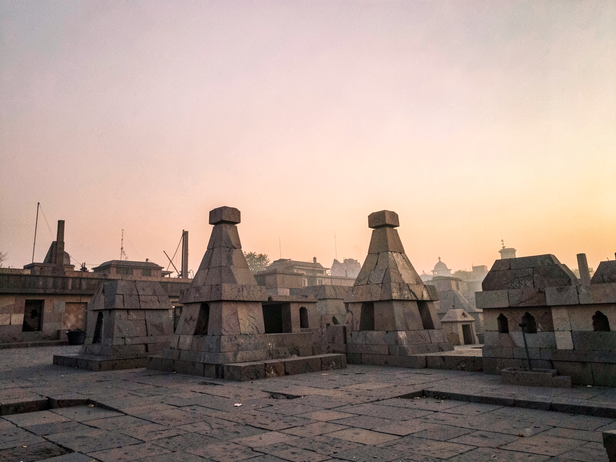
Ancient Indian cosmology hymn inspires this dawn view of geometric astronomical instruments. Exploring Vedic philosophy on creation.
What the Hymn's Form Does to Its Content
The Nasadiya Sukta is composed in the tristubh metre, eleven syllables to a line, the metre of the heroic and the serious in Vedic poetry. It is the same metre used in the Indra hymns, the great battle hymns, the hymns of cosmological scope. Choosing it for a hymn that ends in admitted ignorance is not accidental. The form promises authority. The content refuses it. That gap between the metre's confidence and the final verse's openness is where the hymn lives.
The Sanskrit word for the hymn's subject, sukta, means "well-spoken" or "well-said". The tradition judged this hymn, which ends by questioning whether anything can be said with authority about origins, to be among the best-spoken things in the collection. That judgment suggests the Vedic poets understood something about the value of a question that does not resolve: it stays alive in a way that an answer cannot.
What Remains After the Hymn Ends
The Nasadiya Sukta does not leave the reader in despair. It leaves the reader in a particular kind of alertness, the alertness of someone who has been told that the ground they assumed was solid is, at its deepest layer, open. The hymn does not tell you what to do with that. It does not offer a practice or a consolation. It offers the question itself as a gift, in the same way that a clear night sky offers its distances without explanation.
What the hymn demonstrates is that the Rigveda contains, within its hymns of confident invocation, a hymn that turns toward the invocations themselves and asks what stands behind them. It is the Vedic tradition questioning its own foundations from inside. The doubt is not imported. It grew here, in the same soil as the certainties, and the tradition kept it, copied it, chanted it, and placed it in the tenth mandala where anyone who reached the end of the collection would find it waiting. The question was not an oversight. It was the destination.