Kisa Gotami walks into the story already broken. Her infant son has died, and she carries him from door to door asking for medicine, because some part of her mind has decided that death is a problem with a solution. The neighbours pity her. Some are afraid of her. Eventually someone sends her to the Buddha.
She does not go to him for philosophy. She goes because she has run out of doors.
The Errand That Cannot Be Completed
The Buddha listens. He does not correct her. He does not explain impermanence. He tells her he can help, but he will need one thing first: a mustard seed from a household that has never known death.
Mustard seeds were everywhere in ancient India. Every kitchen had them. The errand sounds easy, and that is the point. Kisa Gotami goes from house to house, not begging now, but searching with purpose, which is a different kind of motion. At the first house they give her the seed immediately, then pause. Has anyone died here? The father, three years ago. She puts the seed down and moves on.
The next house. A daughter. The house after that, a servant, an elder, a child. She walks the whole city. Every household hands her a seed and then takes it back with a name.
The Buddha sends no one with her. He gives her no teaching. He gives her the city itself as the teaching.
![Ancient Wisdom Illuminated]()
Ancient Wisdom Illuminated
Image credit : AI
The Kisa Gotami mustard seed story speaks of impermanence, a profound Buddhist teaching on grief and loss.
What the Buddha Refused to Do
He refused to explain. He refused to console. He refused to perform the one gesture grief most wants from the people around it, which is to be told that this loss is different, that this particular sorrow is exceptional, that the universe owes this mother something it does not owe everyone else.
The Dhammapada, in the verses surrounding the doctrine of impermanence, returns again and again to a single Pali word: anicca. Impermanence. Not as punishment, not as cosmic indifference, but as the nature of all conditioned things. What arises, passes. The Buddha understood that Kisa Gotami did not need this stated. She needed to discover it in the faces of strangers who had already survived what she was living through now.
Grief, in its sharpest phase, feels like a private catastrophe. The Buddha's method was to dissolve that privacy, not by minimising the loss, but by multiplying it until the mother could see that she was standing inside something universal rather than something uniquely cruel.
The Moment the Seed Is Set Down for Good
The story does not dramatise the exact moment Kisa Gotami understands. The texts say only that she sat with the body of her son at the edge of the city as evening came, and that she saw what she had not been able to see before: that she had loved him, and that he had lived, and that this was the whole of it.
She returns to the Buddha without the seed. He asks if she found it. She says no. He asks what she found instead. She tells him.
He ordains her. She becomes one of the earliest female monastics in the Buddhist tradition, and the Therigatha, the verses of the elder nuns, one of the oldest surviving collections of poetry written by women anywhere in the world, preserves her words. She does not write about the child. She writes about what it is to walk through fire and come out the other side not unburned, but clear.
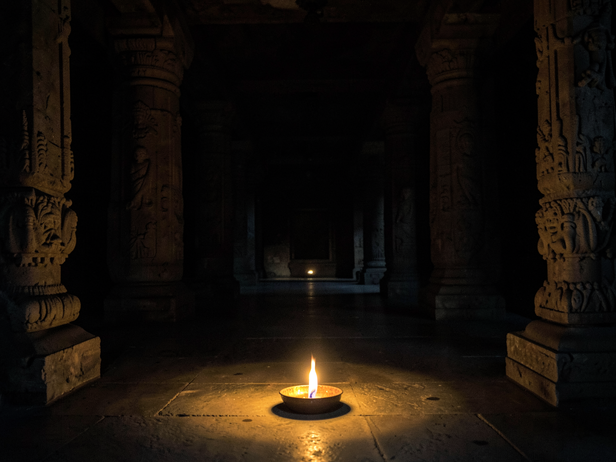
![Temple Corridor Diya Glow]()
Temple Corridor Diya Glow
Image credit : AI
A single diya's flame offers a beacon of light, a reminder of impermanence in the ancient stone.
What This Story Is Not Saying
It is not saying that grief resolves. It is not saying that understanding impermanence makes loss hurt less. The Buddha does not promise Kisa Gotami that she will stop missing her son. He offers her something smaller and more durable than comfort: the knowledge that she is not alone in the structure of her suffering, even if she is completely alone in its texture.
There is a difference between those two things, and the story lives in that gap.
The mustard seed exercise is sometimes read as a kind of trick, a sleight of hand that distracts a grieving woman until she comes to her senses. That reading misses what the Buddha is actually doing. He is not distracting her. He is sending her toward other people's grief, because the only way out of the conviction that your pain is singular is to stand in front of someone else's and recognise it.
Why the Story Has Lasted
The Kisa Gotami story appears across Theravada and Mahayana traditions, in Pali commentaries and in later Sanskrit retellings. It has lasted not because it resolves grief but because it refuses to. Every other figure in the story offers Kisa Gotami something, pity, a seed, a referral. The Buddha is the only one who offers her a task that will teach her something true.
The story also survives because Kisa Gotami is not passive. She walks the whole city. She asks every door. She does the work. The insight does not arrive because the Buddha is wise; it arrives because she is willing.
The Therigatha verse attributed to her ends not with peace as an absence of feeling, but as a different relationship to feeling. She does not say the grief is gone. She says she has set it down. The distinction is everything, because setting something down implies you were the one carrying it, and that you still have your hands.