On 14 October 1956, B.R. Ambedkar knelt at Deekshabhoomi in Nagpur and took Dhamma Diksha from Mahasthavir Chandramani. Six lakh people converted alongside him. The twenty two vows he administered that day are often recited as a list. Read slowly, they are something else: a structured dismantling of every theological and social claim that had been used to justify caste. Each vow names a specific thing and refuses it. The sequence is not accidental.
The First Fourteen: Refusing the Brahminic Cosmology
The opening vows move in a clear order, from the highest claim to the most immediate one. Vow one refuses Brahma, Vishnu, and Mahesh as gods. Vow two refuses Ram and Krishna as gods or as objects of worship. Vow three refuses Gauri and Ganpati. Vow four refuses the divine origin of any avatar. These are not rejections of culture or story. They are refusals of a specific theological architecture in which the caste hierarchy was embedded, where the varna system was held to be divinely ordained through the Purusha Sukta of the Rigveda, where untouchability was made cosmological rather than historical.
Vow five refuses the belief that Buddha was an avatar of Vishnu. This one is precise in a way that matters. The Brahminic tradition had absorbed the Buddha by making him the ninth avatar of Vishnu, a move that neutralised the challenge of Buddhism by domesticating it. Ambedkar's fifth vow refuses that absorption. It insists that Buddha stands outside and prior to that system, not as one of its expressions.
Vows six through nine refuse specific ritual practices: Shraddha, the post-death rites for ancestors; pind offerings; the authority of Brahmin priests over life-cycle rituals; and the belief that caste distinctions are divinely sanctioned. Vow ten refuses the equality of all human beings as a Brahminic concession, it does not accept equality as a gift from above but asserts it as a prior fact. Vows eleven through fourteen refuse specific social and religious observances that Ambedkar saw as instruments of humiliation rather than devotion.
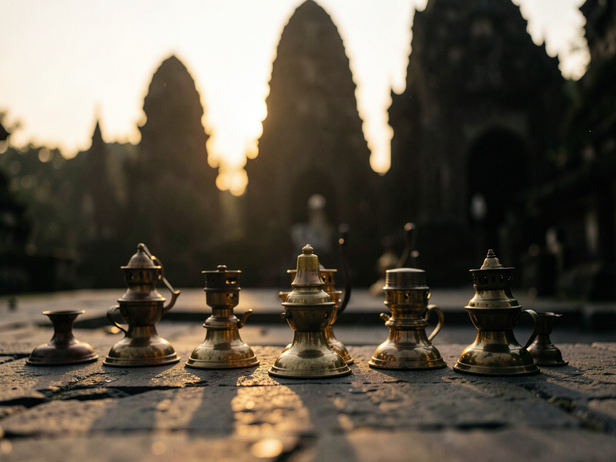
![Temple Lamps at Dawn]()
Temple Lamps at Dawn
Image credit : AI
Golden light from temple lamps illuminates the dawn, hinting at ancient rituals and spiritual awakening.
The Middle Vows: What Buddhism Is Being Chosen For
Vows fifteen through seventeen are the pivot. They do not refuse, they affirm. Vow fifteen accepts that the Dhamma of the Buddha is the true religion. Vow sixteen accepts that taking this Dhamma is a new birth. Vow seventeen accepts that one will conduct oneself according to the principles of the Dhamma.
This is where the structure of the twenty two becomes visible. The first fourteen clear the ground. These three plant something in it. Ambedkar had spent years arguing, in his 1956 work
The Buddha and His Dhamma, that Buddhism was not a religion of otherworldly escape but a social ethics, that the Buddha's teaching of equality, reason, and the rejection of ritual hierarchy was the only framework that could carry the emancipatory project he had in mind. The middle vows are the hinge on which the whole ceremony turns.
The Final Five: The Social Contract
Vows eighteen through twenty two move from theology to conduct. Vow eighteen commits to the equality of all human beings. Vow nineteen commits to following the Eightfold Path. Vow twenty commits to practising the ten paramitas of the Dhamma. Vow twenty one commits to treating all beings with compassion. Vow twenty two, the last, commits to following the twenty one vows that came before it.
The final vow has a recursive quality that is easy to miss. It does not add a twenty second thing to refuse or accept. It makes the act of vowing itself the subject. The person who takes it is not just agreeing to a set of propositions; they are committing to the practice of having committed. This is a Dhamma understanding of what a vow is: not a declaration made once, but a discipline taken up repeatedly.
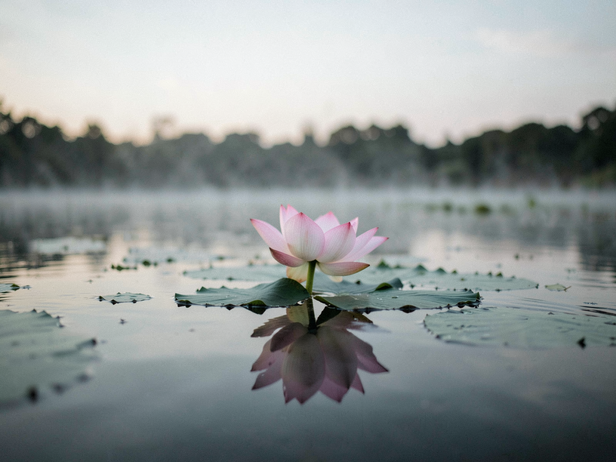
![Dawn Lotus Mist]()
Dawn Lotus Mist
Image credit : AI
A serene lotus emerges from mist at dawn, a symbol of purity. Reflecting the pale morning sky on dark water.
Deekshabhoomi and the Meaning of the Location
The site matters. Nagpur is in the Vidarbha region of Maharashtra, where the concentration of Mahar communities, the community from which Ambedkar came, was high, and where the conditions of untouchability were among the most documented and most organised against. Deekshabhoomi, the ground of initiation, was not a temple or a monastery. It was an open field. The conversion was not a private spiritual event. It was a public political act conducted in the open air before the largest crowd that had gathered for a religious conversion in modern Indian history.
Ambedkar died forty six days after the ceremony, on 6 December 1956. The twenty two vows he had written and administered were among the last public acts of his life. The stupa that now stands at Deekshabhoomi was built later, and the site draws lakhs of visitors each year on 14 October, which is observed as Dhamma Chakra Pravartan Din. The vows are recited there every year. What makes them worth reading carefully is not their repetition but their precision: each one names a specific claim and refuses it on specific grounds, which is a different thing entirely from a general renunciation.
The twenty two vows do not ask for a change of feeling. They ask for a change of allegiance, from a system that had assigned a person's worth at birth, to one that located it in conduct, reason, and the refusal to accept inherited diminishment as a permanent condition.