The Kartik full moon falls on a single night and carries three separate debts. Sikhs call it Guru Nanak Jayanti and fill the gurdwara with light. Jains call it Kartiki Poornima and close the spiritual year they opened at Paryushana. Hindus call it Dev Deepawali or simply Kartik Poornima, and wade into the river at dawn to float a lamp for the dead. None of these traditions borrowed the date from the other. Each arrived at it through its own logic, and the convergence holds a question worth sitting with: what does it mean when three very different understandings of the sacred land on the same night?
The Light That Guru Nanak Carried Into the World
Guru Nanak Dev Ji was born in 1469 in Nankana Sahib, in what is now Pakistan. The Sikh calendar marks his birth on the full moon of Kartik, Guru Purab, the Guru's day, though the Gregorian date shifts each year. The night is observed with an akhand path, the unbroken recitation of the Guru Granth Sahib that begins forty-eight hours before and ends at dawn on Poornima. By the time the recitation closes, the gurdwara has been awake for two full days.
What the tradition is doing with that vigil is not incidental. Guru Nanak's first teaching after his three-day disappearance into the river, the moment the tradition marks as his awakening, was Na koi Hindu, na koi Musalman: there is no Hindu, there is no Muslim. He did not say this to erase difference. He said it to locate the sacred somewhere prior to the categories. The full moon of Kartik, the month when the river is considered most alive with spiritual current, is the frame the tradition chose for that teaching. Light, water, and a refusal of enclosure. The choice of date is already a kind of argument.
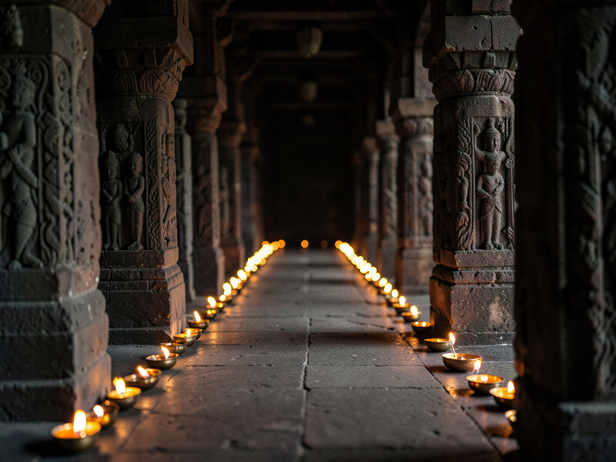
![Temple Corridor Lit by Diyas]()
Temple Corridor Lit by Diyas
Image credit : AI
I witness the sacred glow of diyas, a beautiful scene during Kartik Poornima, filling the temple with warmth.
What the Jains Are Completing That Night
Kartiki Poornima is the formal close of the Jain religious year. Paryushana, the eight-day period of intensive fasting, confession, and the seeking of forgiveness, ends in Bhadrapada, months earlier. But the spiritual arc it opens does not close until Kartik. The intervening period, Chaturmas, is the rainy-season retreat during which monks and nuns do not travel, because movement in the monsoon risks harm to the small creatures that emerge in the wet. The retreat ends at Kartiki Poornima.
The Jain logic here is precise. Ahimsa, non-harm, is not a sentiment but a practice with a season. Chaturmas is the season when the earth is most alive with life at its smallest and most vulnerable, and the tradition responds by staying still. Kartiki Poornima is the night that stillness is formally released. Monks resume movement. Laypeople who have been observing partial fasts return to ordinary eating. The moon that night is not a symbol of completion so much as its literal marker: the night is full, the retreat is full, the year is full.
The River and the Lamp That Crosses It
For Hindus, Kartik Poornima carries a different weight. The month of Kartik is already dense with significance, Ekadashi fasts, the tulsi vivah, the gradual brightening of the lunar fortnight that ends in this full moon. On Dev Deepawali, which falls on the same night in the Hindu calendar, it is said that the devas themselves descend to bathe in the Ganga. The ghats at Varanasi are lit with hundreds of thousands of diyas. Priests perform the Ganga aarti on a scale that dwarfs the ordinary evening ritual. Pilgrims wade in before sunrise.
The lamp floated on the river is an old gesture. It is sent for the ancestors, the pitru, who are believed to receive it across the water. The act belongs to a cosmology in which the living and the dead are not separated by an absolute barrier but by a crossing that can, on certain nights, be made thinner. Kartik Poornima is one of those nights. The river is the crossing. The lamp is the message. The full moon is the light by which both shores can see.
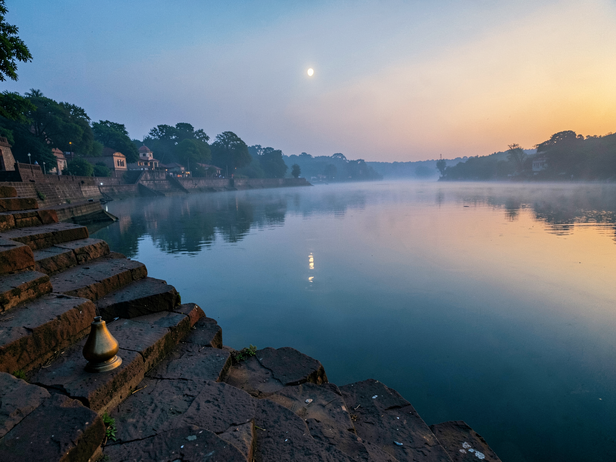
![Moonlit River Ghat Dawn]()
Moonlit River Ghat Dawn
Image credit : AI
I observe the sacred Kartik Poornima full moon reflected on the still water, a single lamp guiding the way.
Why the Convergence Is Not Accidental
The Kartik full moon was auspicious long before any of these traditions named it. It falls at the end of the monsoon, when the rivers have receded, the fields are full, and the sky is clear enough for the moon to be genuinely brilliant. The agricultural calendar and the sacred calendar were never separate in the subcontinent; they were the same calendar read at different registers. A full moon at the end of the harvest season, when the rains have stopped and the river is passable again, was always going to attract meaning.
What each tradition brought to that night was its own answer to a shared question: how do you mark the end of one kind of time and the beginning of another? Sikhism answered with continuous recitation, the Guru's word as the bridge. Jainism answered with the resumption of movement after deliberate stillness, ahimsa as a seasonal practice, not a permanent abstraction. Hinduism answered with the lamp on the water, the gesture that acknowledges the dead while remaining among the living. Three answers. One moon.
What It Means to Stand at the Ghat That Night
Varanasi is the easiest place to feel the convergence, because the ghats hold all of it at once. The gurdwara near the river is lit. The Jain dharamshala a few lanes back is observing its own quiet close. The priests are arranging the aarti lamps in rows that will be carried down to the water. The pilgrims are already in the river before the sun is fully up.
None of these people are worshipping together. They are not sharing a ritual or a theology. But they are sharing a night, a river, and a recognition that this particular full moon carries weight. The Guru Granth Sahib says, in the Japji Sahib with which every Sikh day begins, that the One is without fear and without enmity, Nirbhau, Nirvair. The Jain Namokar Mantra, recited on Kartiki Poornima, salutes the liberated souls in all directions without naming a single one. The Ganga aarti ends with the lamp going into the river, released, not held. The gestures are different. The direction they point is the same.
The Kartik full moon does not belong to any one tradition because it arrived before the traditions named it. What the three faiths share that night is not a belief but a practice: the willingness to mark the turn of time with something more than a calendar entry, a flame, a word, a step into cold water before dawn.