The river does not ask for credentials. The sun does not wait for a priest to arrive before it rises. Chhath Puja, observed across Bihar, eastern Uttar Pradesh, and the Terai belt of Nepal, and now carried by migration into every major Indian city, rests on this understanding so completely that it has built no architecture around it at all. No temple complex, no consecrated idol, no ritual specialist standing between the worshipper and what is being worshipped. The vrat is among the oldest solar observances in the subcontinent, with roots scholars trace to Vedic Surya worship and to passages in the Atharva Veda and the Mahabharata. And yet its form is startling in its plainness: a riverbank, standing water, a bamboo basket of fruit and thekua, and a body turned toward the light.
The Architecture of Absence
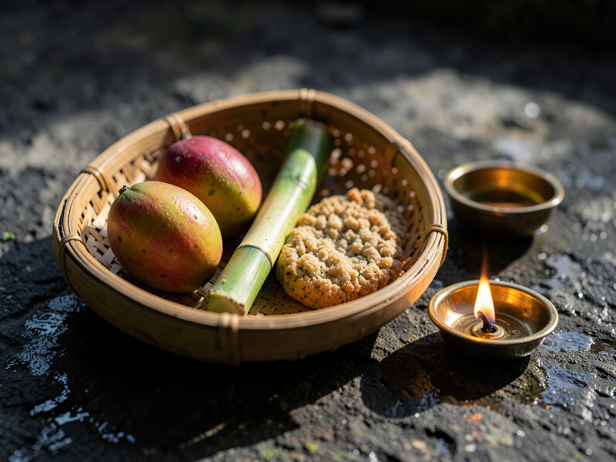
The Brahminic temple tradition developed, over centuries, a sophisticated logic of mediation. The deity resides in the garbhagriha, the womb-chamber, and approach is structured, through the gopuram, the mandapa, the antarala, so that proximity to the sacred is earned and managed. The priest holds the key. Chhath refuses this architecture entirely. There is no garbhagriha because the sun cannot be housed. There is no idol because the deity is present and visible, rising and setting on a schedule indifferent to human ceremony. The worshipper does not approach through a series of thresholds. She walks into the river. The water rises to her waist. She lifts the arghya, a shallow bamboo soop filled with sugarcane, seasonal fruit, and homemade thekua, above the waterline and holds it toward the horizon. The offering is made directly, hand to sky, with nothing in between. This is not primitive. It is a theological position.
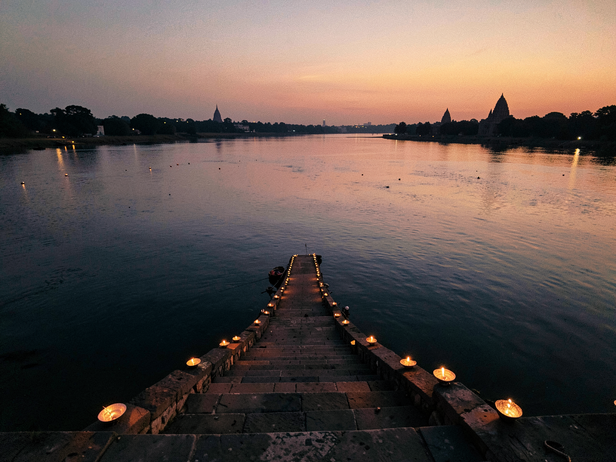
![Dusk River Ghat Lit Diyas]()
Dusk River Ghat Lit Diyas
Image credit : AI
I observe the spiritual significance of Surya worship at dusk, with diyas adorning the ghat and river.
Surya as the Unmediated Witness
The Rigveda's Surya hymns, particularly the Surya Sukta, address the sun as the eye of the cosmos, the one who sees all without obstruction. The Sanskrit root of Surya connects to svar, radiance, and to the idea of a light that does not filter. Chhath's ritual logic follows this directly. If Surya is the witness who sees everything, then a witness needs no interpreter. The devotee speaks, through the gesture of the arghya, through the four-day fast, through the vigil at the ghat, and the speaking is itself the prayer. No mantra needs to be chanted in a language the worshipper cannot understand. No intermediary needs to translate the intention upward. The sun sees. The Chhath tradition holds that Surya Shashthi, the sixth day of Kartik's shukla paksha, is when Surya's energy is most accessible, not because a priest has opened a channel, but because the astronomical moment itself is the opening.
The Devotee as Her Own Ritual Authority
What is less often said plainly: Chhath is overwhelmingly a women's festival. The primary vratis, the fasting devotees who observe the most rigorous portions of the ritual, are women. They do not require male sanction to perform it. They do not require caste certification. A Dalit woman and a Brahmin woman stand at the same ghat, knee-deep in the same river, holding the same bamboo soop toward the same sun. The festival's structure makes hierarchy impossible to enforce, because there is no ritual position of authority for hierarchy to occupy. The priest's role in other festivals is not only spiritual, it is also social, a mechanism by which certain bodies are permitted closer to the sacred than others. Chhath removes the mechanism. The river is the only threshold, and the river lets everyone in. This is not incidental to the festival's meaning. It is the festival's meaning, carried in its form rather than stated in any text.
![Chhath Puja Offering]()
Chhath Puja Offering
Image credit : AI
I arrange this Chhath Puja offering, a symbol of Surya worship, with a diya's warm glow.
What the Diyas at Dusk Are Actually Doing
On Sandhya Arghya, the evening of the third day, thousands of diyas float on the water as the sun descends. The image is among the most photographed in Indian devotional life, and it is easy to receive it as spectacle. But the diya at the ghat is doing something specific. In most Hindu ritual, fire is tended by a priest who knows the correct procedure. Here, every devotee lights her own. The flame is not consecrated by expertise, it is consecrated by intention and by the act of placing it on water, releasing it to the current. The offering goes where the river takes it. Control is surrendered at the moment of giving. The Bhagavad Gita's ninth chapter, in verses 26 through 28, describes a mode of offering in which the devotee gives whatever she has, a leaf, a flower, water, fruit, and the sincerity of the giving is what reaches Krishna. Chhath's arghya sits inside this logic. The thekua is handmade at home, not purchased from a temple stall. The sugarcane is unprocessed. The fruit is whole. Nothing has been refined into something more impressive. The offering is ordinary, and its ordinariness is the point, because the sun does not require performance. It requires presence.
A Theology That Lives in the Body
The four-day observance moves through nahay-khay, lohanda and kharna, Sandhya Arghya, and Usha Arghya, each stage tightening the fast, reducing the body's ordinary comforts, until the vrati stands at the water's edge before dawn on the final morning having eaten almost nothing for thirty-six hours, having slept on the floor, having kept the mind turned toward the practice. This is tapas in its oldest sense: the heat generated by discipline, the burning away of everything that is not essential. The body becomes the ritual vessel. There is no external vessel, no temple tank, no sacred fire managed by a specialist, because the body is already doing that work. When the sun clears the horizon on Usha Arghya and the vrati lifts the arghya toward the first light, what has been prepared over four days is not an offering sitting in a basket. It is the person holding the basket. The absence of priest, idol, and temple is not a lack. It is the festival saying, with complete clarity, that the sacred does not require a middleman, and that the most direct line between a human being and what she is reaching toward runs through her own discipline, her own body, her own hands open at the water's edge as the sun comes up.