The Sanskrit word for the Hindu marriage rite is Vivaha, but the ceremony inside it that makes the marriage real is called Saptapadi, the seven steps taken together around Agni, the fire. Without those steps, without that fire, the union is not considered complete under traditional Hindu understanding. No signature substitutes for it. No photograph proves it. The fire alone witnessed it, and the fire alone is considered incorruptible.
Agni as the Divine Witness
![Sacred Havan Kund at Dawn]()
Sacred Havan Kund at Dawn
Image credit : AI
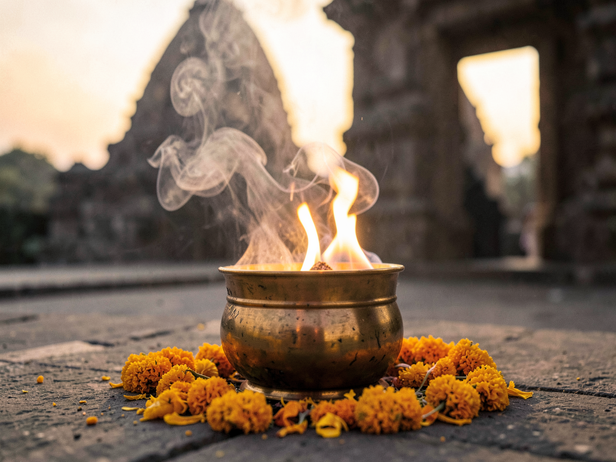
A brass havan kund, a focal point of the sacred fire, with marigold petals. Witness to the Agni witness Hindu wedding.
In the Rigveda, Agni is addressed as the carrier of oblations to the gods, the one who takes what is offered in the physical world and delivers it to the divine. This is not metaphor inside the tradition; it is understood as function. When the couple circles the fire in the Saptapadi, they are not performing a symbol. They are making a declaration in front of the one witness who cannot lie, cannot forget, and cannot be bribed. The Bhagavad Gita, in Chapter 15, verse 14, names Agni as the force that enters the body and sustains digestion, Vaishvanara, the fire that lives in all living things. The same fire that burns in the sacrificial kund is understood to be the same fire present in every body that stands before it. The witness and the witnessed share a substance.
What the Seven Steps Actually Bind
Each of the seven steps, the Saptapadi, carries a spoken vow corresponding to a specific domain of shared life: food, strength, prosperity, progeny, seasons, health, and friendship. The Ashvalayanagrihyasutra, one of the oldest texts governing domestic ritual, specifies that the marriage is complete only after the seventh step is taken. The vows are not exchanged across a table or before a magistrate. They are spoken into fire, which means they are spoken into the same medium that carries everything offered to the divine. A signature on paper is a legal instrument. A vow into Agni, in this understanding, is a cosmic one, witnessed by something that existed before the couple and will exist after them.
The Pancha Mahabhuta and Why Fire Alone Witnesses
![Ancient Manuscript and Lamp]()
Ancient Manuscript and Lamp
Image credit : AI
A sacred manuscript and Agni witness, symbolizing ancient wisdom and devotion. The warm light evokes reverence.
Hindu cosmology recognises five great elements, Pancha Mahabhuta, from which all matter is composed: earth, water, fire, air, and space. Each has a quality. Fire's specific quality is form and transformation. It is the only element that visibly changes what it touches. Water dissolves. Earth holds. Air moves. Space contains. Fire transforms. A marriage, in Hindu understanding, is precisely a transformation, two individuals become a single dharmic unit. The witness of a transformation must be the element of transformation itself. This is not poetic reasoning. It is structural. The selection of Agni as witness follows from what Agni is, not from what it represents.
The Kanyadan, the Mangalsutra, and What Comes Before the Fire
The rituals that precede the Saptapadi, the Kanyadan, in which the bride's father places her hand in the groom's; the tying of the Mangalsutra; the application of sindoor, are significant, but none of them complete the marriage. They are preparatory. The Kanyadan is a transfer of responsibility, acknowledged by both families. The Mangalsutra and sindoor are markers that will be worn and seen in the world outside the ceremony. The fire alone completes what those gestures begin. This sequencing is not accidental. The visible social markers come before the cosmic sealing. The community sees the intention. The fire seals it.
Why Paper Cannot Do What Fire Does
A marriage registration under the Hindu Marriage Act of 1955 is a legal record. It establishes rights, governs inheritance, and creates a document the state can recognise. The tradition does not dispute its usefulness. What it does not accept is that the document is the marriage. The registration records something that already happened. The fire was present when it happened. In the traditional understanding, a marriage registered but never solemnised by Saptapadi is a legal arrangement. A Saptapadi completed without registration is a marriage. The two systems are not rivals, they address different questions. The state asks who is legally bound. The rite asks what has been transformed and before whom.The fire that burns in a wedding kund carries oblations upward, as it always has. What the couple walks around is not a symbol of permanence. It is the oldest available witness to the claim that something real has changed between two people, and that the change was made in the presence of something that does not forget.