The Pandavas set out on their final journey already stripped of everything. Draupadi fell first on the mountain path, then Sahadeva, Nakula, Arjuna, Bhima, each one dropping in the snow, each death explained by some flaw Yudhishthira named aloud and kept walking past. By the time he reached the gate of Svarga, only one companion remained: a dog, nameless in most tellings, who had joined the procession somewhere on the road and simply never left.
What Indra Actually Offered
![Temple Corridor's Amber Glow]()
Temple Corridor's Amber Glow
Image credit : AI
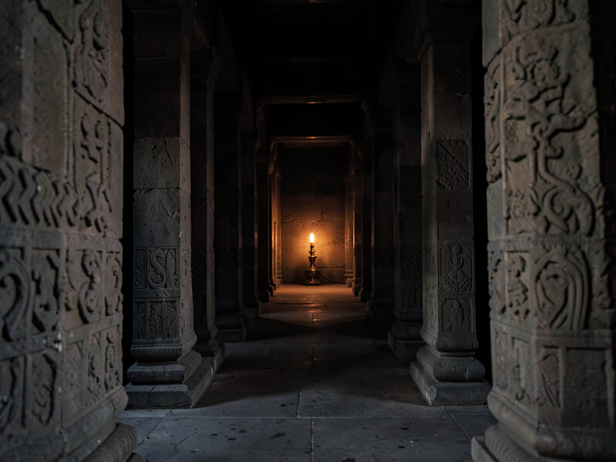
The warm amber light of a single lamp illuminates a temple corridor, hinting at the spiritual lessons of dharma and loyalty.
Indra arrived in a celestial chariot, radiant, entirely pleased with Yudhishthira. The invitation was direct: ascend. You have earned this. The chariot is here. Yudhishthira asked whether the dog could come. Indra said no. He offered reasons, the dog was impure, unfit for heaven, the presence of a dog would defile the realm. Each reason was theologically tidy. Each reason was also a test of whether Yudhishthira would accept a tidy reason for abandoning someone who had trusted him with nothing to offer in return.
The Refusal That Defines the Epic
Yudhishthira's answer in the Mahaprasthanika Parva is not a speech. It is a single, plain refusal. He will not abandon the dog. He lists what he has already lost, his brothers, Draupadi, everything he built, and says that abandoning a devoted creature who has sought his protection would be a sin he cannot undo with any heaven. The word he uses is adharma. Not inconvenience. Not sentiment. Adharma: a violation of the order that holds the world together. The dog, the Mahabharata then reveals, is Dharma himself, Yudhishthira's own divine father, testing his son in the form of the one being he had no reason to protect.
The Shape of the Test
![Dawn Lotus Serenity]()
Dawn Lotus Serenity
Image credit : AI
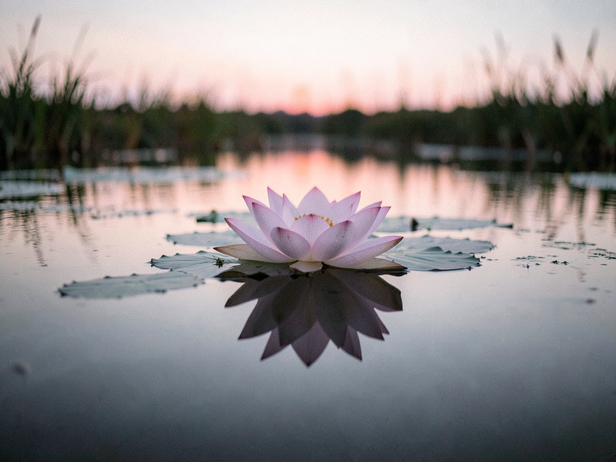
A serene dawn unfolds with a lotus on still water, its reflection a mirror of purity. Exploring dharma and loyalty in Hindu philosophy.
The test is not about dogs. It is about the category of loyalty that survives the removal of all incentive. Every other relationship Yudhishthira carried on that mountain path had a history, a name, a claim on him. The dog had none of these. It had only followed. The gate of heaven is precisely the moment when everything that was ever promised becomes available, and the question the Mahabharata asks is whether you will arrive there as the same person who set out. Yudhishthira's brothers fell because of pride, partiality, attachment to beauty, anger. He nearly fell at the gate because of the oldest temptation: the idea that what you are being offered is large enough to justify what you are being asked to leave behind.
What the Story Is Actually Asking You
The dog at the gate appears in smaller forms constantly. It is the relationship you deprioritise when the promotion arrives. The friendship you quietly let lapse when the new circle opens up. The commitment you made when you had nothing, which you now find inconvenient because you have something. The Mahabharata is not sentimental about this. It does not say these choices are easy or that loyalty is always the correct answer to every situation. It says that the moment of ascent, the moment when the gate is open and the chariot is waiting, is exactly when the choice reveals what the entire journey was made of. Yudhishthira had spent his life being called the son of Dharma. At the gate, he proved it was not a title. It was a description.