The langar at Ajmer Sharif has been burning since the thirteenth century. It does not pause for the census. Hindus, Muslims, Sikhs, the landless, the titled, the grieving, and the merely hungry have all eaten from the same deg, and the Chishti order has never considered this a concession.
What Sulh-e-Kul Actually Means
![Golden Light on Threshold]()
Golden Light on Threshold
Image credit : AI
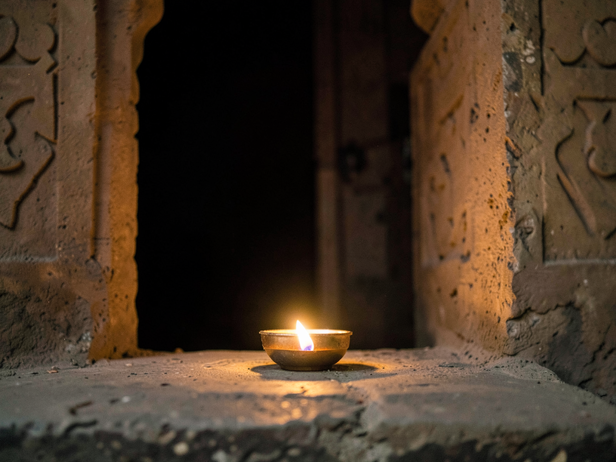
A solitary diya's warm glow on an ancient threshold, evoking Sufi hospitality and the spirit of sulh-e-kul.
The phrase is Arabic-Persian: sulh, a treaty or peace; kul, all or the whole. Together they name a position, not a sentiment. Moinuddin Chishti, who arrived in Ajmer in the late twelfth century, did not coin the term, but his order gave it an architecture. Sulh-e-kul was later formalised in Mughal political thought under Akbar, whose court philosopher Abu'l-Fazl used it to describe a sovereignty that did not require religious uniformity from its subjects. The Chishtis had been practising the thing before anyone named it in a firmān.The principle holds that the divine does not apportion itself by community. If the Sufi premise is that the human heart is the seat of the divine, then the kitchen door that screens hearts by creed has already made a theological claim the Chishtis reject.
The Deg and Its Deliberate Scale
The great cauldrons at Ajmer, the degs, are not symbolic. The larger of the two, donated by the Mughal emperor Akbar after a pilgrimage on foot from Agra, holds a quantity of rice that requires teams of men to stir. This is not incidental. Chishti hospices, called khanqahs, were deliberately sited where the poor gathered, and the langar, the communal kitchen, was funded through nazrana, offerings brought by visitors of all stations.Khwaja Moinuddin's own reported instruction to his disciples was that the highest form of worship was to feed the hungry, clothe the naked, and relieve the distressed, and that this held regardless of who was hungry, who was naked, and who was distressed. The Fawaid ul-Fuad, a record of the sayings of Nizamuddin Auliya compiled by his disciple Amir Hasan Sijzi in the fourteenth century, returns to this theme repeatedly: the Chishti master in Delhi kept a kitchen that fed hundreds daily, and when asked how it would be sustained, he is recorded as saying he placed his trust in what arrived unsolicited each morning.
Nizamuddin Auliya and the Decision That Was Never Announced
![Aged Brass Cauldron Still Life]()
Aged Brass Cauldron Still Life
Image credit : AI
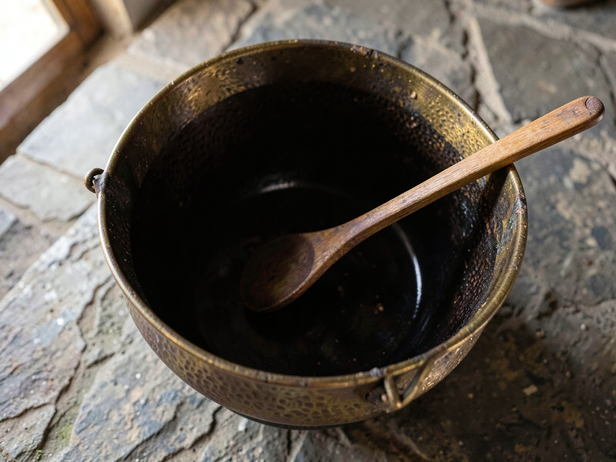
Aged brass cauldron, a symbol of Sufi hospitality and langar, rests on a stone floor, bathed in warm light.
Nizamuddin Auliya did not issue a fatwa about who could eat at his khanqah in Ghiyaspur, on the banks of the Yamuna. He made no declaration. The kitchen was simply open, and the record left by Amir Khusrau and Amir Hasan Sijzi shows that it fed Hindus, Muslims, and people of no declared faith without ceremony or condition.This is the Chishti method: the doctrine lives in the practice, not in the announcement of the practice. The absence of a formal ruling is itself the ruling. A door that requires paperwork is not open.Nizamuddin's relationship with Amir Khusrau, a Hindu-born poet who became his closest disciple, is often cited as personal evidence of sulh-e-kul. But the kitchen is the institutional evidence. One friendship can be called exceptional. A langar that has fed across community lines for eight centuries is policy.
What the Chishti Order Decided About Caste
The langar at a Chishti dargah does not seat by caste. This was not a minor position in medieval India. The Chishtis arrived into a subcontinent where the question of who could eat with whom, from whose hand, and in whose presence was one of the most charged social questions available. To feed without regard to jati was to make a claim about the human person that most of the surrounding social order denied.Some scholars have noted that the Chishti saints drew heavily on the Bhakti movement's similar insistence on the irrelevance of caste before the divine. The traffic was not one-directional: Kabir, who refused to be claimed by either tradition, said things about the kitchen and the divine that could have come from Nizamuddin's recorded conversations, and vice versa. The shared position was not coincidence. It was a recognition that the same theological logic, the divine does not discriminate, therefore those who claim to serve the divine cannot discriminate, arrives at the same kitchen door from more than one direction.
The Dargah Kitchen as a Living Argument
The deg at Ajmer still burns. The langar at Nizamuddin Dargah in Delhi still feeds. These are not museums of a medieval idea. They are the idea, still running.What the Chishti masters decided, and it was a decision, even when it was made without announcement, is that hospitality is not charity extended conditionally to the deserving. It is the baseline expression of a theology that takes seriously the claim that the divine is present in every person who walks through the door. The kitchen is not separate from the shrine. It is the argument the shrine is making, served in a bowl.