The fire has gone cold. The guests have eaten. Somewhere between the saptapadi and the sindoor, the night has become morning's edge, and the bride is led outside and shown a star. Not the brightest one. Not the closest. The one that does not move.
Dhruva Darshan, the witnessing of Dhruva, the Pole Star, is performed as one of the concluding rites of the Hindu Vivah Sanskar. The groom points toward Polaris, or the priest does, and the bride looks. A few words are spoken. Then it is over, absorbed into the larger ceremony, often without explanation. Most brides remember it as a moment of cold air and an upward gaze. Few are told what they are actually being asked to carry.
The Boy Who Refused to Move
In the Vishnu Purana and the Bhagavata Purana, Dhruva is a prince, five years old, turned away from his father's lap by a stepmother who tells him he has no right to sit there. His own mother, Suniti, cannot undo the insult. She tells him the only throne worth seeking is one no one can take away. The boy walks into the forest and meditates on Vishnu with a ferocity that embarrasses the devas. Narada tries to turn him back. Dhruva does not move. When Vishnu finally appears and asks what he wants, the boy, who came for a kingdom, finds he no longer wants it. He asks only to remain. Vishnu places him at the axis of the sky, the point around which all other stars rotate, and tells him he will hold that position until the dissolution of the world.
The story is not a parable about ambition rewarded. It is a parable about a child who wanted recognition, found something larger than recognition, and chose to stay anyway. That is the Dhruva the bride is being shown. Not the triumphant one. The one who stayed after the wanting changed.
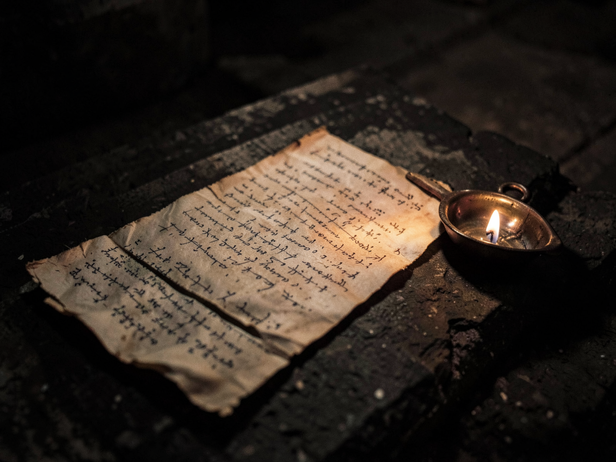
![Ancient Manuscript and Diya]()
Ancient Manuscript and Diya
Image credit : AI
I reveal the ancient wisdom of a palm-leaf manuscript, its pages softened by time, illuminated by a single diya, hinting at the Dhruva Darshan ritual.
What the Astronomy Actually Says
Polaris sits within approximately 0.7 degrees of the celestial north pole, the point in the sky around which Earth's axis points. Because of this alignment, every other star in the northern hemisphere appears to rotate around it across the night. It does not rise or set. It does not drift. For navigators across centuries, Arab, Indian, European, Chinese, it was the one fixed coordinate in a turning sky. Indian astronomers called it Dhruva Tara, the fixed star, and its constancy was not metaphor. It was navigation.
There is a subtlety the ritual does not mention. Polaris is not eternally fixed. Earth's axis wobbles slowly in a cycle of roughly 26,000 years, a motion called axial precession, and the star that sits at the pole shifts over millennia. Around 3000 BCE, the pole star was Thuban in the constellation Draco. In roughly 12,000 years, it will be Vega. Polaris holds the position now. The sky's constancy, it turns out, is also a long patience, not a permanent fact.
This does not diminish the ritual. It deepens it. The star is fixed within a human lifetime, within many lifetimes. That is the scale of constancy being invoked, not cosmic eternity, but the span of a life, which is the only span a marriage can actually ask of anyone.
What the Ritual Was Asking of Her
The Grihyasutras, ancient Sanskrit texts governing domestic rites, including those of Ashvalayana and Paraskara, describe Dhruva Darshan as part of the sequence of rituals that bind the couple after the saptapadi, the seven steps around the fire that formalise the marriage. The groom traditionally says something to the effect of: as Dhruva is fixed in the sky, so may you be fixed in this home, in this family, in your vows.
Read plainly, this sounds like an instruction to a woman to be immovable for her husband's convenience. That reading is not wrong about what the ritual has sometimes been used to mean. But it is incomplete about what the ritual contains.
Dhruva's constancy in the Puranic story is not passivity. He is not still because he has nowhere to go. He is still because he chose to remain after he no longer needed to. The distinction matters. The bride being shown that star is being shown a model of chosen steadiness, not enforced submission. The ritual carries both possibilities simultaneously, as most old rituals do. What a family makes of it depends on what they choose to see in the sky.
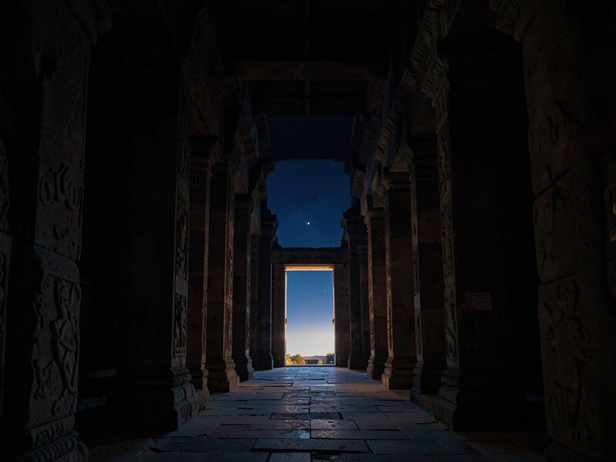
![Temple Corridor to the Star]()
Temple Corridor to the Star
Image credit : AI
I witness the Dhruva Darshan ritual, a sacred moment under the Pole Star, as dawn approaches.
The Star as a Witness
Hindu marriage rituals make frequent use of cosmic witnesses, Agni the fire, Vayu the wind, the sun, the directions. Dhruva functions differently from the others. The fire is present, active, receiving the oblations. The Pole Star is simply there, watching from a distance that makes human urgency look small.
There is something in this that the ritual understands about marriage that the ceremony's more celebratory moments do not. The fire of the wedding night will not stay lit. The garlands will dry. The guests will leave. What remains has to be built from something quieter than celebration, from the kind of steadiness that does not announce itself, that simply continues to be where it said it would be.
The bride looks up at Dhruva and the ritual asks her to recognise something she already knows: that to hold a position in someone's life across decades is not a small thing. It costs. Dhruva's story begins with a child who wanted to be held and was turned away. What he became was the one who holds everything else in place. The ritual does not pretend this is easy. It shows her a star and lets her draw her own conclusions about what it took to stay there.