Madhvacharya did not refine Advaita. He rejected it. In the thirteenth century, from the temple town of Udupi, he built a philosophical system whose central claim was simple and, to many, scandalous: difference is real, irreducible, and not a symptom of ignorance.
The Five Differences Madhva Would Not Collapse
Dvaita Vedanta rests on what Madhva called the pañca-bheda, five real distinctions. God is distinct from the individual soul. The individual soul is distinct from matter. Souls are distinct from one another. Each soul is distinct from the material world. And each object in the material world is distinct from every other. These are not appearances generated by maya, not provisional truths that dissolve on enlightenment. They are ontological facts. Vishnu, whom Madhva identified as the supreme reality, is not a being you can merge with. He is a being you can only ever approach.
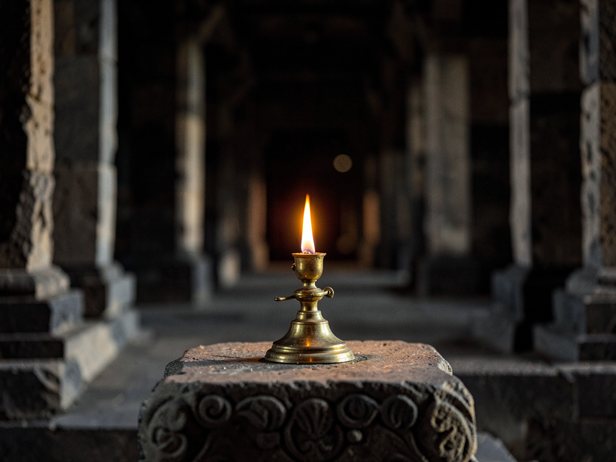
![Temple Lamp's Golden Glow]()
Temple Lamp's Golden Glow
Image credit : AI
The steady flame illuminates the ancient stone, a beacon of light in the temple's quiet darkness. Exploring Dvaita philosophy.
The Argument Against Shankara
Adi Shankaracharya had read the Upanishads and arrived at Advaita: Brahman alone is real, the world of multiplicity is maya, and the apparent self is identical to the absolute. The mahavakya from the Chandogya Upanishad, Tat tvam asi, Chapter 6, seemed to settle it. You are that. Madhva read the same texts and refused the same conclusion. His method was to argue that Shankara's reading required grammatical and logical contortions the texts did not support. Where Advaita read identity, Madhva read relation. The soul is not Brahman. The soul belongs to Brahman, is sustained by Brahman, is dependent on Brahman in a way that requires two real entities, not one entity mistaking itself for two. A relationship between nothing and nothing is not devotion. It is category error.
What Taratamya Means for the Soul
Madhva's system introduces taratamya, a hierarchy of souls, graded by their inherent capacity for liberation. Not all souls are equal. Some are suited for mukti, eternal proximity to Vishnu in Vaikuntha. Others are destined for eternal damnation, a position so stark it has no real parallel in mainstream Vedantic thought. The soul that reaches liberation does not become Vishnu. It reflects Vishnu, the way a mirror reflects light without becoming light. Anandatirtha, Madhva's own name in the tradition, described liberated souls as experiencing bliss that is real but always derivative, always pointing back to a source they are not. The gap does not close. The gap becomes the site of eternal joy.
![Dawn Lotus Temple Serenity]()
Dawn Lotus Temple Serenity
Image credit : AI
I observe the serene dawn, a lotus on still water, reflecting the temple's silhouette. This scene embodies the pañca-bheda teaching.
The Bhakti Consequence
If difference is real, then devotion has genuine stakes. In Advaita, bhakti is a provisional practice, useful until the meditator realises the lover and the beloved were always one. In Dvaita, bhakti is the permanent structure of the relationship. You cannot outgrow it because there is nowhere to arrive that dissolves the distinction. The Madhva tradition centred on Udupi Sri Krishna Matha, which Madhva himself established, and its practice of paryaya, the rotating stewardship of temple worship, embeds this theology into ritual. The priest serves a god who remains other. The service is not a stage. It is the point. Madhva's reading of the Bhagavata Purana pushed this further: Vishnu's grace is not earned by philosophical realisation. It is given, and the soul's capacity to receive it is itself a given, which is why taratamya unsettles liberal readings of karma. Difference runs all the way down.
Why the Argument Still Cuts
The Dvaita critique of Advaita is not merely historical. It presses on a question that any non-dualist system eventually faces: if the self is already Brahman, what is the self that needs to discover this? Who is deluded, and by whom? Madhva's answer was that the question is malformed. There is no hidden identity waiting to be uncovered. There is a real soul, genuinely finite, genuinely dependent, genuinely capable of devotion, and a real God who is genuinely other. The dissolution that Advaita promises is, in Madhva's reading, a philosophical comfort that erases the very subject who might be comforted. Dvaita keeps the subject intact precisely because it refuses to resolve the tension. The distance between Jiva and Ishvara is not the wound. It is the relationship.