The Nyaya school did not begin with faith. It began with a problem: how does a human being know anything at all? Before it would let you assert a single claim about the world, it demanded you account for the machinery of your knowing, the pramanas, the valid sources of knowledge. There were four: perception, inference, comparison, and testimony. Miss any one and your argument was not wrong. It was not yet an argument.
The Five Steps That Had to Hold
The Nyaya anumana, the inference framework, moved through five members, the pancavayava, with a precision that left no gap for rhetorical sleight of hand. You began with the pratijna, the proposition: the hill is on fire. Then the hetu, the reason: because there is smoke. Then the udaharana, the universal example grounded in a real case: wherever there is smoke there is fire, as in a kitchen hearth. Then the upanaya, the application of that universal back to the specific case: this hill has smoke of that kind. Then the nigamana, the conclusion: therefore the hill is on fire.
Each step was not decoration. The udaharana was not an illustration. It was the load-bearing member, the moment the argument reached outside itself to touch something the listener could verify. Without it, the inference was a closed loop, talking only to itself. The Nyaya logicians called an argument that skipped or faked this step a hetvabhasa, a fallacy that resembled a reason without being one. They named five species of it. They were not being pedantic. They were protecting the difference between appearing to argue and actually arguing.
![Dawn at Jantar Mantar]()
Dawn at Jantar Mantar
Image credit : AI
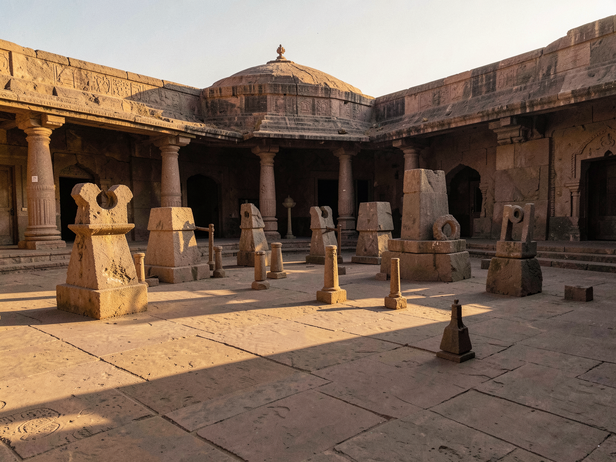
Ancient astronomical instruments at dawn, casting geometric shadows. Exploring Nyaya philosophy proof through observation.
Vatsyayana and the Weight of the Seen World
Vatsyayana's Nyayabhasya, the oldest surviving commentary on Gautama's Nyaya Sutras, makes a point that still stings. He insists that pratyaksha, direct perception, is the foundation on which every other pramana rests. Inference is valid only because it has been built on observed regularities. Testimony is valid only because the speaker's words ultimately trace back to someone's perception. The chain of knowing had to touch the world at least once or it was not knowledge. It was recitation.
This mattered enormously because the Nyaya school was not hostile to the Vedas or to theological argument. It was, in fact, one of the six orthodox astika darshanas. But it insisted that even scriptural testimony, shabda, earned its validity through the same structure. The speaker had to be trustworthy, the words unambiguous, the claim about something knowable. Revelation was not exempt from the demand for coherence. That was not scepticism. That was intellectual honesty dressed in philosophical Sanskrit.
What Dignaga Sharpened and Why It Was Resisted
The Buddhist logician Dignaga, working in the fifth century, pushed back on the Nyaya framework from the outside and in doing so clarified what made it strong. He reduced the valid pramanas to two, perception and inference, and argued that testimony and comparison were simply species of inference. The Naiyayikas disagreed, but the disagreement was conducted at the level of the framework itself, not around it. Both sides accepted that you had to show your work.
Dharmakirti, who followed Dignaga, sharpened the criterion for a valid hetu into three conditions, the trairupya, that the reason must satisfy: it must be present in the subject, present in similar cases, and absent in dissimilar cases. This is not far from what a contemporary scientist would call a necessary and sufficient condition. The conversation between the Nyaya and Buddhist logical traditions across roughly a thousand years was one of the most sustained exercises in epistemological rigour the ancient world produced. It was not mysticism. It was argument that took itself seriously enough to have rules about what counted as losing.
![Temple's Luminous Heart]()
Temple's Luminous Heart
Image credit : AI
My light reveals the Nyaya philosophy proof, a lotus blooming in the temple's quiet depth.
Where the Demand for Proof Went Quiet
The Navya-Nyaya school, which flourished in Bengal and Mithila from roughly the twelfth century onward, developed a technical metalanguage of extraordinary precision, a notation system for logical relations that some scholars compare to symbolic logic. Gangesa's Tattvacintamani, composed around the twelfth century in Mithila, is dense enough that generations of pandits spent careers on single chapters. The tradition did not collapse. It became a specialist's art.
What slipped away was not the tradition itself but its place in the common intellectual atmosphere. The demand for pramana, for accountable sources of knowing, stopped being the entry fee for serious conversation and became the property of a technical lineage. Argument in public life, in religious discourse, in the slow drift of what counts as wisdom, moved toward assertion backed by authority or feeling rather than assertion backed by a demonstrable chain from perception to conclusion. This is not unique to India. Every intellectual tradition has watched its rigorous core become the property of specialists while the surrounding culture argues by volume. But the Nyaya school made the loss visible, because it had named the thing being lost so precisely.
What Remains When You Take the Framework Seriously
The Nyaya pramanas are not a historical curiosity. They are a description of what happens when an argument is actually doing something. The udaharana step, the demand for a real case that grounds the universal, is what separates an analogy from evidence. The hetvabhasa taxonomy, the named fallacies, is what separates a debate from a performance of debate. Vatsyayana's insistence that every chain of knowing touch the world at least once is what separates conviction from knowledge.
The tradition did not ask you to abandon belief. It asked you to know the difference between what you had verified and what you had inherited, and to be honest about which was which in any given sentence. That is not a demand the modern world has made obsolete. It is a demand the modern world keeps finding reasons to defer.