Sometime in the fortnight before Navratri, the calendar turns a particular shade of restraint. Pitru Paksha, the sixteen-day lunar period in the Krishna Paksha of Bhadrapada, when the sun transits Kanya rashi, arrives not with celebration but with a deliberate slowing. Weddings are postponed. Griha pravesh ceremonies wait. New business ventures hold. The rule is widely observed across India, from Tamil Nadu's Mahalaya Amavasya to the Gaya shraddha rituals in Bihar, yet the reasoning behind it is rarely examined with the same seriousness as the rule itself.
What the Rule Actually Prohibits
The prohibition in Pitru Paksha is specific, not total. Shubha karyas, auspicious beginnings, are what the period suspends. This means weddings, namkaran ceremonies, griha pravesh, new business registrations, and the purchase of property or vehicles are conventionally deferred. Routine life continues: people work, travel, study, and cook. The pause is not an interruption of living. It is an interruption of beginning.
The distinction matters because it reveals the logic underneath. A beginning is an act of forward attention, you are staking a claim on the future, investing energy in what is not yet. Pitru Paksha asks that this particular kind of attention be turned backward instead, toward those who are no longer present to claim anything at all. The two orientations are understood to be incompatible within the same ritual window, not because one contaminates the other, but because genuine attention cannot be split between the unborn and the already gone.
![Ancient Ritualistic Offering]()
Ancient Ritualistic Offering
Image credit : AI
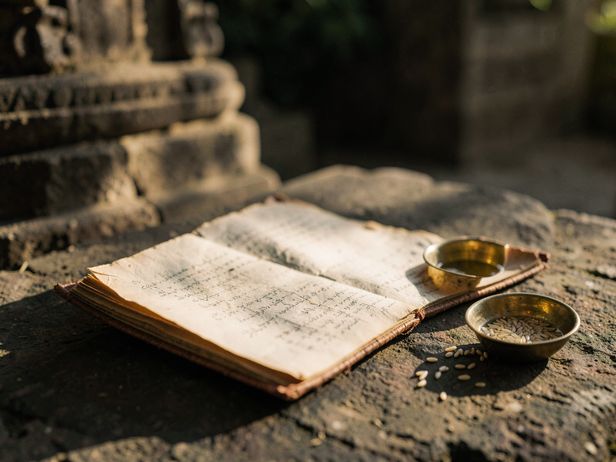
I observe an ancient manuscript, a brass bowl, and rice, hinting at the significance of shraddha rituals.
The Cosmology Behind the Fortnight
The Garuda Purana and the Mahabharata's Shanti Parva both carry versions of the belief that the pitrs, the ancestral souls, descend closer to the living realm during this fortnight, when the sun moves through Kanya. The Vishnu Purana places the pitrs in a realm called Pitrloka, neither the realm of the living nor the final liberation of moksha, but a middle state where they remain dependent on the tarpan, water offerings, and pinda, rice ball offerings, that their descendants perform. Shraddha, the ritual practice of this period, is not mourning in the Western sense. It is a form of sustenance, a debt being serviced.
The Sanskrit word shraddha shares its root with shraddha meaning faith, but the older usage means something closer to a careful, attentive act performed with full intention. The Bhagavad Gita's Chapter 17, verse 3, sattvanurupa sarvasya shraddha bhavati bharata, places shraddha as the quality of one's inner being expressing itself outward. To perform shraddha for the ancestors is to let that inner attention become an act. The ritual and the inner state are meant to be the same thing, not a ceremony performed while the mind is elsewhere planning the new venture that will begin on day seventeen.
Why Beginnings Specifically
The logic of the prohibition becomes clearer when you consider what a new beginning requires of the person undertaking it. Auspicious starts in the Hindu ritual calendar are not casual. A griha pravesh involves a muhurta selected by a jyotishi, a havan, a set of intentions spoken aloud about what this home will hold and who will flourish in it. A wedding involves the seven pheras, each a vow about the future. These are acts of concentrated forward-facing intention, performed with the expectation that the cosmos is listening and that the moment of beginning shapes what follows.
Pitru Paksha holds a competing claim on exactly that kind of concentrated attention. The shraddha rituals performed at Gaya, at Prayagraj, at Rameswaram, or at the banks of any river are also acts performed with the expectation that something unseen is listening. To perform both simultaneously is not a scheduling conflict. It is a dilution of sincerity. The traditional understanding is that the pitrs require undivided ritual attention, and a household that is simultaneously celebrating a wedding and performing tarpan is doing neither with the quality of intention that either deserves.
![Dawn's Quiet Offering]()
Dawn's Quiet Offering
Image credit : AI
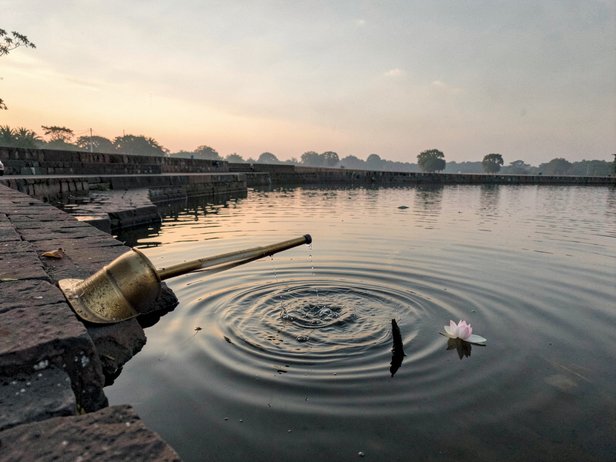
Observing the quiet rituals of Pitru Paksha significance in Hinduism, a moment of reflection.
The Pause as a Technology of Memory
There is something structurally unusual about a culture that builds a mandatory pause into the calendar, not a pause for rest, but a pause specifically oriented toward the dead. Most calendars mark time by what is coming: harvests, festivals, new years, the return of a season. Pitru Paksha runs against this grain. It asks the living to stop accumulating and to spend time instead on those who can no longer accumulate anything.
In practice, this means the fortnight functions as a forced reckoning with lineage. Families who might otherwise move through the year without thinking about their grandparents or great-grandparents are pulled into a ritual structure that requires them to name those people, to offer water in their direction, to consider what was passed down and what was not. The Mahalaya Amavasya that closes the fortnight, observed with particular intensity in Bengal, where it marks the descent of Devi before Durga Puja, is in this sense a threshold: the living have done what the dead require, and now the calendar is permitted to turn forward again.
What the Observance Asks of the Living
The rule against beginning anything is, at its core, a rule about the direction of attention. It does not ask the living to grieve. It does not require sorrow or performance of loss. What it requires is acknowledgment, the specific, ritually structured acknowledgment that the people who came before you are not simply gone but are still, in some sense, in relationship with you. The tarpan offered at the riverbank, the pinda placed at the shraddha ceremony, the sesame seeds and kusha grass that appear in the ritual's older forms: these are the grammar of that relationship, maintained even after death has made conversation impossible.
The new venture, the wedding, the house, they can wait sixteen days. What the prohibition is actually saying is that the living have a prior obligation, and that obligation has a name, a ritual form, and a specific window in which it is meant to be discharged. The pause is not an absence of action. It is the most deliberate action the calendar contains: the decision to face backward, fully, before turning forward again.