Open the Vishnu Purana and Brahma creates the world. Open the Shiva Purana and Shiva was there before Brahma existed. Open the Devi Bhagavata Purana and the goddess precedes them both, and the question of who created whom dissolves entirely. These are not three drafts of the same manuscript. They are three complete, internally consistent cosmologies, each composed with full awareness that the others existed.
The Tradition Had a Name for This
The Sanskrit term is anekanta, the many-endedness of truth, and while it is most formally developed in Jain philosophy, the Puranic tradition operated on a related intuition: that a single account of the ultimate could only be a partial account. The Bhagavata Purana states this with unusual directness in its opening verses. In 1.1.2, it announces itself as the ripened fruit of the wish-fulfilling tree of the Vedas, but the image is telling, a fruit is the end of a particular branch, not the whole tree. The text knows its own position.
The Puranas were composed across roughly a thousand years, between approximately the third and thirteenth centuries CE, in different regional centres, for different communities, and in service of different devotional lineages. A Shaiva monastery in Kashmir and a Vaishnava community in Tamil Nadu were not competing to establish a single canonical account. They were each articulating the experience of the absolute as their tradition had encountered it. The contradictions between the texts are, in large part, a map of that geography.
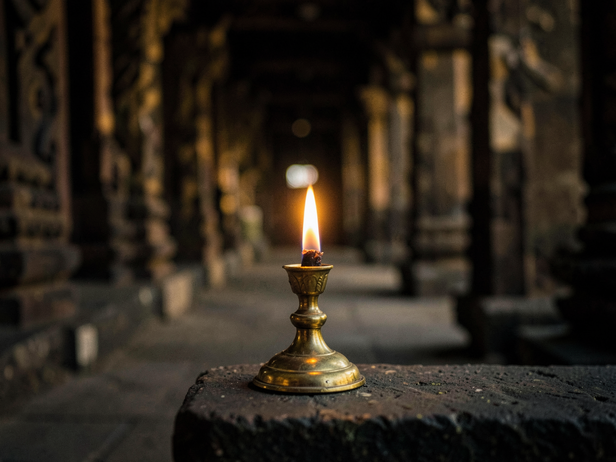
![Temple Lamp's Golden Glow]()
Temple Lamp's Golden Glow
Image credit : AI
I observe the steady flame of a brass oil lamp, a single glowing focal point amidst the ancient temple's mystery. This scene reminds me of the Puranic tradition and truth.
What the Compilers Actually Thought They Were Doing
The Puranas themselves explain their own method, and the explanation is not what a reader trained in documentary historiography would expect. The word Purana means old, or that which renews the old, and the tradition understood its task as preserving not events but meanings. The Vishnu Purana in 3.6 describes five defining characteristics of a Purana, panchalakshana, of which itihasa, history, is only one. The others concern cosmic cycles, genealogies, and the nature of creation. The frame is not journalistic. It is cosmological.
When the Shiva Purana tells a story in which Brahma lies about having found the top of Shiva's infinite linga and is cursed never to be properly worshipped, this is not a factual claim about a conversation that occurred. It is a theological argument, about the limits of Brahma's principle, about the danger of mistaking a partial view for a total one, about what happens when the creator-function claims sovereignty over what it cannot contain. The story is doing philosophy. Its truth is not the truth of a dateable event.
The Reader the Texts Were Written For
The Puranas circulated in oral recitation, in temple contexts, in katha traditions where a trained narrator would unpack a text over days or weeks for a gathered community. That community was not expected to resolve the cosmological contradictions. It was expected to inhabit them. A listener who had heard the Devi Mahatmya, which forms part of the Markandeya Purana, knew that the goddess was the ground of all power. A listener who had grown up with the Bhagavata Purana knew that Krishna's flute was the sound the universe made when it forgot it was separate from itself. These were not rival claims requiring adjudication. They were different doors into the same building, and the building was not a building.
The tradition's word for this is adhikara, eligibility or readiness. Different teachings were considered appropriate for different stages of understanding. A story that presents Vishnu as the supreme deity is not wrong for a devotee of Vishnu; it is the form of the truth that community can receive and act on. A more abstract formulation, the nirguna Brahman of the Upanishads, without qualities, without story, is not more true, but it requires a different kind of preparation to be useful. The Puranas were not written for the philosopher in the forest. They were written for the person at the threshold of the temple, which is to say for almost everyone.
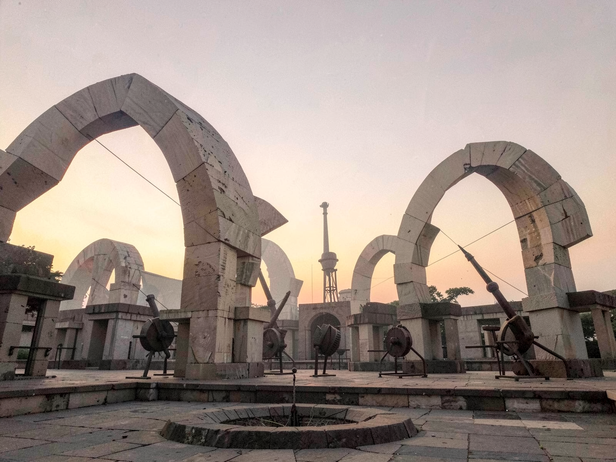
![Dawn at Jantar Mantar]()
Dawn at Jantar Mantar
Image credit : AI
I witness the dawn light illuminating the ancient Jantar Mantar, a testament to astronomical observation and the Puranic tradition.
Where the Modern Confusion Comes From
The question of why the Puranas contradict each other became urgent at a specific historical moment: the nineteenth century, when Sanskrit texts began to be edited, translated, and evaluated by scholars trained in European philology. That tradition had spent two centuries establishing the single original text behind variant manuscripts, the one true reading beneath the corruptions. Applied to the Puranas, this produced a long search for the Ur-text, the original version, the account that the later ones had distorted. The search was not entirely without value, it produced careful manuscript scholarship, but it rested on an assumption the Puranic tradition did not share: that multiplicity is a problem to be solved rather than a structure to be inhabited.
A Purana that exists in four recensions, each with different episodes in different order, is not a damaged Purana. It may be a Purana that was always meant to be a living text, reshaped by each community that received it. The Skanda Purana, the longest of the eighteen Mahapuranas, survives in versions so different that some scholars treat them as distinct texts. The tradition that produced them apparently saw no contradiction in calling all of them the Skanda Purana.
What This Asks of the Reader Now
The Bhagavata Purana's tenth book, the one that contains the full Krishna narrative, opens not with Krishna's birth but with a question. The sages at the forest of Naimisha ask Suta, the narrator, what is the one thing a person should hear if they have only a moment left. The answer is the story of the one who is beyond all stories. The frame is deliberate: the text begins by acknowledging that it is a story, that stories are limited, and that the limitation is not a flaw but the condition that makes the story receivable at all.
The Puranas contradict each other because the thing they are pointing at cannot be captured by any single account. Each tradition knew this. The contradictions were not lapses in editorial control. They were the tradition's way of keeping the centre from calcifying into a doctrine, of ensuring that no single story could be mistaken for the last word on what the stories were about.