The Bhagavata Purana does not describe the Raas Leela as a dance. It describes it as an impossibility that happened anyway. Each gopi believed Krishna stood only beside her. Each was right. This is the event Sharad Purnima holds, not a festival of romance, but a record of what happens when the infinite tries to meet the particular without diminishing either.
What the Sharad Purnima Night Actually Was
The full moon of the autumn season, called Sharad Purnima, falls in the month of Ashwin. Ancient Indian astronomy marked it as the night the moon is closest to full luminosity, and the Bhagavata Purana sets the Raas Leela precisely here, not incidentally, but because the moon in this tradition is the mind's mirror, the faculty that receives beauty without grasping it. The setting is Vrindavan, the banks of the Yamuna, and a night so bright that shadows fell in silver. The gopis heard Krishna's flute and left whatever they were doing. The Purana is specific: some left cooking fires, some left sleeping children, some left husbands. The pull was not social. It was prior to social.Krishna did not invite them. He tested them first, as the tenth canto of the Bhagavata Purana records, telling them to go back, to honour their duties, to love him from a distance as the wise love the unattainable. They refused, and the Purana treats their refusal not as transgression but as the correct answer. The gopis had already understood something the argument for distance had not accounted for: that the divine is not honoured by being kept at arm's length.
![Moonlit Diya Arc]()
Moonlit Diya Arc
Image credit : AI
Golden lamp glow meets cool moonlight, a scene evoking the spiritual significance of Sharad Purnima.
The Multiplication and What It Means
The philosophical weight of the Raas Leela sits entirely in one moment. As the dance began, each gopi felt Krishna beside her, his hand in hers, his attention entirely on her. The Bhagavata Purana, in its tenth canto, says Krishna expanded himself into as many forms as there were gopis. The Sanskrit term used across commentaries is vyuha, a structured emanation, though the Purana's own language is more immediate: he appeared between each pair, beside each one, so that none was dancing with a copy and none was dancing alone.
The Advaita reading, articulated most precisely by Adi Shankaracharya's commentators, treats this as the text's central teaching. A finite being chooses because choosing is what finitude requires, you can only be in one place, so you must decide which place matters more. The divine, being non-dual and without location in the ordinary sense, faces no such constraint. Krishna did not multiply himself as a trick or a miracle performed for effect. He multiplied himself because singularity is a limitation, and limitations do not apply to what the Upanishads call Brahman taking a personal form. The Raas Leela is the moment the Purana shows rather than argues this.
The Vaishnava reading, particularly as developed in the Gaudiya tradition by Chaitanya Mahaprabhu and later by Rupa Goswami in his Bhakti-rasamrita-sindhu, arrives at a different but not contradictory place. Here the multiplication is not a philosophical demonstration but an expression of Krishna's nature as the source of all rasa, all relational flavour. He is not proving omnipresence. He is being what love actually is when it is not rationed by scarcity. Human love contracts because the lover is finite. Divine love expands because the lover is not.
The Gopis as a Category, Not a Cast of Characters
The Bhagavata Purana does not name most of the gopis. This is not an oversight. The tradition's commentators, from Shridhara Swami in the medieval period onward, have read their anonymity as structural. They are not individuals in a story about individuals. They are the type of the soul that has turned entirely toward the divine and has no remainder of self-interest to protect. The Sanskrit word for their condition is vyakulata, a restlessness or agitation that has no worldly object, the soul that cannot settle because it has already recognised what it is missing.
Radha, who holds a singular place in the Gaudiya tradition though she appears by name in the Purana only obliquely, is understood as the foremost of this type, not because Krishna chose her above the others, but because her longing is the most complete. The Brahma Vaivarta Purana and later Gaudiya texts make her the hladini shakti, the bliss-power of the divine itself, which is why she is not a competitor to the other gopis but their source. The Raas Leela does not have a winner. That is the point.
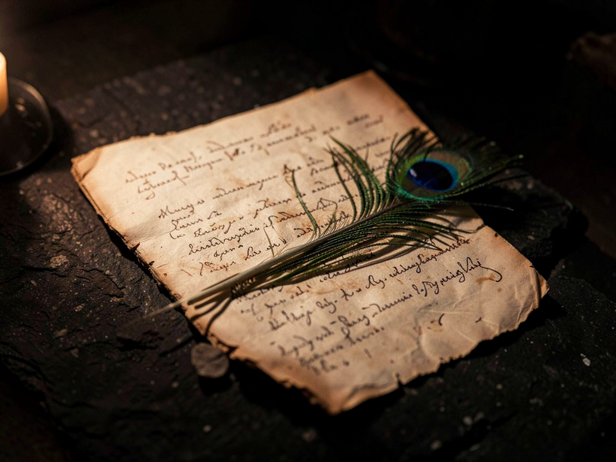
![Ancient Manuscript and Feather]()
Ancient Manuscript and Feather
Image credit : AI
A glimpse into ancient lore, a peacock feather graces an aged manuscript, hinting at stories of Krishna's divine love philosophy.
Sharad Purnima as the Right Night for This Story
The Bhagavata Purana's placement of the Raas Leela on Sharad Purnima is not decorative. The autumn full moon in Indian astronomical tradition is the night the moon's cooling light is at its most complete, associated with amrita, the nectar that sustains, and with clarity rather than heat. The Chandogya Upanishad (1.6.6 to 7) connects the moon to the mind's capacity for reflection, and several commentators on the Bhagavata read the Sharad moon as the prepared mind: bright enough to receive what is being shown, cool enough not to distort it.
The dance ends before dawn. The Purana records that Krishna disappeared at some point in the night, not as punishment, not as test, but because the form that had been present was never the whole of what was there. The gopis' grief at his absence is treated in the tenth canto with as much care as the dance itself, because the Purana is not interested only in union. It is interested in what the soul learns about the nature of the beloved when the beloved is no longer immediately present. The Raas Leela and its aftermath together make the argument: the divine is encountered most fully not in the moment of presence, but in what that presence reveals about the nature of longing itself.
The Raas Leela asks what it would mean for love to have no scarcity at its root, no competition, no hierarchy of preference, no one left outside the circle. The multiplication is Krishna's answer, given not in argument but in the specific grammar of a moonlit night on the Yamuna, where every dancer believed she was the only one, and every dancer was correct.