The priest arrives before sunrise. He has bathed, said certain syllables in a certain order, and now he stands before the sanctum holding a lamp. Every movement he makes, the angle of the flame, the number of circuits, the sequence of offerings, is prescribed. Not by the Rigveda. Not by the Upanishads. By a body of texts called the Agamas, which most worshippers walking past him have never once heard named.
What the Agamas Actually Are
The Agamas are a vast corpus of Sanskrit scripture concerned almost entirely with one question: how do you approach a deity correctly? They specify temple architecture, idol proportions, the materials for each ritual, the mantras that activate an image, the hours at which different forms of worship must occur, and the qualifications of the priest performing them. They are, in the most precise sense, manuals, but manuals written as revealed texts, understood within their traditions as knowledge that came down from Shiva, Vishnu, or the Goddess herself, depending on the lineage.
The three major streams are the Shaiva Agamas (sixty-four in number, governing Shiva temples), the Vaishnava Agamas, more commonly called the Pancharatra and Vaikhanasa Samhitas, and the Shakta Agamas, also known as the Tantras. Each stream has its own internal hierarchy of texts, its own ritual grammar, and its own understanding of what the deity is and how a human being may draw near to it. The Shaiva Siddhanta tradition of Tamil Nadu, for instance, follows the twenty-eight Shaiva Agamas with a precision that has been unbroken for well over a thousand years. The great temples of Chidambaram, Madurai, and Tiruvannamalai are Agamic temples in every physical and ritual detail.
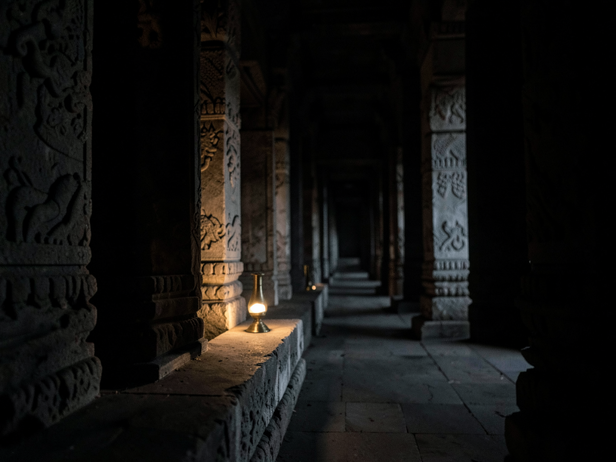
![Temple Corridor's Dim Light]()
Temple Corridor's Dim Light
Image credit : AI
Exploring the ancient Shaiva Agamas, I find myself in this dimly lit temple corridor, the lamp casting a sacred glow.
Why Vedic Ritual and Temple Worship Diverged
The Vedas were composed for a world without temples. Vedic ritual, the yajna, the fire sacrifice, happens in an open space, around an altar built fresh for each occasion, with no permanent image. The deity is invoked into the fire, receives the oblation, and the ritual ends. There is no idol, no sanctum, no daily schedule of waking, feeding, and putting a god to sleep.
Temple worship requires all of those things. When permanent stone temples began to appear across the subcontinent, a process well underway by the early centuries of the Common Era and accelerating sharply between the sixth and tenth centuries, a new liturgical framework was needed. The Agamas provided it. They answered questions the Vedas had no occasion to ask: How large should the deity's image be relative to the sanctum? Which stone or metal is appropriate for which form? How do you install life into an image, what is the ritual called pratishtha, and what does it accomplish? How many times a day must the deity be worshipped, and in what sequence?
The Agamas did not replace the Vedas. In most temple traditions, Vedic mantras are still chanted at certain moments. But the structural logic of the ritual, the why, when, and how of every action, comes from the Agamic texts. A Vedic priest and an Agamic priest are trained differently, hold different competencies, and are not interchangeable inside a consecrated temple.
The Concept That Makes Agamic Worship Distinctive
At the centre of Agamic theology is an idea that has no real equivalent in Vedic ritual: the idea that a properly consecrated image is not a symbol of the deity but a living presence. The ritual of pratishtha, consecration, is understood to transfer divine consciousness into the image. After that moment, the image must be treated as a living being. It is woken each morning, bathed, dressed, fed, shown a lamp, entertained with music, and put to sleep at night. The schedule of these services, called upacharas, is the skeleton of temple worship across India.
This is why a temple priest's role is closer to that of an attendant in a royal household than to a preacher or a theologian. The Agamas frame the deity as a sovereign and the ritual as a protocol of service. The worshipper who comes for darshan, the visual encounter with the deity, is not attending a ceremony. She is being granted an audience. The distinction matters because it explains why the image must face the devotee directly, why the lamp is shown in specific arcs, and why certain hours are considered more auspicious for darshan than others. All of it encodes the logic of royal reception, translated into the relationship between the human and the divine.
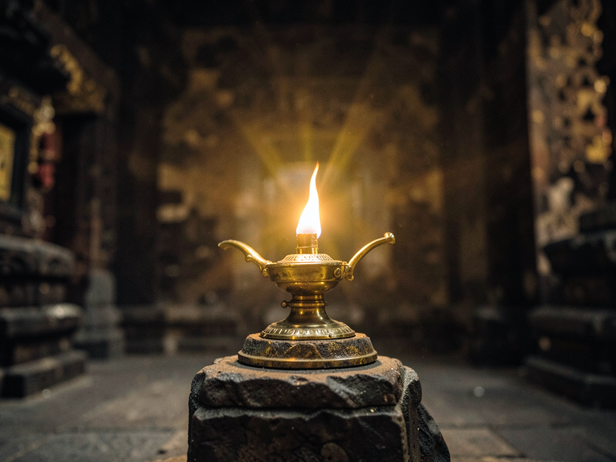
![Temple Lamp Illuminates Idol]()
Temple Lamp Illuminates Idol
Image credit : AI
I illuminate the stone idol base with a camphor flame, a ritual central to Shaiva Agamas and temple worship in India.
How the Agamas Reached Ordinary Worshippers
The Agamas were traditionally restricted texts. Knowledge of them passed from teacher to initiated student within specific lineages, and the priests trained in Agamic ritual, the Shaiva priests called Adishaivas in Tamil Nadu, for instance, held hereditary rights to perform worship in certain temples. This gatekeeping was not merely social; it reflected the Agamic understanding that incorrect ritual was not merely ineffective but potentially harmful, a disruption of a living relationship rather than a failed administrative act.
What most devotees encountered was the downstream effect: a ritual environment shaped entirely by Agamic prescription, without knowing the name of the texts behind it. The flowers placed at specific points on the image, the camphor flame shown at the close of worship, the pradakshina, the clockwise circumambulation, performed a fixed number of times, the silence required in certain inner corridors: each of these has an Agamic source and an Agamic rationale.
In recent decades, several Agamic texts have been edited and published, and scholars both within and outside India have begun systematic study of them. The French Institute of Pondicherry has done significant work on the Shaiva Agamas of the Tamil tradition. Within India, the Agama Shastra departments of traditional Sanskrit institutions continue to train priests in the living ritual application of these texts, not as historical study but as active practice.
What This Changes About How You See a Temple
Most visitors to a major South Indian temple experience it as spectacle: the scale, the gopuram, the crowd, the smell of camphor and jasmine. The Agamas ask you to read it differently, as a diagram. The layout of a temple built on Agamic principles is a map of the cosmos. The innermost sanctum, the garbhagriha, is the seed-point. The successive enclosures moving outward represent expanding levels of manifestation. The gopuram at the entrance, the tallest structure, marks the threshold between the ordinary world and the consecrated space. You walk inward and downward, toward something more concentrated.
The deity inside is not waiting to be visited. According to the Agamic frame, the deity is continuously present, continuously attended, and the worshipper who enters is the variable, arriving at a relationship that has been maintained without interruption, sometimes for centuries. The rituals at Chidambaram have been performed daily since at least the tenth century. The Agamas that govern them are older still.
The Vedas gave India its cosmology and its philosophy of sacrifice. The Agamas gave it its temples, the architecture, the images, the daily rhythm of worship that has continued across invasions, reformations, and centuries of change. Most of what a Hindu does when she enters a temple, she does because someone, long ago, wrote it down in a text she has never read.