The fire is lit, the priest chants, and two people walk around it seven times while guests photograph the moment. By the time the seventh step is complete, most couples could not tell you what they promised on the fourth. Saptapadi, from the Sanskrit sapta, seven, and padi, steps, is the legal and spiritual core of a Hindu marriage. Under the Hindu Marriage Act of 1955, the marriage is considered solemnised the moment the seventh step is taken. Everything else in the ceremony is context. These seven steps are the contract.
What the Vedic tradition actually says
![Ancient Manuscript and Lamp]()
Ancient Manuscript and Lamp
Image credit : AI
Aged palm-leaf manuscript, illuminated by a brass oil lamp, evokes ancient wisdom. The Saptapadi meaning is often found within such texts.
The Saptapadi finds its earliest textual grounding in the Rigveda and is elaborated in the Grihyasutras, ancient household ritual manuals that specified how domestic rites should be performed. The Ashvalayana Grihyasutra and the Paraskara Grihyasutra both describe the ritual in detail, naming the seven steps as pheras or parikramas taken together, with each step accompanied by a specific mantra spoken by the groom and, in many traditions, answered by the bride. The fire, Agni, is not a backdrop. Agni is the witness. In Vedic cosmology, what is spoken before Agni cannot be unsaid. The vows are not exchanged with each other alone; they are registered with the universe.
The seven steps, one by one
The precise wording of each vow varies by regional tradition, family lineage, and the school of Vedic recitation the priest follows. But the meaning of each step has remained consistent across centuries of practice. The first step is for food, the groom promises he will provide nourishment, and the couple together promises that the home they build will never turn anyone away hungry. It is a vow about sustenance in its most literal sense. The second step is for strength, physical and moral. The promise here is that they will stand together against whatever comes, and that neither will be diminished by the other. The third step is for prosperity. This is not only about wealth; it is about the management of what they have, the agreement that abundance and scarcity will be faced as one household. The fourth step is for happiness, and this is the step most often rushed past. The Sanskrit word used in most traditions is sukha, which carries a meaning closer to ease or wellbeing than to happiness as a feeling. The vow is for a life where both people can breathe. The fifth step is for children and the continuation of the family line, but in older readings it is also a vow for the welfare of all living beings, a widening of the circle of care beyond the two people walking. The sixth step is for health and long life. The seventh step, the one that makes the marriage legally complete, is for friendship. Sakhya. The word means companionship, a bond chosen rather than inherited. The last promise they make is not about duty or progeny or prosperity. It is about choosing each other as a friend.
Why the seventh step is the one that matters most
![Temple Corridor Dawn Light]()
Temple Corridor Dawn Light
Image credit : AI
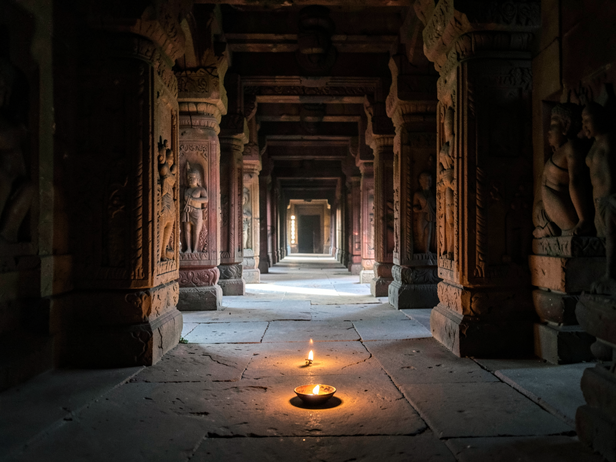
Ancient temple corridor at dawn, a single diya casting a warm glow, evoking the sacredness of the Saptapadi.
The Taittiriya Upanishad describes the highest human relationship not through the language of obligation but through the language of ananda, joy that arises from genuine connection. The placement of friendship as the final and legally binding step is not accidental. The six steps before it build a structure: food, strength, prosperity, happiness, progeny, health. The seventh step is what makes the structure worth living in. Many scholars of dharmashastra, the body of classical Hindu legal and ethical texts, have noted that the Saptapadi is unusual among ancient marriage rites in that it is explicitly bilateral. Both people are walking. Both people are speaking. The fire hears two voices, not one giving and one receiving.
How the ritual has changed, and what has stayed
In practice, regional variation is enormous. In South Indian traditions, particularly in Tamil and Telugu ceremonies, the steps are sometimes taken in a different order and the accompanying mantras differ significantly from North Indian Brahminical forms. In some Bengali traditions, the couple takes the steps holding a cloth between them rather than hand in hand. In Punjabi ceremonies, the pheras are sometimes four rather than seven, each circuit carrying a different weight. What has not changed is the fire and the forward direction. You do not walk backward in Saptapadi. The steps move only ahead. In Jain wedding ceremonies, which borrowed and adapted the ritual, the same principle holds. The direction of the steps is itself a statement about time and intention. The Saptapadi is not a commemoration of the past. It is a declaration about what comes next.
What it means to know what you promised
There is a difference between performing a ritual and inhabiting it. The Bhagavad Gita, in Chapter 3, Verse 9, draws a distinction between action performed as yajna, as offering, as something given outward, and action performed only for the self. Saptapadi sits squarely in the first category. The steps are not walked for the family watching, or for the photographs, or for the tradition as an abstraction. They are walked for the person beside you and for the witness in the fire. Knowing what each step promises does not make the ritual more solemn. It makes it more honest. The seventh step is already taken. The question is whether both people know what they said when they took it.