There is a moment in Vallabhacharya's Anubhashya, his commentary on the Brahmasutras, where he makes a claim so structurally different from most Indian philosophical schools that it takes a second reading to absorb. Liberation, he writes, is not attained. It is given. Not as a concession, not as a culmination of long practice, but as an act of what he calls pushti: the nourishing grace of Brahman that flows without condition and without cause.
The Problem Pushtimarg Was Built to Solve
Vallabhacharya, the fifteenth-century Vaishnava acharya born in 1479 in Champaranya, was working against the dominant logic of his time. Across traditions, Advaita, Vishishtadvaita, the various Mimamsa schools, salvation was something you moved toward. You accumulated punya, you performed ritual correctly, you subdued the senses, you studied. The path was a gradient and you climbed it.
His question was a simple and devastating one: what about the person who cannot climb? What about the one whose circumstances, whose karma, whose very psychological constitution makes sustained sadhana impossible? The Bhagavata Purana, which Vallabhacharya took as his primary text, offered him an answer in the figure of Krishna himself, not as a goal at the end of a path but as the one who chooses whom to draw near.
He formalised this into a threefold typology. Maryada marg is the path of discipline and scriptural observance, where the practitioner's effort carries weight. Pravaha marg is the way of the world, ordinary life following ordinary currents. And then there is Pushtimarg, the path of grace, where the initiative belongs entirely to Shrinathji, the form of Krishna enshrined at Nathdwara, and the devotee's role is not to earn but to receive.
![Ancient Wisdom Illuminated]()
Ancient Wisdom Illuminated
Image credit : AI
Exploring ancient texts, I ponder the path of Vallabhacharya grace teaching and divine grace.
What Pushti Actually Means in the Philosophy
The Sanskrit root of pushti is the verb push, to nourish. Vallabhacharya uses it with precision. Pushti is not a vague divine benevolence. It is the active, sustaining energy of Brahman directed toward a specific soul. In his Siddhantarahasya, he distinguishes between three kinds of jivas, souls, based on how much of this divine nourishment they carry: the pushti jiva who is already saturated with grace, the maryada jiva who works within the law, and the pravaha jiva who drifts.
The pushti jiva does not become that through practice. The grace precedes the devotee. This is the philosophical move that separates Pushtimarg from nearly every other school: causality runs the other way. You do not generate the conditions for grace. Grace generates the conditions for you.
Vallabhacharya grounds this in the Bhagavata Purana's tenth skandha, where Krishna does not wait for Radha or the gopis to achieve spiritual readiness. He calls. The call itself is the transformation. The Bhagavata's phrase, which Vallabhacharya returns to repeatedly, is that Krishna's grace is svatantra, self-willed, unconditioned by anything outside itself.
Seva as Response, Not Transaction
A common misreading of Pushtimarg stops at the word seva and concludes that the tradition is simply about devotional service as a means to an end. The eight-fold daily seva offered to Shrinathji, the mangala, shringar, gwal, rajbhog, uttapan, bhog, sandhya, and shayan darshans, looks from the outside like a system of meticulous ritual. Internally, the theology inverts the logic entirely.
Seva in Pushtimarg is not an offering you make to Krishna in exchange for his attention. It is a response to attention already given. Vallabhacharya's son Vitthalnathji, who systematised the aesthetic theology of the path through the Ashtachap poets, Surdas, Kumbhandas, Paramanandadas, Krishnadas, Chaturbhujdas, Govindswami, Nandadas, and his own father, made this explicit in the rasa theology he developed. The devotee serves because they have already been drawn in, not in order to be drawn in.
This matters because it changes what failure means. In a merit-based system, failing to perform correctly is a setback on the path. In Pushtimarg, the devotee who stumbles in seva is not losing ground they had gained. The grace that drew them is not conditional on the quality of their response. Vitthalnathji's commentary on the Subodhini describes this with unusual directness: the Lord's grace does not withdraw because the devotee is imperfect. The devotee is imperfect precisely because they are still being nourished toward wholeness.
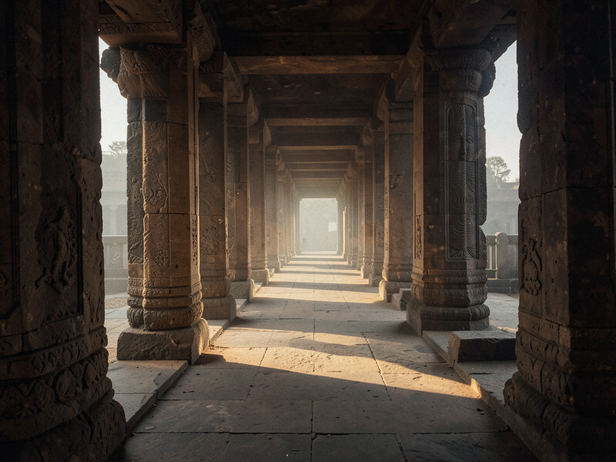
![Temple Corridor's Dawn Embrace]()
Temple Corridor's Dawn Embrace
Image credit : AI
I witness the serene beauty of the temple corridor, bathed in early dawn light, a testament to Shrinathji devotion and divine grace.
What the Tradition Says You Cannot Do
Pushtimarg is explicit about what does not work. Tapas, austerity, does not generate pushti. Scholarly mastery of scripture does not generate pushti. Pilgrimage, fasting, ritual correctness performed with the aim of accumulating merit: none of these are the mechanism. Vallabhacharya is not dismissing these practices as worthless in other contexts. He is saying they belong to a different logic, and importing that logic into Pushtimarg misunderstands what Pushtimarg is.
The Bhagavata verse he returns to most often in this context is from the eleventh skandha: the Lord is not attained through yoga, through Sankhya, through dharma, through study, or through austerity. He is attained only through bhakti, and in Vallabhacharya's reading, even that bhakti is itself a form of grace already operating, not a technique the devotee applies from outside.
This creates a peculiar kind of spiritual humility that is different from the humility of effort-based paths. On a path of discipline, humility is the recognition that you have more work to do. In Pushtimarg, humility is the recognition that the work was never yours to do. The devotee's position is not the climber who knows they have not yet reached the summit. It is closer to the one who has been carried and is only now beginning to understand that they were never walking.
Grace Without Cause and the Question It Leaves Open
The philosophical difficulty Pushtimarg does not try to dissolve is the one every unconditional grace theology eventually faces: if grace is given without cause, why is it not given to everyone equally? Vallabhacharya's answer, worked through in the Tattvartha Dipa Nibandha, is that the question itself imports the wrong frame. Grace is not distributed according to a principle of fairness that operates outside the Lord's will. It is an expression of his freedom, his svatantrata, and that freedom is precisely what makes it grace rather than a mechanism.
He is not saying some souls are abandoned. He is saying the logic of desert and distribution does not apply here. The gopis of Vrindavan were not more virtuous than other devotees. They were simply the ones Krishna chose to draw near in that lila, and the choosing was itself the teaching. What Pushtimarg asks of the devotee is not to solve this question but to stop trying to position themselves advantageously within it. The attempt to engineer the conditions for grace is the one thing that most clearly misunderstands what grace is.