The god does not disappear. He turns inward. Vishnu reclines on Shesha, the great serpent, on the waters of Kshira Sagara, and for four months, from Ashadha Shukla Ekadashi to Kartika Shukla Ekadashi, the sustainer of the world is understood to be in yoga nidra, that state which is neither sleep nor wakefulness but something the Mandukya Upanishad calls the witness of both. The world does not stop. It is asked to change its tempo.
The Logic Behind the Prohibitions
The rules of Chaturmas are specific and, to a modern sensibility, oddly particular. No weddings. No thread ceremonies. No new business ventures, no long journeys, no beginning of construction. Certain vegetables, brinjal, leafy greens, root vegetables, are traditionally avoided in the early weeks, a restriction that scholars of Ayurveda trace to the monsoon's effect on soil microbes and the heightened risk of contamination before the rains fully settle. The prohibitions are not arbitrary austerity. They follow a logic: the four months fall precisely when the subcontinent is most disrupted by water, when roads were historically impassable, when disease moved fastest, when the social infrastructure for celebration was hardest to sustain.
The Skanda Purana and the Padma Purana both give extended treatments of Chaturmas vrata, and what they emphasise is not the list of things to avoid but the quality of attention the period is meant to cultivate. Monks of the Jain tradition observe Paryushana within this window. Vaishnava communities observe Tulsi vivah at its close as a formal re-entry into auspicious time. The structure is not punishment, it is a container.
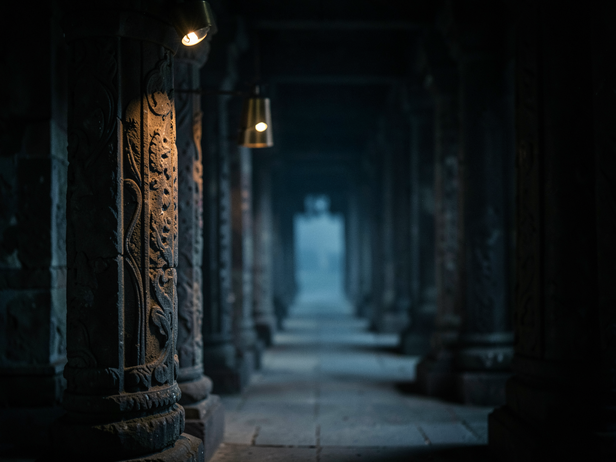
![Temple Corridor's Warm Glow]()
Temple Corridor's Warm Glow
Image credit : AI
I capture the serene atmosphere of a temple corridor, hinting at monsoon's presence and the spiritual significance of Chaturmas.
What Gets Postponed Is Not What Gets Cancelled
There is a difference between deferral and denial, and Chaturmas is built on that distinction. A wedding postponed to after Kartika Ekadashi is not a wedding abandoned. A journey not taken during the rains is not a journey refused. The period asks you to hold certain desires in suspension, to want something, to know you will have it, and to wait without the waiting becoming resentment.
This is harder than renunciation. Renunciation has a clean edge. Suspension does not. You are still in your life, still near the things you are not doing, still aware of what you are holding back. The Bhagavad Gita's second chapter, verse 47, gives the frame that the tradition reaches for here: you have a right to the action, not to the fruit. But Chaturmas takes that one step further, it asks you to pause even the action, and to discover what remains when the doing stops.
The God's Sleep and Your Own Wakefulness
Yoga nidra is not unconsciousness. It is, in the classical understanding, the state in which the witness persists after the senses have withdrawn. Vishnu in yoga nidra is not absent from the cosmos, he is present to it in a different mode. The tradition's invitation to the devotee during these four months mirrors that: not to become inert, but to shift the quality of attention from outward project to inward observation.
Chaturmas is when the ashrams of wandering monks historically became stationary. The monks stopped moving, stayed in one place, and taught. The householder's parallel is quieter but structurally similar: stay where you are, look at what is actually here, stop using movement and celebration and acquisition as a way of not looking. The period has always functioned as a forced confrontation with whatever you have been successfully avoiding by staying busy.
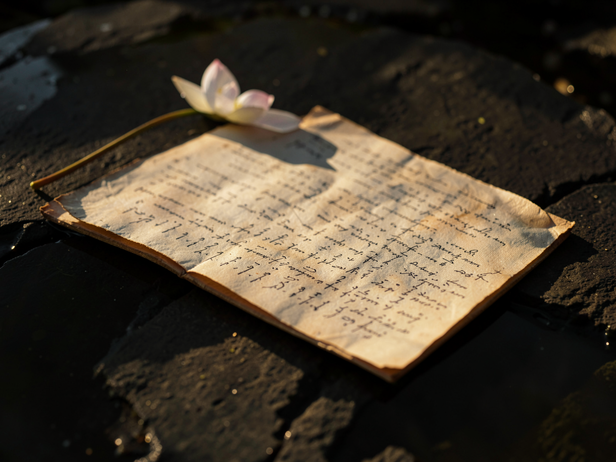
![Ancient Wisdom, Sacred Bloom]()
Ancient Wisdom, Sacred Bloom
Image credit : AI
Exploring the spiritual significance of Chaturmas with this ancient manuscript and serene lotus.
What the Close of Chaturmas Reveals
Kartika Shukla Ekadashi, Prabodhini Ekadashi, the day of awakening, is when Vishnu is understood to open his eyes. The conch is blown, the lamps are lit, and the Tulsi plant is married to the shaligrama in a ceremony that formally reopens auspicious time. What is striking about this moment is how ordinary it looks from the outside: a small plant, a stone, a flame, a chant. The scale is domestic, not cosmic.
That is the point. The god who sustains the universe wakes to a lamp in a courtyard. The four months of suspension resolve not into spectacle but into attention, the same attention the period was always training. What Chaturmas asks you to postpone are the events that announce your life to others. What it asks you to face is your life as it actually is, in the months when no one is watching and nothing is being celebrated. The god sleeps so that you might, for once, stay awake.