Bhishma did not die on the battlefield at Kurukshetra. He fell there, pierced by Arjuna's arrows, and lay on a bed of those arrows for fifty-eight days waiting. He had the boon of iccha mrityu, death at his own choosing, and he chose to wait for Uttarayana, the sun's northward turn, before he released himself. The last five days of Kartik, ending on Kartik Purnima, are called Bhishma Panchak. They mark the final stretch of that waiting.
The Bed of Arrows as a Spiritual Posture
What the Mahabharata gives us in Bhishma's waiting is not a story about endurance as strength. It is a story about endurance as clarity. He lay on the ground, in pain, with kings and sages gathering to hear him speak, and what he gave them was the Vishnu Sahasranama and the Shanti Parva, thousands of verses on dharma, on governance, on what holds a life together. He did not spend those fifty-eight days in grief about what had been lost. He used them to say everything he still had left to say.
The Bhagavad Gita, spoken earlier on that same battlefield, addresses the one who cannot act because he is overwhelmed. Bhishma Panchak addresses a different moment: the one who has already acted, already suffered, and is now learning what it means to wait without resistance. Krishna tells Arjuna in Gita 2.19 that the self is neither born nor slain. Bhishma, lying on his arrows, was living that verse rather than hearing it.
![River of Light]()
River of Light
Image credit : AI
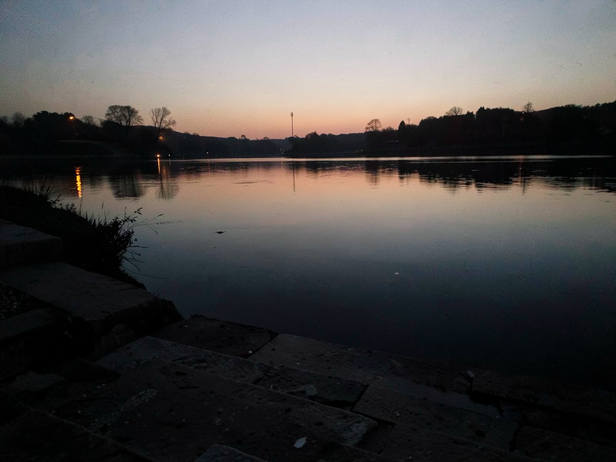
Golden diyas reflect on the still river, a symbol of letting go during Kartik Purnima.
What Kartik Carries That Other Months Do Not
Kartik is the month of Vishnu's waking. He rises from Yoga Nidra on Devuthani Ekadashi, four days before Bhishma Panchak begins. The month is associated with deep observance, Kartik snan, the pre-dawn bath in the Ganga or any river, the lighting of deep-daan lamps at the water's edge, fasting, and the reading of Vishnu's names. Temples across Varanasi, Mathura, Vrindavan, and Dwarka hold their most sustained observances of the year in this month. The air of the month is already one of completion before the Panchak arrives.
Bhishma Panchak sits inside that completion like a held breath. The five days are Ekadashi to Purnima: from the eleventh tithi to the full moon. Devotees who observe them fast, recite the Vishnu Sahasranama, offer tulsi, and light lamps. The fast is sometimes called the Vishnu Panchak fast. But the tradition does not separate the ritual from the figure it honours. You are fasting in the company of a man who waited with full consciousness for the right moment to go.
The Specific Grief of Holding On
There is a kind of waiting the mind does that looks like loyalty but is really fear. You hold onto a version of something, a relationship, a role, a grief, a hope, past the point where it can still grow, because letting go feels like betrayal. Bhishma's waiting was not that. He was not holding on to his life because he feared death. He was holding on because he had not yet finished what he came to do. That is the distinction the Panchak asks you to sit with.
The Mahabharata is careful about this. Bhishma on his arrow-bed is not described as suffering in the way we imagine suffering. He is described as radiant, as clear, as a man whose mind had already completed its arc. The body was still there. The waiting was still real. But the attachment to outcome had already been released. What remained was the work: the speaking, the teaching, the transmission of everything he knew to the people gathered around him.
If you are in a period of waiting, for a decision to become clear, for a loss to settle into something you can carry, for a chapter to close, the Panchak is not asking you to perform peace. It is asking whether your waiting is still in service of something, or whether it has become its own kind of clinging.
![Temple Lamp's Golden Glow]()
Temple Lamp's Golden Glow
Image credit : AI
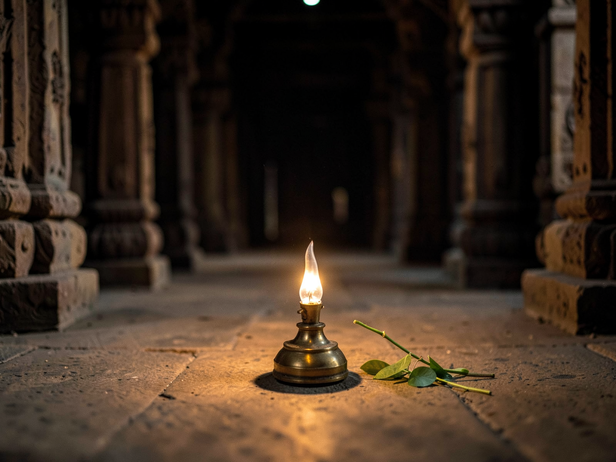
My warm light pools on the stone, a focal point beside the tulsi, reflecting the spiritual significance of Kartik Purnima.
Ritual as a Container for What Cannot Yet Be Said
The observances of Bhishma Panchak are simple in form: the fast, the recitation, the lamp, the tulsi offered at the water. Their simplicity is deliberate. When the interior work is large and shapeless, the exterior practice needs to be small and repeatable. You light the lamp. You say the names. The ritual does not resolve the waiting. It holds it.
The Vishnu Sahasranama, which Bhishma recited from his arrow-bed and which devotees recite during these five days, is not a prayer in the sense of asking for something. It is a naming, a thousand names for the one principle that underlies everything that changes. Reciting it during a period of personal transition does something specific: it shifts the scale. Whatever you are waiting to release becomes one thing among the thousand things that have already moved through the world and been held by that principle.
Kartik Purnima, the full moon that closes the Panchak, is also the night of Tripurari Purnima, the night Shiva destroyed the three cities of the asuras, the night the Ganga is said to descend in full force, the night Dev Diwali is celebrated along the ghats of Varanasi with hundreds of thousands of lamps set on the water. It is one of the most luminous nights in the Hindu calendar. Bhishma chose this month, this light, as the context in which to finally let go.
What the Five Days Are Actually Asking
Bhishma Panchak is not a festival of mourning. It is not a commemoration of a death. It is an observation of a particular quality of consciousness, the kind that can hold pain without being consumed by it, that can wait without becoming the waiting, that can speak truth even when the body is broken.
The tradition does not ask you to be Bhishma. It asks you to recognise the Bhishma Panchak quality in your own life: the places where you are lying on your arrows, still with something left to say or give or understand, not yet at the moment of release but moving toward it with your eyes open. The five days are a structured invitation to stop fighting the waiting and to ask what the waiting is still trying to teach you.
Kartik ends with a full moon and a river full of lamps. Whatever you are carrying, the month is not asking you to carry it forever. It is asking you to carry it consciously, until you know what it was for.