The Shiva Samhita opens with a premise that most yoga philosophy quietly avoids: the world is real, and you are in it. Where the Advaita tradition treats the householder's life as a provisional stage to be outgrown, and where the forest-renunciant traditions treat the city as noise to be escaped, the Shiva Samhita, a Sanskrit tantric text composed somewhere between the fourteenth and seventeenth centuries, addresses itself to the practitioner who is not going anywhere. The spouse is there. The children are there. The landlord will come on the first of the month. What does the text say to this person?
The Householder as the Harder Path
The Shiva Samhita does not console the householder by telling him his life is fine as it is. It does something more precise: it argues that the conditions he is trying to escape are themselves the practice. Chapter One establishes that liberation, moksha, is not a destination that requires a particular geography. It is a quality of attention that can be cultivated in any circumstance, and that the householder who sustains that attention while managing obligation is, in a real sense, doing something more difficult than the sannyasi who has removed the obstacles.
This is not a comfortable reading. It does not mean the householder gets credit for merely surviving his life. The text is clear that without disciplined practice, pranayama, dharana, sustained meditation, the householder's circumstances will simply consume him. The world's realness, which the text affirms, cuts both ways. It is real enough to be a field of practice. It is also real enough to be a field of distraction.
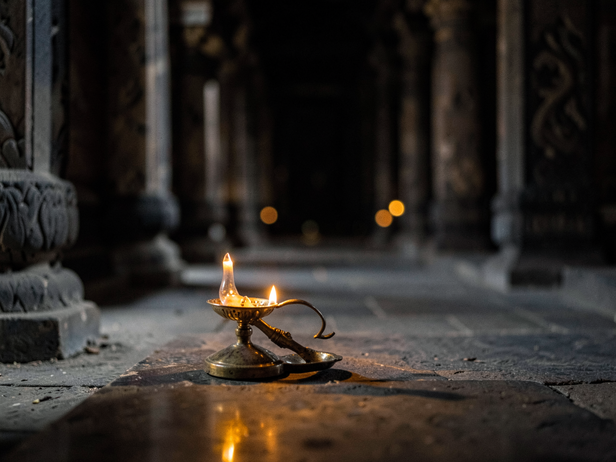
![Golden Flame in Temple Shadow]()
Golden Flame in Temple Shadow
Image credit : AI
My warm glow reflects on polished stone, a beacon in the temple's deep shadow. Practicing tantric yoga daily life is my path.
What the Text Actually Prescribes
Chapter Three of the Shiva Samhita gives detailed instruction on pranayama, the regulation of breath, as the central householder's practice, not because breathing is simple, but because it is portable. The breath does not require a forest. It does not require a particular hour, though the text recommends the sandhya periods, the transitional light of dawn and dusk, as especially conducive. It does not require the suspension of responsibility. A householder can sit before the household wakes and work with kumbhaka, the retention of breath, without leaving anything undone.
The text describes four grades of practitioner: the mridu, the madhya, the adhimatra, and the adhimatrama, the mild, the moderate, the intense, and the supremely intense. The householder is not assigned to the lowest grade by default. His grade is determined by the quality and consistency of his practice, not by his social station. This is the text's quiet radicalism: it refuses to rank the forest above the kitchen.
On the Role of the Guru
The Shiva Samhita is insistent on one thing that the householder cannot substitute with convenience: the living teacher. Chapter Two returns to this repeatedly. The text does not say that a book, including itself, is sufficient. It says that without a guru who has traversed the same ground, the practitioner is navigating without a map he can trust. For the householder, this creates a genuine tension. The forest renunciant can live near his teacher. The householder must find a way to maintain that relationship across the ordinary interruptions of a working life.
The text does not resolve this tension with a workaround. It holds it open. The implication is that the householder must value the relationship with the teacher enough to protect time for it, the way he protects time for the obligations that feel non-negotiable. The guru is treated as non-negotiable in the same register.
![Dawn's Still Life: Conch and Brass]()
Dawn's Still Life: Conch and Brass
Image credit : AI
I observe the conch and brass vessel bathed in dawn's light, a moment of quiet contemplation for householder yoga.
What Renunciation Means Here
The Shiva Samhita does not ask the householder to renounce his life. It asks him to renounce his identification with its outcomes. This is the vairagya, dispassion, that Chapter One describes not as emotional coldness but as a kind of metabolic change in how results are held. The householder does the work. He does not own the fruit. This is not a new idea in Indian philosophy; the Bhagavad Gita states it in Chapter Two, verse 47, karmanye vadhikaraste ma phaleshu kadachana, with a directness that has never been improved upon. The Shiva Samhita arrives at the same position through the body, through breath, through the architecture of the subtle body, rather than through argument.
What changes when a householder actually practices this is not that the mortgage disappears. It is that the mortgage stops being the thing his awareness lives inside. The obligations remain. The suffering that comes from treating every obligation as a referendum on his worth begins, slowly, to loosen.
The Forest the Text Is Actually Describing
There is a passage in the Shiva Samhita that describes the ideal place for practice: quiet, clean, free from disturbance, near water if possible. Commentators have read this as a description of an ashram or a forest hermitage. A different reading is available. The text is describing a quality of internal space that the practitioner constructs through practice, and that can be made to exist, briefly, imperfectly, with effort, inside a two-room flat in a city that does not sleep. The forest is not a place the householder needs to reach. It is a condition he learns to carry. The Shiva Samhita's wager is that this carrying, done honestly and without self-congratulation, is the practice itself, not a lesser version of it, not a compromise, but the thing the text was always pointing toward.