The Mahabharata gives Amba more lifetimes than almost any other character and still does not give her what she asked for. That is not an oversight. It is the architecture of her story.
What Bhishma Actually Did
![Ancient Temple Corridor's Glow]()
Ancient Temple Corridor's Glow
Image credit : AI
A solitary brass lamp illuminates a stone temple corridor, casting a warm glow on carved pillars. Echoes of Amba's story linger in the shadows.
Bhishma did not kidnap Amba out of desire. He did it as a transaction, a bride-price paid in violence on behalf of his half-brother Vichitravirya, who needed a queen. Amba, eldest of the three daughters of the king of Kashi, was already promised to Shalva. She told Bhishma this. He returned her. Shalva, humiliated that his betrothed had been taken at all, refused to take her back. She returned to Bhishma. He refused her too, bound as he was by his vow of celibacy. She went to the elders. She went to the warriors. She went to Parashurama, Bhishma's own teacher, who fought his former student to a standstill and still could not compel him. Every door she knocked on opened into another man's limitation.
The Logic of Her Rage
What the text records with unusual precision is not Amba's grief but her argument. She does not weep her way through the Udyoga Parva, she makes a case. Bhishma took her. Bhishma ruined her. Bhishma must therefore either marry her or die. The argument is legally sound within the epic's own moral framework. The problem is that the framework has no mechanism to enforce it against Bhishma, who is both too powerful and too bound by a vow everyone treats as sacred. Her justice is structurally impossible. The epic knows this. It does not pretend otherwise.
What Tapas Does in a Story Like This
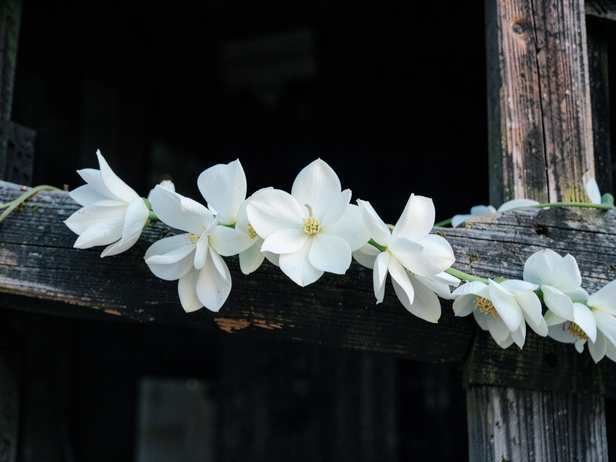
![Lotus Garland on Ancient Gate]()
Lotus Garland on Ancient Gate
Image credit : AI
A delicate garland of white lotus flowers rests on an ancient gate, a symbol of purity against weathered wood. Amba's story resonates.
When human courts fail her, Amba turns to austerity. She performs tapas of such intensity that she earns a boon from Kartikeya: she will be the instrument of Bhishma's death. She carries a garland of ever-fresh lotuses, the mark of that boon, and offers it to every king and warrior she can find. None will wear it. They fear Bhishma. She hangs it on the gate of King Drupada's palace and leaves. The garland stays there, untouched, through the years. Tapas in the Mahabharata is not prayer in the devotional sense, it is the accumulation of a force the universe is obliged to answer. Amba's austerities are not surrender. They are the continuation of her argument by the only means still available to her.
The Third Life and What It Costs
She burns herself on a pyre, is reborn as a river's daughter, loses that life, and is reborn again as Shikhandini, later Shikhandi, the child of Drupada, raised as a son. The garland she left at Drupada's gate is still there. Shikhandi takes it up. At Kurukshetra, Bhishma sees Shikhandi on the battlefield and lowers his bow. He will not fight one he recognises as a woman in a former life. Arjuna stands behind Shikhandi and shoots. Bhishma falls. The epic is precise about this: Shikhandi's arrows do not kill Bhishma. Arjuna's do. But Shikhandi is the reason Bhishma's hands drop. Amba's three lifetimes of rage create the exact condition under which the man who wronged her becomes killable. It is not the justice she named. It is the only justice the epic's world could produce.