Chhath Puja does not begin with prayer. It begins with the body, with what you agree to stop giving it. Four days before the devotee stands at the ghat, she has already eaten her last grain of salt. By the third day, she has eaten nothing and drunk nothing, not a sip of water, for thirty-six hours. She will break that fast only after she has offered arghya to the rising sun on the fourth morning, standing in cold river water up to her waist, arms raised, holding a bamboo soop filled with thekua and seasonal fruit toward a sky that is not yet fully light. No other mainstream vrat in the Hindu calendar combines nirjala fasting with full-body river immersion at both sunset and sunrise across two consecutive days. That combination is not incidental. It is the architecture of the vrat.
What the Four Days Actually Ask
The vrat opens on Chaturthi, the fourth day of the Kartik Shukla Paksha, with Nahay Khay, the devotee bathes, cooks one sattvic meal of lauki and chana dal, eats once, and does not eat again until the following evening. The second day, Kharna, is the last time food enters the body: a small offering of kheer made from jaggery and rice, eaten after sunset. From that moment, the nirjala fast begins. No water. No fruit. No medicine that is not a medical necessity. The third day is Sandhya Arghya, the first offering to the setting sun, made standing in the river as the light fails. The fourth morning, Usha Arghya, is the offering to the rising sun. Only after that offering is accepted, after the sun has fully cleared the horizon, does the fast break. Thirty-six hours without water is not a metaphor for devotion. It is devotion made physiological.
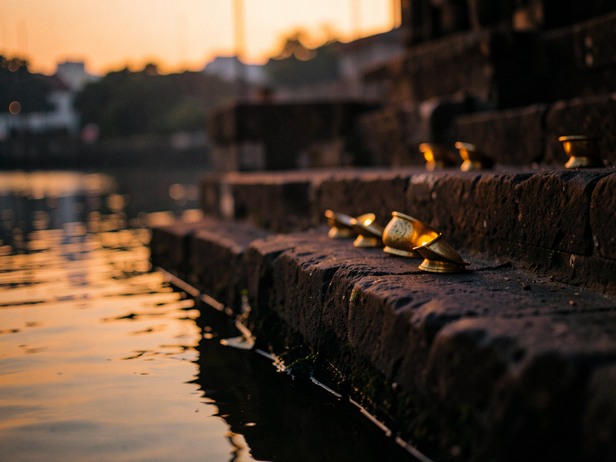
![Diyas Glow on Ghat]()
Diyas Glow on Ghat
Image credit : AI
Witnessing the serene glow of diyas on the ghat, a beautiful reflection of Chhath Puja vrat significance.
Why the Sun and Not a Temple
Chhath is among the oldest Vedic rituals still practiced in its original form, and it is addressed directly to Surya, not to a murti inside a sanctum, not through a priest, not mediated by an intermediary of any kind. The ghat is the temple. The river is the threshold. The devotee faces the sun herself. This directness is unusual in the larger ritual grammar of Hinduism, where the deity is typically approached through a consecrated image and a trained officiant. In Chhath, the sun is present and visible. The offering goes straight to the source. The Rigveda's Surya Sukta (Book 1, Hymn 115) addresses Surya as the eye of Mitra and Varuna, the soul of all that moves and stands still, a conception in which the sun is not a symbol of the divine but the divine made manifest and observable. Chhath keeps that directness intact. You do not represent the offering. You stand in the water and make it.
The Role of Chhathi Maiya
The presiding deity of the vrat is not Surya alone. Chhathi Maiya, identified with Shashthi Devi, the sixth manifestation of Prakriti, is the protector of children and the giver of life. The fast is most commonly undertaken for the health and long life of one's children, or for the blessing of a child where there is none yet. This is the emotional center of the vrat that the ritual's austerity sometimes obscures. The difficulty is not self-punishment. It is the grammar of a specific ask. In the logic of this tradition, the size of what you surrender signals the size of what you are asking for. A mother standing nirjala in a cold river at four in the morning is not demonstrating suffering. She is making an argument with her body about how much the child matters. Chhathi Maiya, in the folk tradition of the Gangetic plains, is understood to hear that argument precisely because it costs something real.
![Ancient Manuscript, Lotus Dawn]()
Ancient Manuscript, Lotus Dawn
Image credit : AI
I observe an ancient manuscript and a lotus blossom at dawn, a moment of quiet contemplation. The significance of Chhath Puja vrat is felt.
Why It Survives Without Institutionalisation
Chhath has no single founding text, no governing priestly class, no temple that owns it. It is transmitted entirely within families and communities, woman to woman across generations, in the Bhojpuri, Maithili, and Magahi belts of Bihar, eastern Uttar Pradesh, and Jharkhand, and now wherever those communities have carried it, to Mumbai's Juhu beach, to Delhi's Yamuna ghats, to Suriname and Mauritius. The songs, the chaupals, the specific sequence of the thekua recipe, all of it travels by memory and practice, not by scripture. This is unusual for a vrat of this antiquity and intensity. Most major Hindu observances are anchored in a Purana, a Mahatmya, a temple lineage. Chhath is anchored in the community itself. That may be why it has not softened. There is no institution to modernise it, no committee to make the nirjala portion optional. The women who keep it keep it whole.
The hardest vrat in the Hindu calendar is hard not because the tradition demands suffering, but because the tradition understands that some things can only be asked for in a language the body speaks. Four days, two rivers, two suns, and nothing in the stomach, that is the grammar. The sun rises anyway. The question the vrat puts to the devotee is whether she was there to meet it.