Sometime around the third or fourth century BCE, a thinker named Kanada looked at a grain of wheat falling to the ground and asked a question that sounds simple until you try to answer it: what, exactly, just moved? Not the name of the thing. Not its use. What is it, at the level where it cannot be broken further? That question became the Vaisheshika Sutra, and the system it founded was the first sustained attempt in any philosophical tradition to produce a complete inventory of reality, not as a spiritual exercise, but as a logical settlement of a problem that was tearing Indian philosophical debate apart.
The Problem Vaisheshika Was Built to Solve
The debate it entered was already old. The Upanishads had argued that beneath all apparent multiplicity there is one substance, Brahman, and that the separateness of things is a kind of error. The early Buddhists had pushed in the opposite direction: there is no permanent self, no unchanging substance, only a stream of momentary events. Both positions were coherent. Both were also, to a rigorous logician, incomplete. If everything is one, why do fire and water behave differently? If everything is momentary flux, what makes this grain of wheat the same grain a moment later?
Kanada's move was to stop asking about the ultimate nature of reality before asking what kinds of things there are. His system, later developed by Prashastapada in the Padarthadharmasangraha, proposed six padarthas, categories of what genuinely exists. The word padartha means, literally, the meaning of a word, the thing a word points to. The categories were not invented; they were discovered by asking what must be real for ordinary experience and inference to work at all.
![Illuminated Wisdom, Lingering Shadow]()
Illuminated Wisdom, Lingering Shadow
Image credit : AI
A single flame illuminates the Vaisheshika philosophy of padarthas, with a second lamp awaiting its turn.
The Six Categories and the Logic Behind Each
The first padartha is dravya, substance. Vaisheshika listed nine: earth, water, fire, air, ether, time, space, mind, and self. These are not elements in the modern chemical sense. They are the substrates in which qualities inhere. A quality cannot float free; it must belong to something. That something is a substance.
The second is guna, quality. Colour, taste, smell, touch, number, size, conjunction, disjunction, priority, posteriority, weight, fluidity, viscosity, sound, cognition, pleasure, pain, desire, aversion, and effort. Seventeen in the early count, later expanded. These are real, they are not names for nothing, but they cannot exist independently. They ride substances.
The third is karma, motion. Not the moral law of cause and consequence, but physical motion: upward, downward, expansion, contraction, and locomotion. Motion is what connects one state of a substance to the next. It is real, but it is temporary; no substance is always in motion.
The fourth, samanya, is universality, the property by which many individuals share a common nature. When you see several fires and call them all fire, you are tracking a real universal, not projecting a mental habit onto unrelated particulars. Samanya is what makes language possible and inference reliable.
The fifth, vishesha, is particularity, the ultimate differentiator. Two atoms of the same type are qualitatively identical. What makes them two rather than one? Vishesha: an irreducible thisness that belongs to each eternal substance alone. This is the category that gave the school its name. Vaisheshika means the philosophy of vishesha, the philosophy of ultimate distinction.
The sixth, samavaya, is inherence, the permanent, unbreakable relation by which a quality belongs to its substance, a universal belongs to its instances, a part belongs to its whole. It is not the same as ordinary conjunction, which can be dissolved. Inherence cannot. The redness of a red cloth is not resting on the cloth the way a book rests on a table. It is in the cloth in a way that cannot be peeled off without destroying what we mean by either the redness or the cloth.
Atoms and What They Were Meant to Prove
The atomic theory in Vaisheshika follows from the categories rather than driving them. If substances are real and qualities inhere in substances, then division cannot go on forever. At some point you reach a substance with no further parts, a paramanu, an atom, in which a quality inheres without any sub-part to distribute it across. The atom is not a scientific hypothesis in the modern sense. It is a logical necessity: the point at which the regress of part-and-whole stops.
Atoms combine under the influence of adrishta, the unseen force, often translated as fate or the accumulated weight of dharmic action, to form dyads, then larger aggregates, then the perceptible world. The world is not an illusion. It is a real structure built from real components under real causal pressure. This was a direct counter to both the Advaita reading of maya and the Buddhist dissolution of substance into momentary events.
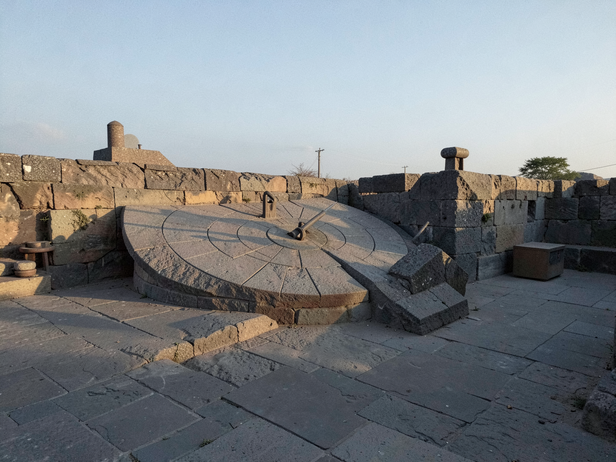
![Ancient Stone Observatory Dawn]()
Ancient Stone Observatory Dawn
Image credit : AI
I observe the Vaisheshika philosophy's influence in these ancient stone instruments, their precise forms hinting at early atomic theory.
What the Method Was Settling
The padarthas were not a dry academic list. Each one was a position in an ongoing argument. Samanya was a response to the Buddhist nominalist who said universals are just mental labels. Vishesha was a response to the Advaita monist who said all distinction is ultimately illusory. Samavaya was a response to anyone who tried to reduce relations to mere proximity or convention. The system was adversarial in the best sense: every category was load-bearing, holding up a specific claim against a specific challenge.
The Nyaya school, which developed alongside Vaisheshika and eventually merged with it into Nyaya-Vaisheshika, contributed the epistemological framework, the theory of valid sources of knowledge, that gave the ontological categories somewhere to stand. You cannot claim that universals are real unless you have an account of how perception and inference can track them. The two schools needed each other.
Why the Categories Still Press on Thought
The Vaisheshika project looks, from a distance, like an early attempt at what analytic philosophy calls ontology, the disciplined study of what kinds of things exist and how they relate. The resemblance is not coincidental. Both traditions were trying to do the same thing: get the categories right before the arguments begin, so that the arguments have something stable to stand on.
The specific nine substances and the atomic theory have been superseded by physics. But the underlying questions have not. What is the difference between a thing and its properties? What makes two things of the same type genuinely two? What is the relation between a part and the whole it belongs to? These are live problems in contemporary metaphysics, argued in journals and not yet settled. Kanada did not solve them. He showed, with unusual precision for his time, that they needed to be solved before anything else could be said with confidence about the world. That methodological move, clear the categories first, is the part of Vaisheshika that has not aged.