The argument you replayed at two in the morning, the slight you have carried for three years, the careful story of who you are and why you turned out this way, all of it rests on one assumption so obvious it never gets examined. That there is a self doing the carrying.
The Buddha called that assumption the root of dukkha, not because selfhood feels bad, but because it is built on something that cannot be found when you actually look.
What Anatta Actually Says
The Pali word anatta is usually translated as no-self, which sounds like annihilation. It is not. The Buddha was not saying you do not exist in any sense. He was making a precise philosophical claim: that what you call the self is not a fixed, independent, unchanging entity. It is a process. A river is not nothing. But a river is also not a thing, it is water moving, banks shifting, depth varying with the season. You point at it and say river, and the word is useful, but no single drop of water is the river, and the river of this morning is not the river of last monsoon.
In the Anattalakkhana Sutta, the discourse on the characteristic of non-self, delivered at Sarnath to the five ascetics who became his first students, the Buddha walked through each of the five aggregates: form, feeling, perception, mental formations, and consciousness. For each one he asked the same question: is this mine, is this me, is this my self? And for each one the answer was the same. If it were truly yours, you could command it. You cannot tell your body not to age. You cannot instruct a feeling to stop arriving. You cannot order consciousness to produce only the thoughts you approve of.
The self that seems so solid is a summary, not a substance.
![Ancient Palm Leaf Manuscript]()
Ancient Palm Leaf Manuscript
Image credit : AI
Exploring the concept of anatta, this ancient manuscript whispers of impermanence and the absence of a fixed self.
The Five Aggregates and the Illusion of the Witness
The Buddha's framework for examining experience is the five khandhas, the aggregates or heaps that together produce the sense of a person. Rupa: the body, its weight and sensation and decay. Vedana: the feeling-tone of each moment, pleasant, unpleasant, or neutral, arising before thought has time to name it. Sanna: perception, the recognition that this is a mango, this is a threat, this is a familiar face. Sankhara: the mental formations, intention, attention, will, habit, the things that move you before you decide to move. And vinnana: consciousness, the bare knowing that something is happening.
Nowhere in this list is there a sixth aggregate called the witness. Nowhere is there a homunculus sitting behind the eyes, watching the other five and calling itself I. What happens instead is that the five aggregates arise together in a pattern, and that pattern generates the sense of a unified experiencer. The experiencer is the pattern. It is real the way a flame is real, continuous, recognisable, causally effective, and it is not a thing the way a flame is not a thing. Blow it out and you do not destroy an object. You end a process.
This is what the Milindapanha, the questions of King Milinda, turns on. The monk Nagasena arrives before the king and is asked his name. He says his name is Nagasena, then immediately adds that Nagasena is only a conventional designation, no person is to be found in that name. The king is annoyed. If there is no Nagasena, who is it that eats, meditates, and attains nibbana? Nagasena asks the king how he arrived. By chariot. Nagasena then asks: is the chariot the axle? The wheel? The yoke? The frame? The king says no to each. Then is the chariot something apart from all these parts? Also no. Then there is no chariot, says Nagasena, only a conventional designation for an arrangement of parts that serves a function. The king, a Greek-educated ruler who had heard every philosophical argument of his era, concedes the point.
Why the Self Feels So Real
The teaching does not ask you to feel that you have no self. It asks you to notice that the feeling of selfhood is itself an arising, something that happens, not something that is. And it happens for good evolutionary and social reasons. A creature that tracks continuity of experience, that attributes actions to an agent, that plans for a future version of itself, that creature survives. The sense of self is extraordinarily useful. The Buddha was not arguing against its utility. He was arguing against taking it for a metaphysical fact.
The difference matters because suffering is built on the gap between what the self wants and what arises. I want this feeling to stay. I want that person to see me correctly. I want my body to remain what it was at thirty. Every one of these wants has the same structure: a fixed self reaching for a fixed outcome in a world where nothing is fixed. Anatta does not promise that recognising this will make you indifferent. It promises that the grip loosens. The argument you rehearsed at two in the morning loses some of its urgency when the self that was wronged is seen as a process rather than a possession.
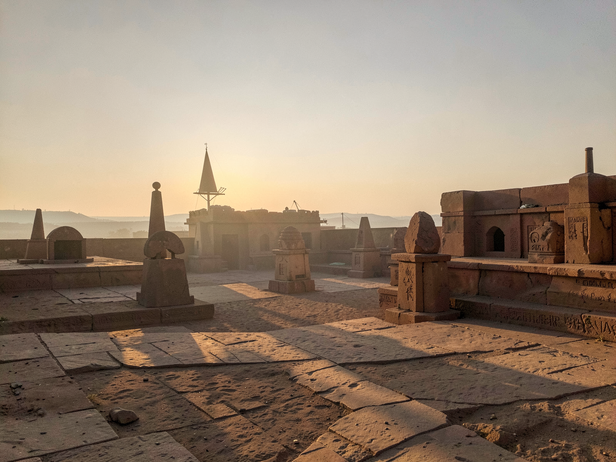
![Ancient Astronomical Dawn]()
Ancient Astronomical Dawn
Image credit : AI
Geometric shadows fall across ancient stone instruments at dawn, a testament to the concept of anatta.
Anatta and the Question of Karma
The most common objection to anatta is the one King Milinda raised in a different form: if there is no self, who bears the consequences of action? If I am not a fixed entity, how does karma make sense? Why should the person who wakes up tomorrow suffer or benefit from what I do tonight, if that person is not really me?
The Buddha's answer, elaborated across several suttas and later in the Abhidhamma, is that karma does not require a self, it requires continuity. A flame lit from another flame is not the same flame and not a different flame. The second flame would not exist without the first, and it carries the character of what it was lit from, but no substance transferred. Similarly, what continues across lifetimes or even across moments within a single life is not a soul but a stream of causally connected events. Each mental act conditions what follows. The conditioning is real. The conditioned entity that carries it forward is also real. What is absent is a permanent, unchanging self that owns the karma the way you own a debt.
This is why the Buddha, in the Dhammapada, opens with the paired verses on mind as the forerunner of all actions. Manopubbangama dhamma, mind is the forerunner of all conditions. Not my mind, not a self's mind. Mind as process, shaping what follows.
What Remains When the Self Is Seen Through
Practitioners who have worked with anatta as a meditation object, and the Anattalakkhana Sutta is itself a meditation instruction as much as a philosophical discourse, often describe something unexpected. The dissolution of the sense of fixed selfhood does not produce emptiness in the bleak sense. It produces what some teachers call spaciousness. When the boundary between the defended self and the rest of experience becomes porous, what contracts is not experience but the suffering layered on top of it.
The Theravada tradition distinguishes between conventional truth and ultimate truth, sammuti sacca and paramattha sacca. At the conventional level, Nagasena exists, you exist, the chariot rolls. These designations are not lies. They are useful maps. At the ultimate level, what exists is a stream of arising and passing phenomena with no fixed owner. Both levels are true simultaneously, and the practice is learning to hold both without collapsing one into the other.
What the Buddha was pointing at in the deer park at Sarnath was not a doctrine to be believed but a fact to be seen. The self you have been defending, the one that was wronged, that deserves recognition, that fears being forgotten, is a process that arose from conditions and will pass when those conditions change. That is not a loss. It is what the grip has been costing you all along.