Most goddesses in the Hindu tradition are approached through what they give. Chinnamasta is approached through what she refuses. She does not offer protection, abundance, or grace in any form the devotee can comfortably receive. She offers a severed head, held in her own hand, with three jets of blood arcing from the neck stump into three open mouths. One of those mouths is her own. The image does not resolve into comfort no matter how long you sit with it, and that irresolution is the entire point.
The Iconography Is a Single Argument, Not a Collection of Symbols
Every element in Chinnamasta's image locks into every other. She stands, or sometimes floats, above Rati and Kamadeva in active union. Rati is desire embodied. Kamadeva is its arrow and its aim. Chinnamasta rises from the very act that generates samsara, the cycle of craving, birth, and return, and she has already decapitated herself. The head she holds is not a trophy. It is still conscious. The eyes in the severed head are open, alert, looking outward. The body from which the head was removed continues to stand and to bleed and to feed.
The two attendants, Dakini and Varnini, flank her and drink from two of the three blood streams. The third stream feeds the head. The body is the source. The head, separated from the body, is still nourished by the body it left. This is not gore for the sake of transgression. It is a precise diagram of what the Tantric tradition means when it says the ego is not the self, and yet the ego, properly understood, is not the enemy either.
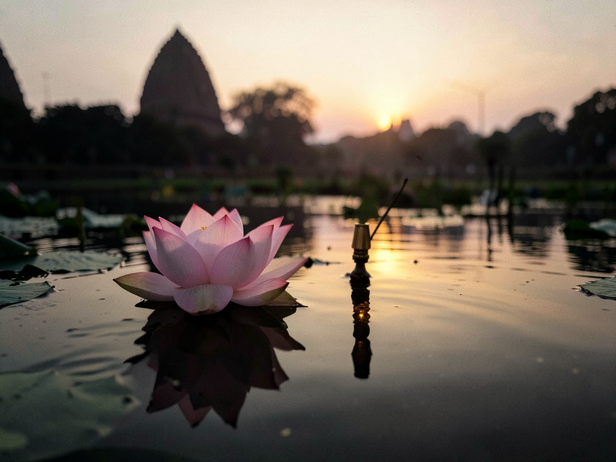
![Dawn Lotus and Lamp]()
Dawn Lotus and Lamp
Image credit : AI
A serene dawn scene with a lotus and a brass lamp's reflection, hinting at the profound Shakta Tantra goddess of self-decapitation.
What the Beheading Is Not Saying
The instinct when encountering this image is to read it as self-destruction, as sacrifice, as the goddess destroying herself for others. That reading is too clean. Chinnamasta does not die. Nothing in the image suggests cessation. The body stands. The blood flows. The head drinks. The act of severing has produced not death but a different relationship between the thinking mind and the living body.
The head, which in Sanskrit philosophical context is the seat of the discriminating intellect, the part of consciousness that says I, that names and separates and judges, has been cut free. And the moment it is cut free, it is fed directly by the life force it spent its whole existence trying to manage and control. The severance is not punishment. It is release, and the release is mutual. The body no longer labours under the head's constant supervision. The head no longer starves itself by refusing to receive what the body generates.
This is why Chinnamasta appears in the Shakta Mahavidyas alongside Kali and Tara and Bhairavi. Each of the ten is an argument about consciousness that cannot be made in a gentler image. Chinnamasta's argument is specifically about the violence of self-knowledge, the recognition that the structure you have called yourself is not the source of your life.
The Couple Beneath Her Feet and What They Are Doing There
Rati and Kamadeva are not incidental. In many Puranic accounts, Kamadeva is the force that broke the meditation of Shiva, and was reduced to ash for it. Desire interrupted transcendence. The familiar reading of that story treats desire as the problem. Chinnamasta's image refuses that reading.
She does not crush the couple. She stands on them, which in the iconographic grammar of this tradition means she encompasses and transcends them, but also that she arises from them. She is not possible without them. The energy that moves through Rati and Kamadeva is the same energy that becomes the blood arcing from Chinnamasta's neck. Kundalini shakti, in the Tantric reading of this image, does not oppose desire. It is desire, redirected not by suppression but by the radical act of cutting the head free from its role as the self's manager.
The Shakta Tantras describe this as the upward movement of prana. The energy that would have fed procreation, or craving, or the ordinary maintenance of the ego's story about itself, instead moves up the sushumna and becomes the food of the awakened mind. Chinnamasta's image shows this happening. The blood is the proof.
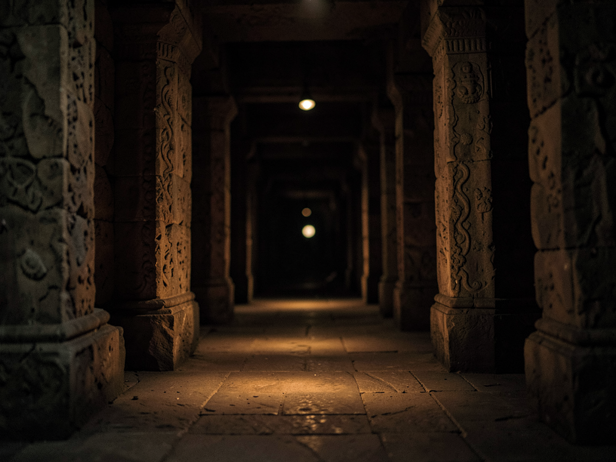
![Temple Corridor's Deep Stillness]()
Temple Corridor's Deep Stillness
Image credit : AI
I explore the profound stillness of a stone temple corridor, its carved pillars lost in shadow, illuminated by a single, warm oil lamp.
Why the Image Makes People Uncomfortable and Why That Is Correct
Chinnamasta is rarely installed as the primary deity of a large public temple. Her worship is concentrated in specific Shakta and Tantric lineages, in places like the Chhinnamasta temple at Rajrappa in Jharkhand, one of the few major shrines dedicated to her, where the Damodar and Bhairavi rivers meet. The confluence is not incidental, water meeting water at a junction has long marked a site where boundaries dissolve.
The discomfort her image produces in a general audience is not a failure of understanding. It is the image working. Chinnamasta is explicitly designed to refuse the consolations that make religious imagery easy to receive. She will not be a mother who protects. She will not be a consort who softens a male deity's power. She is not asking for devotion in the register of petition. She is asking whether the devotee can look at the self-feeding loop of consciousness, the mind that generates its own sustenance and then pretends to receive it from outside, and recognise what is actually happening.
The Tantric texts that address her, including passages in the Shakta Pramoda and the Mantra Mahodadhi, do not offer her as a path to worldly boons. They offer her as a path to the recognition that the seeker and the sought are the same body, and that the head which has been doing all the seeking was always already being fed by the source it was looking for.
The Argument the Image Completes
Taken together, the image of Chinnamasta makes one claim that no amount of doctrinal language makes as efficiently: the self you are trying to transcend is not separate from the life you are trying to transcend it with. The head and the body are one system. The severing is not a solution to the problem of ego. It is the demonstration that the problem was never what the head thought it was.
She holds her own head and feeds it with her own blood and stands on the force that generates all longing, and her eyes, both sets of them, are open. The image is not arguing for annihilation. It is arguing for a different kind of wakefulness, one that does not require the thinking mind to be in charge of the life that sustains it.