The first thing Guru Nanak did when he gathered people was feed them. Not bless them, not teach them, not ask them to recite. Feed them, on the ground, in a single row, shoulder to shoulder, regardless of what caste their birth had assigned them or what coin they carried. The sequence was deliberate. Pangat, the row of diners, came before sangat, the congregation of seekers. Eat first. Then sit together in the name of the divine. The order was the argument.
The Row as a Philosophical Position
Sitting in a row to eat sounds like a logistical arrangement. In fifteenth-century Punjab, it was a provocation. The caste system did not only organise labour and marriage; it organised who could eat near whom, who served whom, whose shadow falling on food made it impure. A Brahmin did not eat in the same line as a Shudra. A landlord did not lower himself to the ground beside a tanner. The body's proximity at a meal was one of the most precise markers of social rank the subcontinent had produced.
Guru Nanak's insistence on pangat collapsed that entire architecture in a single gesture. You cannot sit in a row and maintain hierarchy. A row has no head. Every person in it occupies the same plane, literally, the same level of ground, and receives the same food from the same hands. The body learns something the mind can argue against indefinitely. You have eaten beside the person you were taught to consider lesser. The experience does not ask for your agreement.
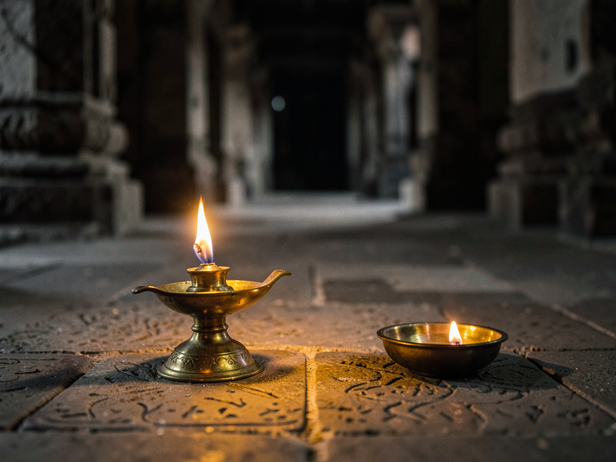
![Temple Diya's Warm Glow]()
Temple Diya's Warm Glow
Image credit : AI
The steady flame of a diya illuminates the sacred space, reflecting the spirit of seva and equality central to langar.
What the Guru Granth Sahib Says About Seva
The Guru Granth Sahib does not treat service as a virtue among other virtues. It treats it as the condition under which the ego, what the text calls haumai, begins to dissolve. Haumai is not pride in the ordinary sense. It is the orientation of the self that makes separation seem natural: I am here, you are there, I am more, you are less. The Granth, in the compositions of Guru Nanak himself, returns repeatedly to this: that the one who serves without thought of rank or return is closer to the divine than the one who performs elaborate ritual while preserving the distances that ritual was built to protect.
In Raag Suhi, Guru Nanak writes of the person who wanders in ego, performing acts of religion while the self remains untouched. The langar was designed as the antidote, not a religious performance but a religious undoing. The person cooking does not know whose plate they are filling. The person eating does not choose who sits beside them. The anonymity is structural, not aspirational.
Mata Khivi and the Langar That Became an Institution
The history of the langar is also a history of women's labour that was rarely called history. Mata Khivi, the wife of Guru Angad Dev, the second Guru, is one of the few women named directly in the Guru Granth Sahib. The Granth describes her as one who distributes the nectar of the Guru's teachings, and the metaphor is made physical in what she actually did, which was run the langar at Khadur Sahib, feeding hundreds of people through her own organisational effort and resources. The text honours her not as a consort but as a practitioner of seva in her own right.
That naming matters. The langar could have been recorded as an abstract principle. Instead, it is embedded in specific people doing specific work, cooking rice, carrying water, sitting with strangers. The institution survived because it was never allowed to become only an idea.
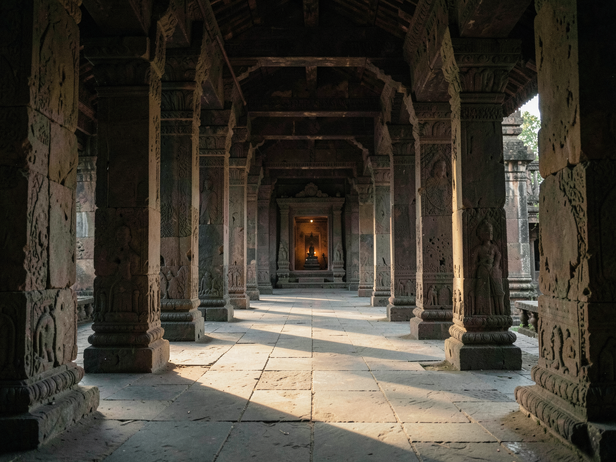
![Temple Corridor at Dawn]()
Temple Corridor at Dawn
Image credit : AI
I observe the tranquil dawn light illuminating a temple corridor, hinting at the profound significance of langar and seva.
Why Akbar Sat on the Ground
The story of Emperor Akbar visiting Guru Amar Das at Goindval is not a diplomatic anecdote. It is a record of the principle being enforced at the highest available test case. Akbar, the Mughal emperor, was told he would eat in the langar before he met the Guru. He sat on the ground. He ate what everyone else ate. Then he met Guru Amar Das.
The sequence was not humiliation. It was the precondition for genuine meeting. A man who arrives as emperor cannot really encounter another person, he can only receive deference. Pangat stripped the title before the encounter. What sat across from Guru Amar Das after the meal was a man who had just eaten on the ground with people he would never have permitted near his own table. Whether Akbar understood that in the moment is less important than what the Guru was demonstrating: that no one enters the sangat carrying rank. You leave it at the door, and the door is the kitchen.
What the Single Row Is Still Doing
The Golden Temple in Amritsar serves somewhere between fifty thousand and one hundred thousand people a day in its langar. The number is staggering, but the number is not the point. The point is that the food is the same for everyone, the floor is the same floor, and the row is still a row. A visiting dignitary eats what a daily labourer eats. A tourist eats beside a pilgrim. The kitchen runs on volunteer hands, many of them belonging to people who have never cooked a meal for strangers before and will not again for years.
The institution has outlasted every empire that tried to contain or co-opt it. It has outlasted the partition that split the Punjab it was born in. It has fed people during floods and pandemics and wars with the same structural logic it began with: hunger is the equaliser, the row is the argument, and the argument is made not in words but in the act of sitting down.
Guru Nanak did not write a treatise on equality. He set a table, on the ground, in a line, and made everyone eat before they could discuss the divine. The theology came second because it had to. You cannot genuinely believe in the oneness of Ik Onkar while maintaining the distances that caste built. The langar was the proof of concept, and it is still running.