Chhath Puja strips ceremony down to almost nothing: standing water, a low sun, bare feet on wet earth, and bamboo in the hands. The soop, the flat winnowing basket, and the daura, the deep round basket, are not decorative. They are the oldest surviving logic of the offering itself, and understanding what they were made to carry changes how the ritual reads.
Bamboo as a Ritual Material
In the Gangetic plains, bamboo has never been considered an ordinary grass. It grows fast, bends without breaking, and survives flood and drought in cycles that mirror the agricultural year. The Atharvaveda references bamboo in contexts of purification and protection, and across the Maithil and Bhojpuri traditions that gave Chhath its deepest roots, bamboo objects were kept separate from daily use, reserved for thresholds, for birth rooms, for the dead, and for offerings. The material itself carried a category distinction. Bringing a plastic crate to the ghat would not simply look wrong; it would collapse the boundary the ritual depends on.
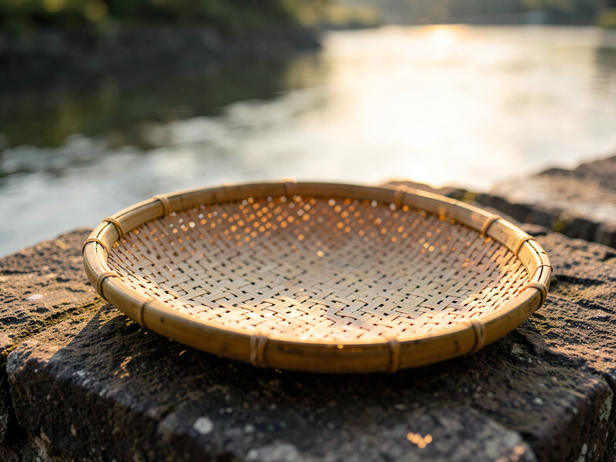
![Golden Light on Bamboo Winnowing Basket]()
Golden Light on Bamboo Winnowing Basket
Image credit : AI
I observe the intricate weave of a bamboo soop, a vital part of Chhath Puja offerings, bathed in gentle light.
The Soop: What Winnowing Has to Do With the Sun
The soop is a winnowing basket. Its original function, tossing grain into the air so the wind separates the useful from the chaff, is an act of discernment, of letting something outside the self decide what stays. Held toward Surya at the moment of arghya, the same gesture carries the same logic. The devotee does not perform a transaction. She presents what she has and lets the light fall on it. The soop's wide, flat surface is designed to receive, grain, light, judgment. Chhath did not borrow a kitchen tool and repurpose it. It recognised what the tool already meant.
The Daura: Depth, Containment, and What Cannot Be Seen
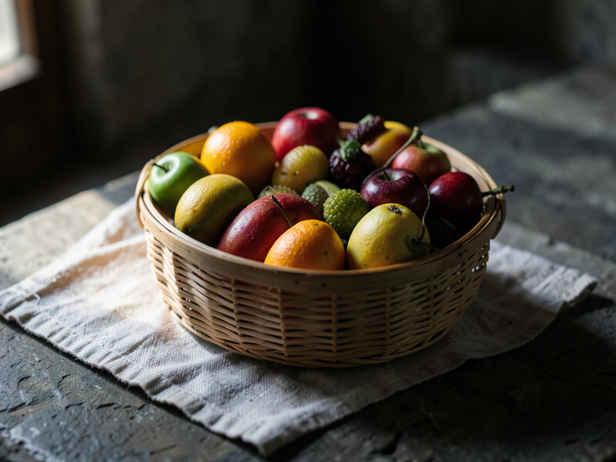
The daura is the container that goes beneath the soop in the offering arrangement. It is deeper, rounder, woven tighter. If the soop is about exposure, the daura is about what is held in reserve, the prayers that are not spoken aloud, the griefs and gratitudes that have no ritual form, the accumulated weight of a year. In many households along the Kosi and Gandak rivers, the daura is woven by a family member in the weeks before Chhath, not purchased. The weaving is itself considered part of the preparation, a form of concentration before the fast begins. What enters the daura, thekua, sugarcane, seasonal fruit, is not symbolic food. It is the actual harvest of the actual season, which is the point.
![Pre-Dawn Fruit Offering Basket]()
Pre-Dawn Fruit Offering Basket
Image credit : AI
I present a traditional soop daura, a significant Chhath Puja offering basket, filled with nature's bounty.
The Hands That Hold Them
Chhath is unusual among major Hindu observances in that its central ritual act belongs almost entirely to women, and the physical carrying of the soop and daura is part of that. The baskets are heavy when full. Walking into the river with a loaded soop balanced on the head or held at chest height, against the current, at dusk or pre-dawn, is not metaphorically demanding, it is physically demanding. The tradition does not separate the spiritual effort from the bodily one. The Rigveda's hymns to Surya, particularly in Mandala 1, where the sun is addressed as the eye of Mitra and Varuna, seeing all that is true, carry the same insistence that the offering must cost something real. The bamboo baskets make that cost legible.
What Survives the Festival
After Chhath, the soop and daura are not thrown away. In many families they are stored, used again the following year, repaired rather than replaced. This is not frugality. It is the same logic as the ritual: continuity matters, accumulation matters, the object that has been held in prayer carries something forward. A basket bought new each year and discarded after is a different object performing a similar gesture. The difference is not visible from the ghat. It is felt in the hands of the person carrying it. The bamboo in Chhath is not a symbol of something else. It is the thing itself, a material that bends toward the water, holds the harvest, and returns to the earth when it is done.