
What the Gita Says About Feeling Directionless
Charu Sharma | Jan 05, 2026, 07:00 IST

Using the Bhagavad Gita as a lens, the article delves into the experience of being lost by comparing it with Arjuna's emotional paralysis in the battlefield. It reconceives bewilderment as recognition, overthinking as a form of love, and detachment as liberation, thus providing a soothing and uplifting spiritual perspective to those who are caught in the crossroads of duty, feeling, and transformation.
There are moments in life when nothing seems wrong enough to account for the heaviness, yet nothing seems right enough to take a step forward. You get up, follow the routine, answer to people, meet deadlines, smile when its needed and still feel oddly unanchored. No definite purpose. No strong desire. No fiery ambition. Just a silent, draining confusion. The Bhagavad Gita is actually a story of not having confidence or clarity, but Arjuna stunned, at the battlefields center, unable to lift his bow. His hands were shaking. His thoughts were going in circles. His heart was torn between duty and feeling. He was not a weak character. He was not a lazy one. He was simply overwhelmed. That moment that inability to move is actually the realistic portrayal of feeling directionless. And the Gita is not disgracing it. It recognizes it. This is not a book providing instant solutions. It is a dialogue about what to do when you are completely lost.
1. Feeling Lost Is Not Failure - It’s the Beginning of Awareness
![Arjuna in his chariot]()
Before Krishna talks about duty, karma, or detachment, Arjuna frankly confesses his bewilderment. He claims that he does not recognize what is right anymore. His moral compass seems to be shattered. His feelings dominate his reason. The Gita does not move on from this point quickly. It stays with it. What it means in real life: We very often consider lack of direction as a defect something that needs to be fixed quickly. Society rewards certainty. People who know what they want are complimented. Those who hesitate are criticized. However, the Gita indicates something completely different: Confusion is not the lack of wisdom it is the moment in which wisdom becomes possible. You can only feel lost when the old answers cease to work. When borrowed dreams, expectations, and external validation fade. That discomfort is not emptiness it is awareness trying to take shape. Arjuna's meltdown is not a side road. It is the doorway.
2. Overthinking Is a Sign of Emotional Involvement, Not Weakness
![Person sitting with Krishna's reflection]()
Arjuna's refusal to fight was not due to fear of the battle. He was terrified of the emotional cost of the battle. He imagines relationships, guilt, loss, and consequences. Krishna doesn't ridicule this sensitivity. What it means in real life: If you are without direction, most likely you are overthinking. You replay conversations in your mind. You weigh outcomes. You fear making the "wrong" choice and hurting yourself or others. The Gita changes this view: Your inability to move is a result of you caring deeply not being unable to. People who are numb to emotions can move without difficulty. Those who are highly sensitive to emotions will hesitate. The problem is not that you are too sensitive. The problem is that you expect to have full understanding before you can move. The Gita teaches that understanding is often a result of your action not a prerequisite.
3. You Are Not Required to See the Whole Path
Krishna does not provide Arjuna with a meticulous life plan. Nor does he assure him of outcomes. Instead, he advises him to concentrate on doing the right thing rather than the future that it might bring. "Karmanye vadhikaraste" you are only in control of action, not results." How it translates into real life: Arguably, a significant reason why many people complain of being lost is that they are under pressure. Pressure to figure out where that degree will take you. What that relationship means for the future. Whether that decision will "pay off". The Gita takes that load off your shoulders very gently. The next right step in your life does not require you to know where your life is going. Being without direction is sometimes a result of wanting guarantees. What the Gita provides is something quieter: trust the step that feels right and honest now. You do not see the entire road at once. You see it by putting your foot down one moment at a time.
4. Detachment Does Not Mean Indifference - It Means Inner Freedom
![Krishna on a chariot]()
Detachment is frequently confused with coldness or a lack of emotional response. Arjuna is terrified that if he acts, he will become a heartless person. Krishna refutes this idea. The actual message of the Gita is: Detachment is not about not caring. It is about not letting the fear of the result of your action control you. Most of the time, lack of direction in life is a result of being too emotionally attached:, Fear of letting down others, Fear of not using your potential, Fear of making the wrong choice and being judged The Gita tells us to experience the emotions fully, but to act without being controlled by them. When you stop holding on to the way things should turn out, you get back your freedom of movement. Not numbness, movement.
5. Surrender Is Not Giving Up - It’s Choosing Honesty Over Control
Arjuna ultimately expresses that he cannot continue to feign understanding. He relinquishes not his responsibility, but his ego. He acknowledges that he requires guidance. It is only after that clarity starts to come. How it translates into life: Being without direction is sometimes the consequence of an attempt to have control over everything the timing, the results, your identity, the success. The Gita proposes a gentler solution: Letting go of oneself does not imply ceasing to make an effort. It signifies ceasing to deceive oneself that one has everything figured out. When you give yourself permission to say "I don't know", without feeling guilty, a space is created. Choices become less difficult. Life becomes less burdensome. At times, the sense of direction coming back may be accompanied not by the answers, but by the tranquility.
Final Note :
The Bhagavad Gita is not a book of resolutions. It is not a book of certainty, rather, it is a book of validation at the point where we are most uncomfortable, the point where we do not know who we are becoming. Arjuna's spirit is one of us all: smart, strong, emotionally mature still, confused by the choice and consequence. The Gita's message is clear, though difficult: It is not necessary for you to run away from your confusion. You must confront it with honesty. Often, change comes quietly and not as a loud voice. It comes quietly when you stop fighting yourself and start trusting your own development. Perhaps, feeling lost is not the lack of a way it is the pause before a way shows itself.
FAQs (Frequently Asked Questions) :
1. Feeling Lost Is Not Failure - It’s the Beginning of Awareness
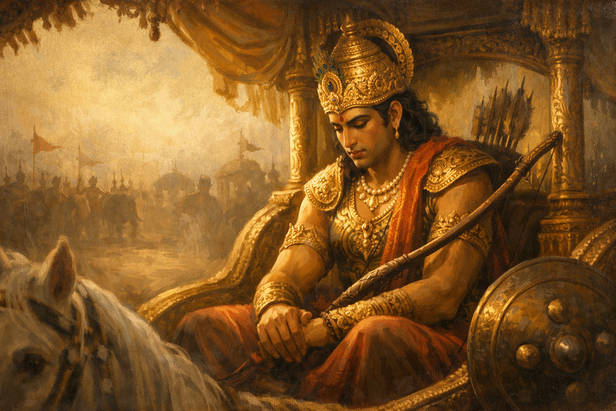
Arjuna in his chariot
Image credit : Times Life Bureau
Before Krishna talks about duty, karma, or detachment, Arjuna frankly confesses his bewilderment. He claims that he does not recognize what is right anymore. His moral compass seems to be shattered. His feelings dominate his reason. The Gita does not move on from this point quickly. It stays with it. What it means in real life: We very often consider lack of direction as a defect something that needs to be fixed quickly. Society rewards certainty. People who know what they want are complimented. Those who hesitate are criticized. However, the Gita indicates something completely different: Confusion is not the lack of wisdom it is the moment in which wisdom becomes possible. You can only feel lost when the old answers cease to work. When borrowed dreams, expectations, and external validation fade. That discomfort is not emptiness it is awareness trying to take shape. Arjuna's meltdown is not a side road. It is the doorway.
2. Overthinking Is a Sign of Emotional Involvement, Not Weakness

Person sitting with Krishna's reflection
Image credit : Times Life Bureau
Arjuna's refusal to fight was not due to fear of the battle. He was terrified of the emotional cost of the battle. He imagines relationships, guilt, loss, and consequences. Krishna doesn't ridicule this sensitivity. What it means in real life: If you are without direction, most likely you are overthinking. You replay conversations in your mind. You weigh outcomes. You fear making the "wrong" choice and hurting yourself or others. The Gita changes this view: Your inability to move is a result of you caring deeply not being unable to. People who are numb to emotions can move without difficulty. Those who are highly sensitive to emotions will hesitate. The problem is not that you are too sensitive. The problem is that you expect to have full understanding before you can move. The Gita teaches that understanding is often a result of your action not a prerequisite.
3. You Are Not Required to See the Whole Path
Krishna does not provide Arjuna with a meticulous life plan. Nor does he assure him of outcomes. Instead, he advises him to concentrate on doing the right thing rather than the future that it might bring. "Karmanye vadhikaraste" you are only in control of action, not results." How it translates into real life: Arguably, a significant reason why many people complain of being lost is that they are under pressure. Pressure to figure out where that degree will take you. What that relationship means for the future. Whether that decision will "pay off". The Gita takes that load off your shoulders very gently. The next right step in your life does not require you to know where your life is going. Being without direction is sometimes a result of wanting guarantees. What the Gita provides is something quieter: trust the step that feels right and honest now. You do not see the entire road at once. You see it by putting your foot down one moment at a time.
4. Detachment Does Not Mean Indifference - It Means Inner Freedom
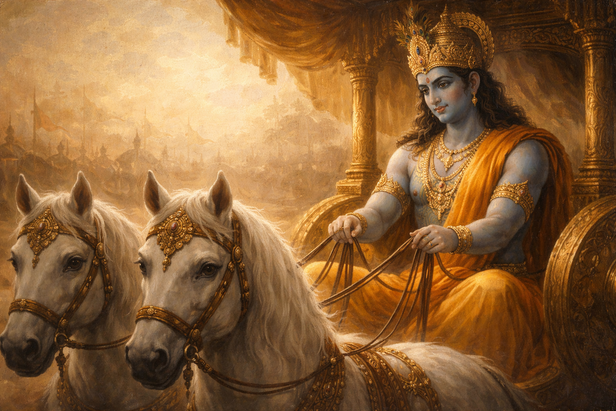
Krishna on a chariot
Image credit : Times Life Bureau
Detachment is frequently confused with coldness or a lack of emotional response. Arjuna is terrified that if he acts, he will become a heartless person. Krishna refutes this idea. The actual message of the Gita is: Detachment is not about not caring. It is about not letting the fear of the result of your action control you. Most of the time, lack of direction in life is a result of being too emotionally attached:, Fear of letting down others, Fear of not using your potential, Fear of making the wrong choice and being judged The Gita tells us to experience the emotions fully, but to act without being controlled by them. When you stop holding on to the way things should turn out, you get back your freedom of movement. Not numbness, movement.
5. Surrender Is Not Giving Up - It’s Choosing Honesty Over Control
Arjuna ultimately expresses that he cannot continue to feign understanding. He relinquishes not his responsibility, but his ego. He acknowledges that he requires guidance. It is only after that clarity starts to come. How it translates into life: Being without direction is sometimes the consequence of an attempt to have control over everything the timing, the results, your identity, the success. The Gita proposes a gentler solution: Letting go of oneself does not imply ceasing to make an effort. It signifies ceasing to deceive oneself that one has everything figured out. When you give yourself permission to say "I don't know", without feeling guilty, a space is created. Choices become less difficult. Life becomes less burdensome. At times, the sense of direction coming back may be accompanied not by the answers, but by the tranquility.
Final Note :
The Bhagavad Gita is not a book of resolutions. It is not a book of certainty, rather, it is a book of validation at the point where we are most uncomfortable, the point where we do not know who we are becoming. Arjuna's spirit is one of us all: smart, strong, emotionally mature still, confused by the choice and consequence. The Gita's message is clear, though difficult: It is not necessary for you to run away from your confusion. You must confront it with honesty. Often, change comes quietly and not as a loud voice. It comes quietly when you stop fighting yourself and start trusting your own development. Perhaps, feeling lost is not the lack of a way it is the pause before a way shows itself.
FAQs (Frequently Asked Questions) :
- What does the Gita suggest when you don’t know what to do?
Focus on right action without obsessing over the outcome. - Why did Krishna not give Arjuna clear future answers?
Because clarity comes through action, not prediction. - What is surrender according to the Bhagavad Gita?
Letting go of ego while remaining fully responsible.