
Why Colonial Translators Altered Meera’s Poetry for a Western Audience
Nidhi | Sept 08, 2025, 17:30 IST

Meera
Image credit : Times Life Bureau
Meera Bai’s poetry, filled with devotion, rebellion, and passion, has captivated India for centuries. When her bhajans were translated into English during the colonial era, translators reshaped her work to suit Victorian morality and Western tastes. Erotic imagery was softened, defiance erased, and Krishna recast in Christian-like symbolism. This article examines why these changes occurred, the cultural and political lenses of colonial translation, and the lasting effect on Meera’s global image. Discover how the saint-poet’s voice survived beyond colonial filters and why her original bhakti remains powerful today.
Meera Bai’s poetry is a testament to love, devotion, and rebellion. Her bhajans, written in Braj and Rajasthani, express an intense longing for Krishna, challenging social norms and asserting spiritual freedom. Yet, when her verses first crossed into English through colonial translations, they were filtered, sanitized, and reshaped to suit Western tastes. The mystical, passionate, and rebellious Meera that Indians knew was transformed into a saintly, gentle figure that fit Victorian ideals of piety and femininity. Understanding why this happened requires a look at the politics of translation, colonial ideologies, and cultural interpretation
![Mantra Ucharan]() Colonial translators framed Meera as a mysterious, otherworldly saint. Instead of presenting her as a poet rooted in specific cultural and religious contexts, they highlighted her as a symbol of “timeless Indian mysticism.” This exotic portrayal satisfied European fascination with the East but stripped her poetry of the lived reality of her village, society, and historical period.
Colonial translators framed Meera as a mysterious, otherworldly saint. Instead of presenting her as a poet rooted in specific cultural and religious contexts, they highlighted her as a symbol of “timeless Indian mysticism.” This exotic portrayal satisfied European fascination with the East but stripped her poetry of the lived reality of her village, society, and historical period.
Meera’s bhajans often include sensual imagery that conveys the intensity of her love for Krishna. Victorian-era translators found this uncomfortable and downplayed or removed these expressions, emphasizing chastity and saintly devotion instead. As a result, readers received a diluted version, missing the profound emotional layers that make her poetry revolutionary.
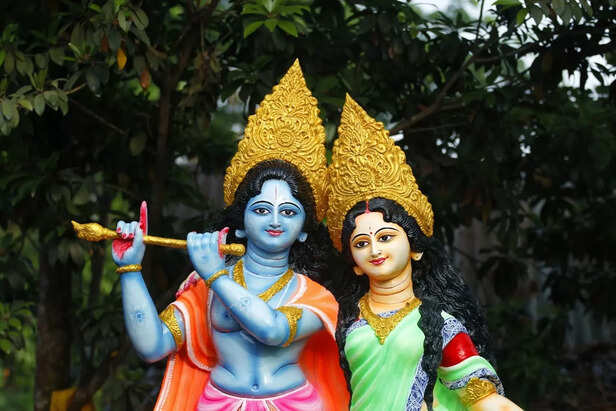
![The Flute Bearer Becomes Charioteer]() To make Meera more relatable to Western readers, translators compared her love for Krishna to a nun’s devotion to Christ. While this made her spirituality understandable, it erased the Vaishnava theological context, replacing her playful and intimate relationship with Krishna with a distant, abstract form of devotion familiar to Europeans.
To make Meera more relatable to Western readers, translators compared her love for Krishna to a nun’s devotion to Christ. While this made her spirituality understandable, it erased the Vaishnava theological context, replacing her playful and intimate relationship with Krishna with a distant, abstract form of devotion familiar to Europeans.
Meera’s poetry is rich with local metaphors, idioms, and cultural references. Translators often simplified her language, removing cultural nuances and folk imagery to make it accessible to Western audiences. While this increased readability, it also diluted the unique texture, rhythms, and regional flavor that define her work.
![renaissance-portrait-woman-as-sun-goddess_23-2151345842]() Meera’s poetry often challenged patriarchal authority, social norms, and even royal expectations. Colonial translators preferred to present her as passive and obedient, highlighting spiritual surrender over her fearless questioning of social conventions. This erasure obscured the radical nature of her bhakti and her role as a woman defying societal boundaries.
Meera’s poetry often challenged patriarchal authority, social norms, and even royal expectations. Colonial translators preferred to present her as passive and obedient, highlighting spiritual surrender over her fearless questioning of social conventions. This erasure obscured the radical nature of her bhakti and her role as a woman defying societal boundaries.
Colonial interpretations frequently cast Meera as a “Hindu nun” or “mystic widow,” fitting her into familiar European gender categories. This framing ignored her active agency, boldness, and assertiveness, reducing her to a symbol of passive female devotion instead of a dynamic poet who used love as spiritual and social resistance.
![Janmashtami Decoration]() Some translators were missionaries who reinterpreted Meera’s devotion as evidence of Hindus seeking the “true God” through misdirected worship. Her passion was reframed as incomplete or misguided longing rather than a valid expression of bhakti. This distorted her theology and spiritual agency to fit colonial religious narratives.
Some translators were missionaries who reinterpreted Meera’s devotion as evidence of Hindus seeking the “true God” through misdirected worship. Her passion was reframed as incomplete or misguided longing rather than a valid expression of bhakti. This distorted her theology and spiritual agency to fit colonial religious narratives.
Colonial translations became the first point of contact for many Western readers, and this image of Meera—gentle, pure, and passive, persisted internationally. These translations influenced later portrayals in films, plays, and literary anthologies, creating a version of Meera far removed from her historical and cultural reality.
![Meera]() Colonial translation of Meera Bai’s poetry shows how power, culture, and ideology can shape literature. While translators opened her work to the world, they also reshaped her voice, erasing her rebellion, sensuality, and cultural specificity. Yet her original songs, sung in villages and temples across India, remain untouched by these filters, carrying the full intensity of devotion and freedom.
Colonial translation of Meera Bai’s poetry shows how power, culture, and ideology can shape literature. While translators opened her work to the world, they also reshaped her voice, erasing her rebellion, sensuality, and cultural specificity. Yet her original songs, sung in villages and temples across India, remain untouched by these filters, carrying the full intensity of devotion and freedom.
The real question is this: when we read translated works of mystics like Meera, are we experiencing their truth, or only the story the translator wanted the world to hear?
1. Exoticizing Indian Spirituality

Mantra Ucharan
Image credit : Freepik
2. Sanitizing Passionate Devotion
3. Interpreting Krishna Through a Christian Lens
The Flute Bearer Becomes Charioteer
Image credit : Pexels
4. Simplifying Complex Language
5. Downplaying Defiance and Rebellion

renaissance-portrait-woman-as-sun-goddess_23-2151345842
Image credit : Freepik
6. Framing Women According to Western Stereotypes
7. Translators with Religious Agendas

Janmashtami Decoration
Image credit : Pexels
8. Shaping a Global Image Through Filters
Meera Beyond the Translator’s Pen

Meera
Image credit : Times Life Bureau
The real question is this: when we read translated works of mystics like Meera, are we experiencing their truth, or only the story the translator wanted the world to hear?