
Why Krishna Offered Vishnu Sahasranamam as a Solution for Kaliyuga
Nidhi | Dec 31, 2025, 11:58 IST

Vishnu Sahasranamam
Image credit : Ai
Why did Krishna associate Vishnu Sahasranamam with Kaliyuga, an age marked by confusion, distraction, and moral decline? Rooted in the Mahabharata and Vaishnava tradition, the Vishnu Sahasranamam is more than a hymn of a thousand names. It is a spiritual method designed for unstable times, shifting devotion from complex ritual to living remembrance. This article explores the deeper reason Krishna endorsed this practice, how it suits the Kaliyuga mind, and why chanting the Lord’s names is considered the most practical path to inner stability and dharma today.
“किं जपन् मुच्यते जन्तुर् जन्मसंसारबन्धनात्?”
This question opens the Vishnu Sahasranamam in the Mahabharata, when Yudhishthira turns to Bhishma after the Kurukshetra war, searching for a dharma that can hold the mind steady when life feels broken from the inside.
And it is here that Krishna’s presence becomes the silent stamp of authority.
Not because Krishna is the one speaking the thousand names, but because the Mahabharata places the Sahasranamam in a moment where Krishna, the charioteer of dharma, is right there as the age changes, and the human mind needs a practice that works even when willpower is low, attention is scattered, and faith feels tired.
That is why, across Vaishnava tradition, Vishnu Sahasranamam is often presented as a Kaliyuga-suitable remedy: not a complex ritual that requires perfect purity, but a name-based sādhana that can be carried into daily life.
1) Because the Sahasranamam is born in a post war mind, the exact mental climate of Kaliyuga

Karna and Duryodhana
Image credit : Pixabay
The Mahabharata doesn’t introduce Vishnu Sahasranamam in a calm temple setting. It arrives after a civilizational collapse: grief, guilt, moral confusion, and exhaustion. That matters.
Kaliyuga is described in many Hindu texts as an age where the mind is repeatedly disturbed and dharma becomes harder to recognize and harder to live. The Sahasranamam is placed as counsel precisely when dharma is no longer theoretical and the mind is no longer stable.
So the stotra is not framed as poetry alone, but as a stabilizer for a shaken king and a shaken society.
2) Because Krishna is identified with the very “Devata” of the chant
In other words, the stotra is Vishnu-centered, yet Krishna-colored, because Krishna is understood as Nārāyaṇa manifest.
3) Because in Kaliyuga, the simplest path must also be the strongest
A famous statement from Srimad Bhagavatam describes Kali as an “ocean of faults,” yet highlights a single great advantage: liberation through chanting the Lord’s names.
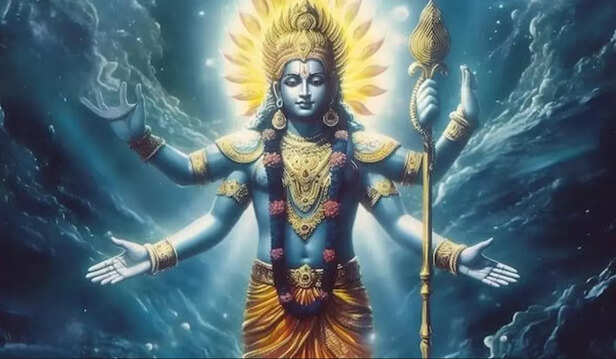
Lord Vishnu
Image credit : Freepik
Vishnu Sahasranamam fits that Kaliyuga logic perfectly:
- no elaborate materials required
- no dependence on a special place
- repeatable daily
- works through sound, meaning, and memory
4) Because the thousand names function like a complete map of God, not one narrow mood
The Sahasranamam is powerful because it does not trap the mind in one definition. The names describe Vishnu as:
- protector and destroyer of adharma
- gentle refuge and cosmic law
- near and personal, yet infinite and beyond form
- immanent in the world, yet untouched by it
5) Because it trains dharma through remembrance, not through moral lecturing
The Sahasranamam solves this in a uniquely practical way. It makes dharma memorable by attaching it to the Divine:
- truth becomes a name
- courage becomes a name
- steadiness becomes a name
- compassion becomes a name
- mastery becomes a name
This is why Krishna, who teaches karma yoga and inner discipline in the Gita, is naturally linked to a practice that builds dharma through repetition and imprinting rather than abstract instruction.
6) Because it carries the Mahabharata’s “one shelter” answer into daily life
That is the Kaliyuga question too. When institutions fail, relationships break, and identity feels unstable, the hunger is not for information but for a shelter that does not collapse.
The Sahasranamam responds by redirecting shelter from external guarantees to inner anchoring: take refuge in Nārāyaṇa through nāma.
7) Because the text is framed as a spiritual medicine with promised outcomes
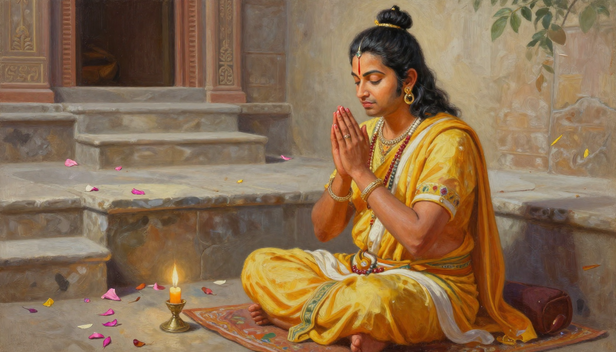
Spiritual Connection Through Devotion
Image credit : Freepik
Most devotees encounter Vishnu Sahasranamam not only as philosophy but as a daily remedy. Many traditional presentations include Phalaśruti, the “fruit of recitation,” emphasizing protection from fear, inner steadiness, and auspiciousness.
Even when one reads it responsibly as devotional assurance rather than mechanical guarantee, its intent is clear: this is not a rare hymn for occasional festivals, but a repeatable daily practice designed to generate transformation.
Kaliyuga demands exactly this kind of practice: one that can be done when motivation is low, and still slowly rebuild the inner world.
8) Because Krishna knows Rituals Alone Won't Survive Kaliyuga
The Bhagavatam highlights the extraordinary potency of the name of the Lord in Kali.
The Sahasranamam is the same principle expressed differently: not one mantra alone, but a thousand-entry doorway into remembrance.
So when people say, “Krishna offered Vishnu Sahasranamam as a solution for Kaliyuga,” what they really mean is this:
Krishna, as the guide of dharma, endorses a path that the age can actually follow.