Sometime in the last days of September, the monsoon lifts off the Garhwal Himalaya the way a curtain gets pulled sideways rather than dropped. One morning the cloud that has sat on Chaukhamba for three months simply isn't there, and the mountain stands so close and so white it looks like something placed rather than grown. This is the window, four to six weeks, from late September through October into early November, when the Garhwal peaks are clearer than at any other point in the year, and the viewpoints that deliver on that clarity are specific enough to be worth naming.
Why the Air Clears After the Rains
The monsoon does two things to the Himalayan atmosphere. It dumps moisture, which means cloud, but it also runs a sustained wash cycle on the particulate matter, dust, smoke, haze, that accumulates through the dry summer months. When the rains stop, that cleaned air remains. The aerosol load over the Garhwal range in October is measurably lower than in April or May, which is why the pre-monsoon spring season, though popular, rarely delivers the same definition on the peaks. Spring views are warm and golden. Post-monsoon views are surgical. The snowline also sits freshly reset: the monsoon deposits new snow on the upper elevations, so the peaks carry a brightness in October that the summer sun has not yet had the chance to erode.
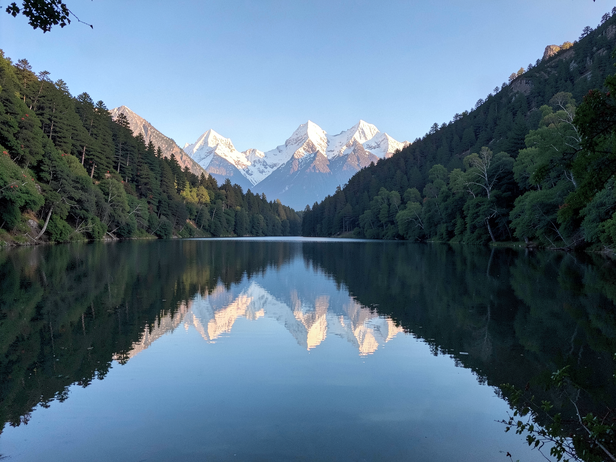
![Himalayan Dawn Reflection]()
Himalayan Dawn Reflection
Image credit : AI
I see the Garhwal peaks post monsoon, reflected in the tranquil lake at dawn. A breathtaking Himalayan vista.
The Viewpoints That Actually Deliver
Deoria Tal, at roughly 2,400 metres above Ukhimath in Rudraprayag district, is the most reliable single frame in the Garhwal for the Chaukhamba massif. The lake reflects the peak on still mornings, and the forest walk from Sari village takes under two hours. The site gets crowded in May; in October it is quiet enough to hear the water. Chopta, the meadow that feeds the trail to Tungnath, gives an unobstructed western view of the Kedarnath range. The road from Ukhimath to Chopta stays open through October and closes with the first snowfall, usually in November. Auli, above Joshimath, is better known as a ski slope but the cable car from Joshimath puts you at 2,519 metres with a clear line to Nanda Devi, Kamet, Mana, and the Dunagiri ridge. The post-monsoon weeks are the only time that entire wall appears without haze at the horizon. For those willing to walk further, the Kuari Pass trail from Auli reaches 3,640 metres and opens the Nanda Devi Sanctuary wall in a panorama that has no equivalent at road level. Two to three days from Auli, it is not a weekend trip, but October conditions make it the most reliable window for summit views on that route.
What the Season Costs and What It Saves
Accommodation in Chopta and around Deoria Tal runs between ₹800 and ₹2,500 per night for a decent guesthouse in October, roughly half the peak-season rate. The Rishikesh to Ukhimath bus takes six to seven hours and costs under ₹300; a shared taxi from Rudraprayag to Sari village for the Deoria Tal walk runs around ₹150 per seat. Auli is more expensive to reach if you take the cable car from Joshimath, ₹1,000 for the return, but the Gorson Bugyal trail from Auli itself costs nothing beyond the entry fee at the forest gate. The Kuari Pass trek requires a registered guide under Uttarakhand forest rules; budget ₹1,200 to ₹1,500 per day for a guide and basic camping support. Flights to Dehradun's Jolly Grant Airport connect from Delhi in under an hour; the drive from Dehradun to Rishikesh and onwards into Garhwal is the standard approach. October temperatures at viewpoint elevations drop to 2 to 5°C at night. A down jacket and waterproof shell are not optional.
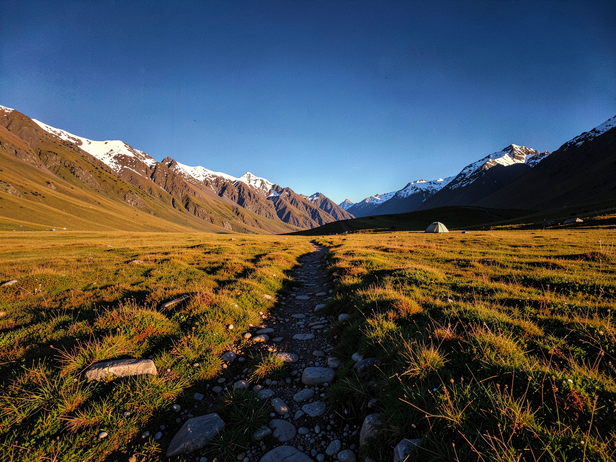
![Himalayan Meadow at Golden Hour]()
Himalayan Meadow at Golden Hour
Image credit : AI
I'm trekking through a Garhwal peaks post monsoon landscape, enjoying the golden light and vast open spaces.
The One Condition That Can Still Close the View
Post-monsoon clarity is not guaranteed every day. A western disturbance, the weather system that moves across northern India from the west, separate from the monsoon, can push cloud and light snow over the Garhwal even in October. These systems typically last two to three days and then clear. The practical implication: build at least five nights into any trip to a single base, so a two-day cloud event does not consume the entire window. Checking the Uttarakhand Meteorological Centre forecast the day before moving to a high viewpoint is worth the five minutes. The clearest mornings almost always follow a cold, still night.