The Panchachuli massif, five summits between 6,334 and 6,904 metres, is usually framed as a climber's objective or a trekker's reward. But from the ridge towns of Pithoragarh district, the same wall of ice and rock appears without earning it. You drive up, you step out, and there it is.
Didihat: The Town That Faces the Peaks Head-On
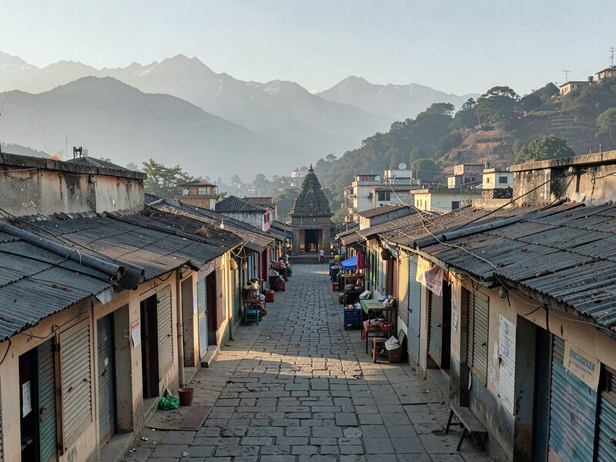
Didihat sits at roughly 1,725 metres on a long ridge in Pithoragarh district, about 75 kilometres from the district headquarters. It is a working town, a sub-divisional centre with a weekly market, a bus stand, and schools, which is exactly why most travellers pass through rather than stop. That is their loss. The ridge the town occupies faces the Panchachuli group almost directly, and on a clear morning between October and early December, the five summits rise above the southern face of the Himalayan wall in a line that fills the northeast horizon. No trail required. The view is there from the main road, from the temple courtyard above the market, from the roof of any guesthouse that faces the right direction. Ask the owner which side when you check in.
The town has a small Shiva temple complex that locals call Adi Kailash Mandir, not to be confused with the Adi Kailash peak circuit further north, and the courtyard there is one of the better places to watch the peaks take the first light. Arrive before six on a clear day.
![Himalayan Hill Town Morning]()
Himalayan Hill Town Morning
Image credit : AI
I observe the serene early morning light in a quiet Indian hill-town market street, offering glimpses of Panchachuli views without trekking.
Berinag: A Ridge With Nothing Between You and the Snow
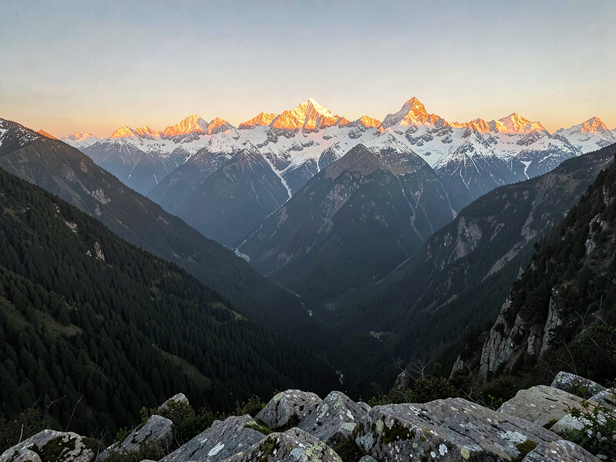
Berinag is smaller and quieter than Didihat, sitting at around 1,800 metres on a ridge that drops sharply on both sides. The town has one main street, a handful of tea shops, and a Nanda Devi temple that gives the settlement its ceremonial weight. What it also has is an unobstructed northern exposure across a deep valley to the high Himalayan wall, with Panchachuli visible to the northeast and Nanda Devi and its satellite peaks to the northwest on clear days.
The classic stopping point is a small viewpoint at the ridge's edge, a short walk from the main street, where the treeline drops away and the panorama opens. On a good October or November morning, this is as complete a Himalayan view as most people will see in their lives, and it costs nothing except the drive up from Pithoragarh town, which takes around two hours on mountain roads. Accommodation in Berinag is basic, a few guesthouses and homestays, but the homestay option is worth choosing because dinner will be Kumaoni: bhatt ki churkani, aloo ke gutke, and rotis made from local flour. These are not dishes you find in the plains.
Getting There and When to Go
Pithoragarh town is the practical base. It is connected to Kathgodam by road, roughly 210 kilometres, five to six hours depending on the stretch, and Kathgodam is the railhead for trains from Delhi. From Pithoragarh, shared jeeps and local buses run to both Didihat and Berinag, though hiring a vehicle for the day gives you the flexibility to stop at viewpoints on the ridge roads between towns. The road from Pithoragarh to Berinag passes through Gangolihat, which has the Haat Kalika temple, a significant Shakti shrine and worth an hour if the timing works.
The window for clear Panchachuli views is October through early December, after the monsoon has cleared the haze and before the high-altitude winter cloud settles in. March and April work too, though the light is different, softer, less sharp, and the peaks carry more snow from the winter just ending. Avoid July and August entirely; cloud cover is near-total and the roads through this part of Kumaon become unreliable.
![Himalayan Dawn from Kumaon]()
Himalayan Dawn from Kumaon
Image credit : AI
I capture the breathtaking Panchachuli views from a Kumaon ridge at dawn, a truly unforgettable Himalayan spectacle.
What These Towns Are Not
Didihat and Berinag are not resort destinations. There is no spa, no curated experience, no café serving pour-over coffee. The accommodation is functional, the roads are mountain roads, and the towns operate on their own schedule rather than a tourist one. This is the point. The traveller who arrives expecting infrastructure will be frustrated. The traveller who arrives expecting a Himalayan market town with extraordinary views will find exactly that. The distinction matters before you book anything.
Panchachuli has been climbed by Indian mountaineers since the 1970s, and the peaks carry a place in Kumaoni mythology, the five hearths where the Pandavas cooked their last meal before ascending to heaven, which is where the name originates. Standing on the Berinag ridge at dawn and knowing that story does not make the view more dramatic. The view is already as dramatic as it gets. But it does make the silence around it feel less accidental.