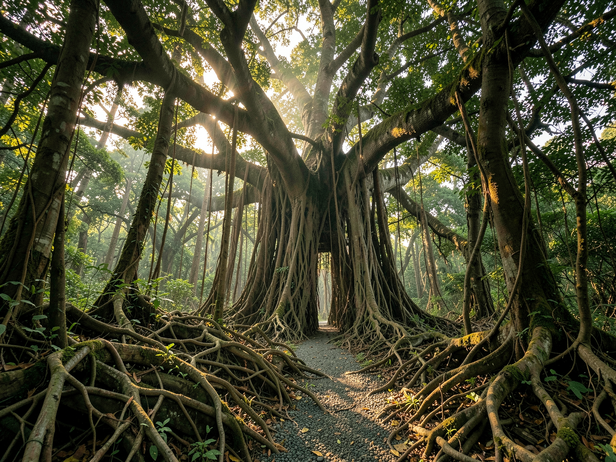
The Great Banyan at Acharya Jagadish Chandra Bose Indian Botanic Garden in Howrah is roughly 250 years old, spreads across 14,500 square metres, and is technically no longer a single tree, its original trunk rotted out in 1925 and what remains is a self-sustaining colony of aerial roots. Most visitors photograph it from the path, note that it looks like a small forest, and move on. That is the wrong way to spend Howrah.
Howrah: What the Lawns Are Hiding
The Acharya Jagadish Chandra Bose Indian Botanic Garden was established in 1787 under the East India Company and now holds over 12,000 species across 109 hectares. The section most visitors skip is the herbarium wing, which holds one of the largest collections of dried plant specimens in Asia, over two million sheets, some pressed in the 18th century. Entry to the herbarium is not through the main gate crowd. Walk past the lily pond and ask at the research block. A guard will usually direct you without ceremony. The sheets themselves are stored flat in acid-free folders, labelled in the handwriting of botanists who are now names on library shelves. There is no drama to the room. That is the point.
The garden also maintains a Fern House and a cactus greenhouse that most visitors walk past assuming they are staff areas. The Fern House is particularly worth the detour, Bengal's humidity means the specimens inside are living rather than preserved, and some of the tree ferns reach the ceiling. The best time to visit is between 7 am and 10 am on a weekday. The light comes in low from the east, the lawn crowds have not arrived, and the gardeners are working, which means the gates to sections that are technically closed to casual visitors are often open.
![Banyan Forest Sunrise Path]()
Banyan Forest Sunrise Path
Image credit : AI
I explore a banyan's aerial root forest, bathed in golden morning light. This path leads into a magical world, a must-see for any botanical gardens India enthusiast.
Getting There and What It Costs
Howrah station is the entry point for most visitors arriving by train. The garden sits roughly 8 kilometres south of the station, reachable by auto-rickshaw in under 30 minutes outside peak hours. Entry for Indian nationals was last listed at ₹30 for adults; the herbarium visit requires a separate written request to the Director's office, which can be done on arrival if you arrive early enough to allow processing time. Photography inside the herbarium requires permission and is sometimes declined. Bring a notebook instead.
Ooty: The Government Botanical Garden and the Fossil Tree
The Government Botanical Garden in Ooty sits at 2,200 metres above sea level and was laid out in 1848 on the slopes of Doddabetta. It covers 22 hectares and is divided into distinct sections, the Italian Garden, the New Garden, the conservatory beds, and the section most people photograph without knowing what they are looking at: a fossilised tree trunk estimated to be 20 million years old, mounted on a plinth near the lower terrace. It is labelled. It is also routinely walked past by visitors who assume it is decorative.
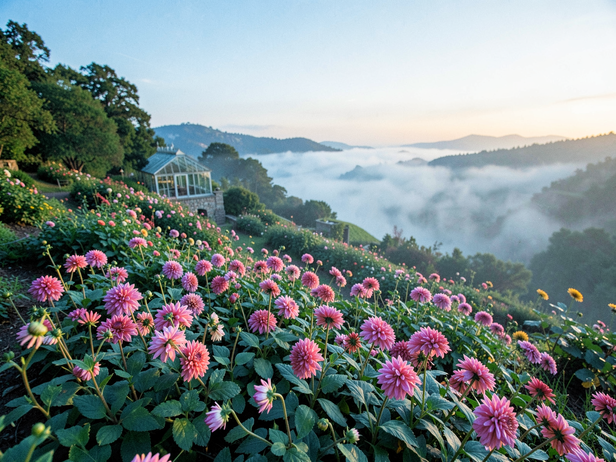
The garden's altitude means it holds species that cannot survive at lower elevations, Himalayan rhododendrons, Japanese cherry trees, and a collection of tree dahlias that bloom between October and December, which makes a November visit particularly well-timed. The conservatory houses a permanent collection of orchids and begonias. The best section for anyone willing to leave the main path is the nursery area behind the conservatory, where the garden's propagation work happens. Staff there are generally willing to explain what is being grown and why, which is more interesting than any signboard.
![Dawn Blooms on the Hillside]()
Dawn Blooms on the Hillside
Image credit : AI
My view of a stunning botanical garden at dawn, a perfect spot for herbarium India travel.
Ooty Logistics
Ooty is most practically reached by road from Coimbatore, roughly 85 kilometres, two to three hours depending on traffic at the Kallar ghat section. The Nilgiri Mountain Railway from Mettupalayam to Ooty is a UNESCO World Heritage route and takes approximately five hours, which is worth doing once as the journey rather than as transport. The garden opens at 8 am. Entry for Indian nationals is around ₹30; the figure has varied slightly across years and is best confirmed on arrival. The Italian Garden section is at its best in the first hour after opening before the school groups arrive.
The Herbarium Habit
Both gardens maintain working herbaria that are distinct from what most people mean when they say botanical garden. A herbarium is an archive of pressed, dried, and labelled plant specimens used for taxonomic research, a physical record of where a species was found, by whom, and when. India's major herbaria, including the ones at Howrah and at the Forest Research Institute in Dehradun, hold specimens that predate the photographic record of those species. Some sheets carry the handwritten notes of Joseph Dalton Hooker, who used Howrah as a base during his Himalayan surveys in the 1840s and whose Flora of British India remained the standard taxonomic reference for decades after his death.
Accessing a herbarium as a casual visitor requires some patience and a straightforward request. Most institutions are not set up for tourism but are not hostile to it either. The ask is simple: you want to see the collection, you will not touch anything, and you will follow whatever the staff require. That is usually enough. What you find inside is not dramatic. Pressed flowers do not look like flowers. But the density of information in a single drawer, species, location, collector, date, annotation, is unlike anything a garden path delivers.
Howrah and Ooty are the two gardens where the infrastructure for this kind of visit is most established, the collections most substantial, and the journey most manageable for a visitor coming from anywhere in India. The lawns are worth seeing. The rooms behind them are worth the morning.