The trucks have taken the idols away. The generators are gone. Kolkata's lanes, which a week ago ran so thick with people you moved in a current rather than a crowd, now carry only the smell of marigold stems rotting in the gutters and the distant sound of someone sweeping. Then, on the full moon of the Bengali month of Ashwin, usually falling in October, the courtyards light up again, quietly, entirely differently.
A Festival That Belongs to the Threshold
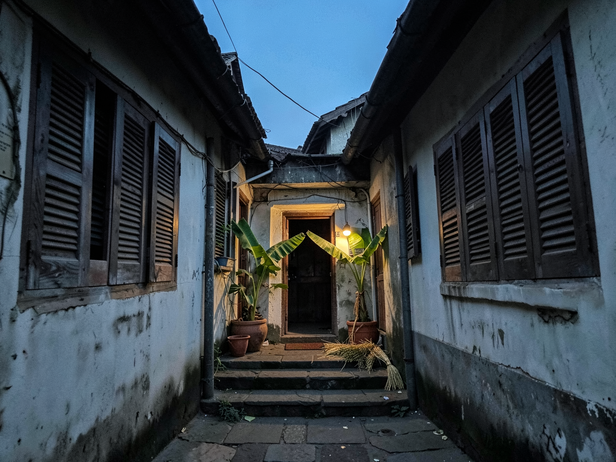
Kojagari Lokkhi Pujo is not a public event. No pandal committee runs it, no loudspeaker announces it, no entry queue forms on the road. It happens inside: in the thakur ghar of a north Kolkata row house, in the verandah of a Howrah joint family, in the kitchen courtyard of a village home in Birbhum or Burdwan. The preparation begins at the floor. Women of the household draw alpona, intricate white rice-paste patterns, from the front door inward, a path for Lakshmi to follow. Paddy sheaves, banana plants, and a clay owl (Lakshmi's vehicle) are placed at the entrance. The goddess being welcomed here is not the sovereign figure of a ten-day public puja. She is the household's own Lokkhi, the one who keeps the grain in the store and the family from fracturing.
![North Kolkata Dusk Ritual]()
North Kolkata Dusk Ritual
Image credit : AI
I witness a traditional Kojagari Lokkhi Pujo ritual in a historic north Kolkata lane at dusk.
What the Night Actually Looks Like
The puja itself is performed after moonrise, which on Kojagari falls late in the evening on a full moon night that Bengalis call Sharad Purnima, the autumn full moon, considered the brightest and most beautiful of the year. The ritual involves the Lokkhi Panchali, a long devotional text read aloud by the women of the family, its cadences somewhere between a story and a lullaby. The panchali narrates Lakshmi's arrivals and departures from households that deserved her and those that did not, a domestic moral universe in verse. Khoi, puffed paddy, naru made from coconut and jaggery, and a clay lamp are the central offerings. No fire sacrifice, no priest necessarily, no crowd. The sound of the night is the panchali being read, the lamp guttering, and occasionally a conch blown once.
Where to Experience It as a Traveller
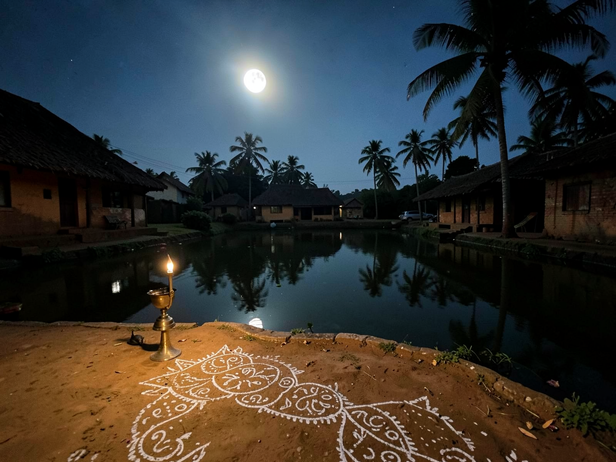
The honest answer is that Kojagari Lokkhi Pujo is not designed to be witnessed by outsiders, and that is precisely what makes it worth going to Bengal for. A traveller who arrives in Kolkata in the week after Durga Puja, roughly mid to late October, depending on the lunar calendar, will find the city in a state that no other time of year produces: post-festival exhale, streets returning to themselves, the light softer, the air cooler. The neighbourhoods of Shyambazar, Sovabazar, and Kumartuli in north Kolkata, where the old joint-family houses still stand, are the right places to walk. If you have a Bengali acquaintance or a homestay host, ask whether their family observes Lokkhi Pujo and whether you may sit in the courtyard. Most families will say yes. The ritual is not secret; it is simply private, and the distinction matters. Outside Kolkata, the villages of Bankura, Birbhum, and the Hooghly district observe it with particular intensity, where the alpona patterns run from the courtyard all the way to the pond's edge and the night smells of wet earth and lamp oil.
![Moonlit Pond, Alpona Glow]()
Moonlit Pond, Alpona Glow
Image credit : AI
I observe the serene beauty of a Bengal village pond during Kojagari Lokkhi Pujo, alpona patterns guiding towards the water's reflection.
The Practical Shape of the Trip
Flights into Netaji Subhas Chandra Bose International Airport from most Indian metros run daily; the train network connects Kolkata to Bankura and Birbhum via Howrah station with several daily departures. Accommodation in Kolkata after Durga Puja is significantly easier to find and cheaper than during the puja itself, when the city fills entirely. Boutique homestays in north Kolkata's heritage houses run in the range of ₹2,500 to ₹5,000 a night and are the right base, they are often run by families who observe the puja themselves. The full moon night requires no ticket, no booking, and no plan beyond being in the right neighbourhood at the right hour and paying attention to where the light is coming from.
What You Are Actually Seeing
Kojagari Lokkhi Pujo is a reminder that Bengali religious culture has two entirely distinct modes. One is the spectacular, civic, weeks-in-the-making mode of Durga Puja, which belongs to the neighbourhood and the street. The other is intimate, domestic, and matrilineal, carried by the women of the household, rooted in agricultural anxiety about the harvest, and expressed through floor art, verse, and a clay lamp. The word Kojagari comes from the Sanskrit ko jagarti, meaning who is awake. The story goes that Lakshmi herself moves through the world on this full moon night, asking the question at each threshold. The households that are awake, lamp lit, floor drawn, panchali read, are the ones she enters. A traveller who stays awake that night, walking the lanes of a north Kolkata neighbourhood or sitting in a village courtyard, is asking the same question of a different kind of journey.