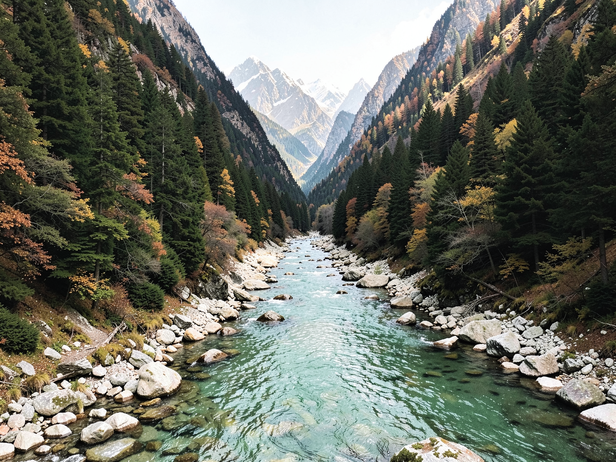
The bus from Aut drops you at a bend in the road where a smaller road peels off toward the Tirthan river, and from that point the valley closes in fast. Within twenty minutes the tar gives way to a track wide enough for one vehicle, the mobile signal goes to one bar, and the river appears below the road, green-blue, fast, running over pale boulders. There is no resort with a spa and a view deck waiting at the end of this road. That is not a gap in the infrastructure. It is the entire argument for coming.
What the valley actually is
Tirthan Valley runs through the southern edge of the Great Himalayan National Park, a UNESCO World Heritage Site since 2014. The buffer zone, which is where guesthouses and fishing camps operate, stretches roughly from the village of Gushaini up to Bathad. Beyond Bathad, entry requires a permit from the GHNP office in Sai Ropa, and no overnight camping is permitted inside the core zone. The river itself is a designated trout reserve, brown trout and snow trout both, and fishing requires a daily permit issued at the range office. The permit costs around ₹300 for a day's angling, and the fish are genuinely visible in the shallows in the morning before the light gets too high.
![Himalayan River Gorge]()
Himalayan River Gorge
Image credit : AI
I capture the serene beauty of a Himalayan river in a narrow gorge, a perfect escape to an offbeat Himachal hill station.
Getting there from Delhi or Chandigarh
The entry point is Aut, on National Highway 3 between Mandi and Kullu. From Delhi, Volvo buses to Kullu or Manali pass through Aut; the journey is ten to eleven hours overnight, and the fare on a government HRTC sleeper runs between ₹700 and ₹900 depending on the season. From Chandigarh, Mandi is four hours by bus, and Aut is another forty minutes from Mandi. From Aut, shared cabs go to Banjar, the nearest town with an ATM, in about an hour. From Banjar, another shared cab or a hired vehicle takes you to Gushaini or further up to the guesthouses near the park boundary. Budget ₹300 to ₹500 for the Aut-to-Gushaini leg depending on what you negotiate. If you are driving from Delhi, the route goes via Chandigarh, Bilaspur, Mandi, and Aut, roughly 530 kilometres, manageable in one long day if you leave before five in the morning.
Where to sleep and what it costs
The accommodation in Tirthan is almost entirely homestays and small guesthouses, most of them built in the traditional Himachali kath-kuni style, alternating layers of stone and deodar timber, thick walls, small windows. Prices range from ₹800 to ₹2,500 per night for a double room with meals included, depending on the season and how far up the valley you go. November, which is when this piece is pegged to run, is late season: the apple harvest is over, the rhododendrons are finished, daytime temperatures in the valley sit around 10 to 14 degrees Celsius and drop hard after sunset. Some guesthouses close by mid-November; confirm before you book. The ones that stay open tend to have wood-burning bukhari stoves, and a room with a lit bukhari at night is one of the better things this valley offers.
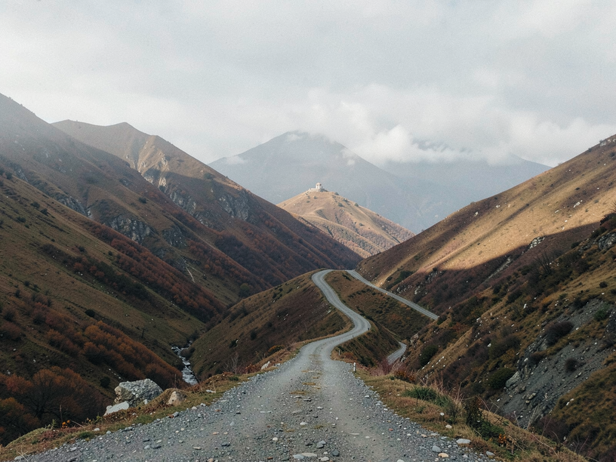
![Autumn Mountain Pass Serenity]()
Autumn Mountain Pass Serenity
Image credit : AI
I capture the serene beauty of Jalori Pass Himachal Pradesh in late autumn, a quiet mountain sanctuary.
Jalori Pass: the walk and what is at the top
Jalori Pass sits at 3,120 metres and is reached by road from Banjar, a winding 30-kilometre drive that takes about ninety minutes. The pass itself is a saddle between two ridgelines, with a small temple to Budhi Nagin on one side and a tea stall that operates through October. From the pass, two trails branch off. The first goes to Serolsar Lake, a glacial lake about five kilometres from the pass through a dense forest of oak and rhododendron; the walk takes two hours each way and is straightforward. The second trail goes toward Raghupur Fort, a ruined hilltop fort with an unobstructed view of the Dhauladhar range to the north and the Kullu valley to the east. The fort is a forty-five-minute walk from the pass. In November, the trees on the Jalori trail have dropped most of their leaves, the rhododendron is bare, and the light is low and clear in a way that the valley does not give you in July. Snow is possible at the pass from late October onward; check conditions before driving up. The road to Jalori is not the place to discover your car has bald tyres.
Why there is no big hotel and why that is unlikely to change
The GHNP buffer zone rules restrict commercial construction within the park boundary, and the road conditions above Gushaini make large vehicle access difficult for most of the year. The valley's appeal rests on exactly this constraint. The rivers here are among the few in Himachal where the trout population has not been severely depleted by overfishing and run-off from upstream development, a direct consequence of the permit system and the limited footfall. The moment a 60-room resort appears at Gushaini with a parking lot for coaches, the trout leave the shallows and the valley becomes Kasol with better scenery. The people running the homestays here mostly understand this, which is why several of them have been vocal in opposing road-widening proposals. The valley's economy depends on remaining the kind of place that a certain kind of traveller will make an effort to reach. That effort, the overnight bus, the shared cab from Aut, the walk up from the road to the guesthouse, is not an inconvenience to be engineered away. It is the filter.