Ireland sits outside the Schengen zone, which catches a surprising number of Indian travellers off guard after they have already booked flights. The Irish Short Stay 'C' visa is a standalone application, processed independently of any Schengen visa you may already hold. Getting both right before you travel is the first real task the trip sets you.
The Irish Visa: What Indian Passport Holders Actually Need
The Irish Short Stay 'C' visa covers tourism stays of up to 90 days. Applications go through the Irish Naturalisation and Immigration Service, either directly or through a VFS Global centre in India, there are offices in Mumbai, Delhi, Chennai, Bengaluru, Kolkata, Hyderabad, and Pune. The processing window is typically four to eight weeks, though it can stretch longer in peak season, so apply at least two months before your travel date.
The core documents are a valid passport with at least six months of remaining validity, confirmed return flights, hotel or accommodation bookings, a bank statement showing sufficient funds for the duration of your stay, and proof of employment or business, a leave letter and salary slips if you are salaried, or ITR and company registration documents if you are self-employed. Travel insurance covering the full trip period is required. The consular fee is in the range of €60 to €100 depending on the visa type, paid at the time of application.
One practical note: if you already hold a valid UK visa or a valid US visa, Ireland allows visa-free entry under a separate scheme. Check the current eligibility conditions on the INIS website before applying, because the scheme has specific conditions and the rules have changed before.
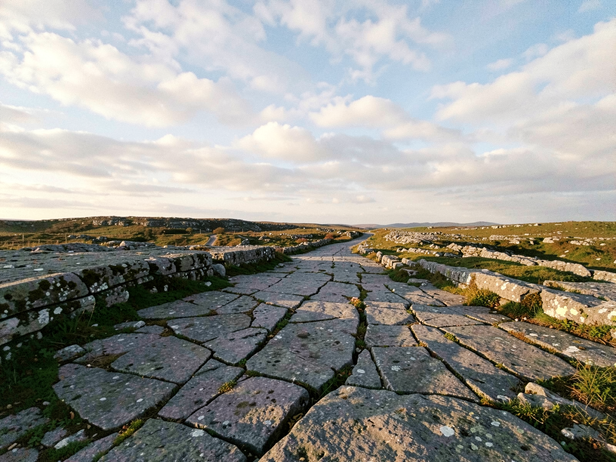
![Burren's Autumn Majesty]()
Burren's Autumn Majesty
Image credit : AI
I explore the Burren's unique landscape on the Wild Atlantic Way, a breathtaking sight in autumn.
Driving in Ireland: The One Advantage Indian Travellers Have
Ireland drives on the left. For most Indian travellers, this is not an adjustment, it is the only thing about Irish driving that feels immediately familiar. The roads, however, are a different matter.
Outside Dublin and Cork, Irish roads narrow fast. The N59 along the west coast is a national primary route on the map and a single-track lane in practice for long stretches, with grass growing down the centre and dry-stone walls close enough to touch from the driver's window. Passing places are marked but not always obvious. The convention is to pull left and let oncoming traffic through, which is the same logic as mountain roads in Himachal or Kerala, read the road early and commit.
Speed limits are posted in kilometres per hour, which removes one source of confusion. National roads run at 100 km/h, regional roads at 80 km/h, and built-up areas at 50 km/h. In practice, the road conditions on the west coast mean you will rarely approach the posted limit on rural stretches. An Indian driving licence is valid in Ireland for short visits, though most rental companies require an International Driving Permit alongside it, confirm this with your specific rental agency before you arrive.
Petrol stations thin out considerably west of Galway. Fill the tank in Galway city before heading into Connemara or onto the Dingle Peninsula. Do not assume the next village will have a station open.
The West Coast Route: Where to Actually Go
The Wild Atlantic Way is a 2,500-kilometre waymarked route running from Donegal in the north to Cork in the south. Driving all of it in one trip is a mistake most people make once. The section that earns its reputation runs from Galway city south through Connemara, across to the Aran Islands by ferry, and then down through County Clare to the Cliffs of Moher, roughly 200 kilometres of driving spread across four to five days.
Galway city is the natural base. It has a proper airport with connections from Dublin, a compact old town that takes an afternoon to walk, and enough restaurants and guesthouses to recover from travel before the driving begins. The Saturday market at the Spanish Arch is the best single hour in the city.
Connemara begins the moment you leave Galway's western suburbs. The landscape shifts inside twenty minutes, blanket bog, granite outcrops, small lakes catching whatever light is moving through the clouds. Kylemore Abbey sits at the end of a long lake and looks like something a Victorian industrialist built to impress a wife, which is exactly what it is. The drive through the Inagh Valley to Leenane is quieter than the main tourist circuit and better for it.
The Aran Islands, Inis Mór, Inis Meáin, and Inis Oírr, sit in Galway Bay and are reached by ferry from Rossaveal, about an hour's drive west of Galway city. Inis Mór is the largest and the most visited. Dún Aonghasa, an Iron Age stone fort sitting on the edge of a 100-metre cliff with no railing and no fence, is one of the genuinely disorienting places in Europe. You stand at the edge and the Atlantic is simply there, all of it, with nothing between you and North America.
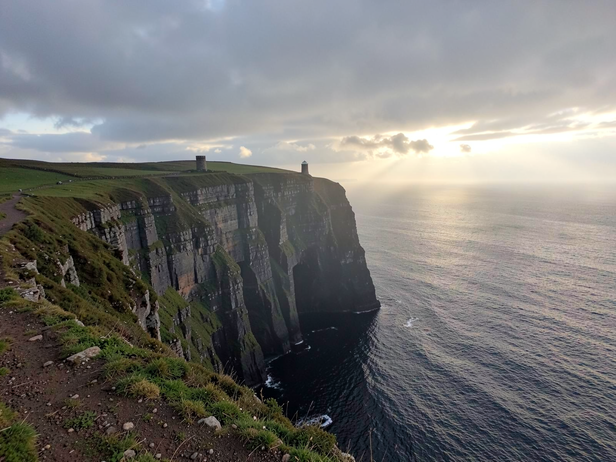
The Cliffs of Moher are in County Clare, south of Galway across the Burren. The Burren is a limestone plateau that looks like the surface of a grey planet and contains, improbably, Mediterranean wildflowers in the cracks between the rocks. The Cliffs themselves are 214 metres at their highest point and stretch for 8 kilometres. They are crowded at the main visitor centre. Walk twenty minutes north or south along the cliff path and the crowds disappear.
![Moher Cliffs, Atlantic Majesty]()
Moher Cliffs, Atlantic Majesty
Image credit : AI
I capture the awe-inspiring Cliffs of Moher on Ireland's Wild Atlantic Way. The dramatic drop and atmospheric light create a powerful scene.
Timing, Weather and What to Pack
October, which aligns with your schedule date, is a reasonable time to visit the west coast. The summer crowds have thinned, the light is low and golden in the afternoons, and the landscape is at its most atmospheric. It is also when the Atlantic weather is at its most unpredictable. Rain on the west coast is not a drizzle, it arrives sideways and it arrives fast. A waterproof outer layer is not optional gear; it is the most important thing in your bag.
Layers matter more than weight. Temperatures in October sit between 8°C and 14°C on the coast. The difference between a sheltered village street and a cliff path in wind is fifteen degrees of felt temperature. Pack accordingly.
Accommodation books out in the villages faster than the cities. Clifden, the largest town in Connemara, has a handful of good guesthouses and a couple of hotels. Book these before you book anything else. Dublin and Galway city have enough supply that last-minute rooms are possible; Connemara does not.
The west coast of Ireland does not reward rushing. The distances look small on a map and take twice as long as the map suggests. That gap, between the map's promise and the road's reality, is where the trip actually lives.