The first thing you notice at a Chhath ghat is that nobody is waiting for you to arrive. The devotees standing waist-deep in the Ganga at Rajghat, or knee-deep in the Hussain Sagar in Hyderabad, or in a flooded Patna street that became a ghat overnight, they are mid-prayer. The sun is moving. The arghya has a window of minutes. Your presence is tolerated; your consideration is what earns you the right to witness it.
What you can photograph and what you cannot
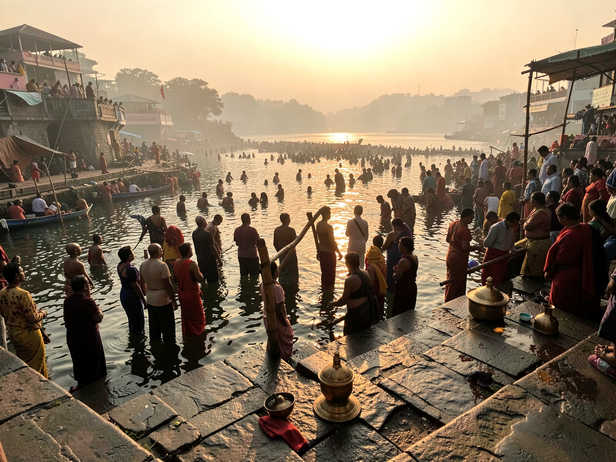
Chhath is visually extraordinary, the bamboo soop laden with thekua and seasonal fruit, the brass lota catching the last light, the long shadows of devotees facing the setting sun. All of this is yours to photograph if you do it with your body positioned behind the worshippers, not between them and the water.
The rule is simple: the devotee's sightline to the sun or the water is sacred geometry. Step into it and you have interrupted a prayer, not just a shot. Stay behind or to the side, keep the lens at a respectful distance, and you will get images that are honest rather than extractive.
Do not photograph women in wet sarees from the front, at close range, or with a long lens that flattens distance. It is not a grey area. If a family signals discomfort, a turned shoulder, a hand raised, a look, lower the camera immediately and move away. Some families will actively invite you to photograph their prasad arrangement; that is a different situation entirely and a genuine kindness worth accepting with a nod of thanks.
Video with flash is banned at most official ghats and the ban is enforced. Drone photography requires prior permission from local authorities and is restricted near major ghats during peak hours. Check with the district administration before you fly anything.
![Golden Hour River Devotion]()
Golden Hour River Devotion
Image credit : AI
Witnessing the serene devotion at the Chhath ghat during golden hour. Remember Chhath Puja ghat etiquette when visiting.
Where to walk and where not to
The ghat during Sandhya Arghya and Usha Arghya is not a promenade. The water's edge belongs to the devotees. The shallow entry points are reserved for families carrying prasad trays and elderly women being helped into the water. Do not use these to get a better angle.
Walk parallel to the ghat, not perpendicular to it. Move in the direction the crowd is moving. If you need to cross a dense cluster of worshippers, wait. There will be a gap. Forcing through a group mid-prayer because you want to reach the next section is the kind of thing that creates the hostile atmosphere visitors then complain about.
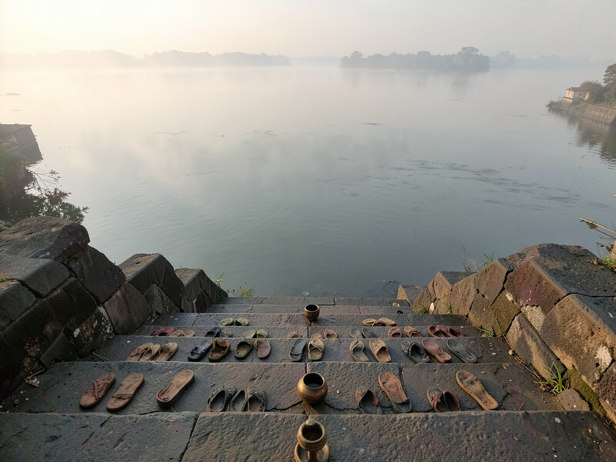
Keep your footwear off from the point the ghat management marks as the boundary, which is usually well before the water. Wet stone steps are slippery and the crowd is dense; flat, bare feet are safer than sandals with grip that catches on wet cloth. Leave shoes at a designated point and remember where you left them, there will be thousands of pairs.
At major ghats in Patna, Varanasi, and Delhi's Yamuna banks, the crowd between 4 PM and 7 PM on the Sandhya Arghya evening is genuinely dangerous if you are not moving with it. Know your exit before you go in.
What to carry and what to leave behind
Carry: a small cloth bag, cash in small denominations if you plan to buy prasad from vendors, a water bottle you can hold in one hand, and a charged phone if that is your camera. A light cotton dupatta or stole is useful, it doubles as something to sit on, something to drape if you feel underdressed, and something to cover your head near the water if the sun is strong.
Leave behind: large backpacks that take up the space of three people in a crowd, tripods and monopods (they are a tripping hazard and most ghats prohibit them during peak hours), and anything that will make you conspicuous or slow. If you are visiting a ghat in Bihar or eastern Uttar Pradesh, leave the idea that you are going to a festival. You are going to a place of worship that happens to be outdoors and happens to be attended by a very large number of people.
Do not bring food that is not prasad. Eating non-vegetarian food near an active Chhath ghat is deeply offensive to devotees who have been fasting for 36 hours. This includes packaged snacks that contain egg. Read the label.
![Serene River Ghat Dawn]()
Serene River Ghat Dawn
Image credit : AI
I observe the quiet reverence at the ghat, a moment before the day's rituals begin. Understanding Chhath Puja ghat etiquette is key.
Timing your visit
The two main arghya moments, Sandhya Arghya at sunset on the third day and Usha Arghya at sunrise on the fourth, are the most photographed and the most crowded. If you want to understand what Chhath actually is rather than what it looks like at peak density, arrive in the early morning of the third day, before the crowds consolidate. The ghats are being prepared. Families are arranging their soop and their offerings. The light is good and the pace is human.
The hour after Usha Arghya is also worth staying for. The fast breaks. Families share thekua and sugarcane. The emotional register drops from concentrated devotion to quiet relief. This is when, if you have been respectful throughout, someone may hand you a piece of prasad. Accept it with both hands.
Chhath asks something specific of a visitor: not reverence you don't feel, but restraint you can practice. The ghat will show you everything worth seeing if you are not in the way of it.